Wednesday, May 30, 2012
Climate change and starvation: assessing the risk
“The most outrageous lies that can be invented will find believers if a man only tells them with all his might.” – Mark Twain
“A lie can travel halfway around the world while the truth is putting on its shoes.” – attributed to Mark Twain
There were a lot of stories in the major media late last year touting experts predictions that climate change will lead to mass starvation unless we do something immediately.
Fortunately, the experts are almost certainly wrong, as they have been for decades, which we’ve pointed out in this series. The stories, however, illustrate the ongoing and pervasive nature of the environmental alarmist narrative.
At least two of the stories appeared in the on-line agricultural journal Drovers CattleNetwork.
The first was a Reuters story reporting the position of the U.N. Food and Agriculture Organization (FAO), that the planet’s environment is seriously degraded, threatened by global warming, and that by 2050 agriculture will be unable to feed the growing global population.
The second story reported on nearly identical findings reported by researchers from Commission on Sustainable Agriculture and Climate Change, convened by the Consultative Group on International Agricultural Research.
These stories and a number of dubious scientific reports were timed to coincide with environmental and food security concerns voiced at the 17th annual global warming conference in Durban, South Africa. The formal recommendations of the conference were “…to advance, in a balanced fashion, the implementation of the Convention and the Kyoto Protocol, as well as the Bali Action Plan, and the Cancun Agreements.”
These protocols, plans and agreements are intended to fight anthropogenic or man-made global warming (AGW) through: 1) carbon emission sequestration through the carbon market, 2) the Clean Development Mechanism, and Joint Implementation, as outlined by the United Nations Framework Convention on Climate Change.
Carbon sequestration and carbon trading quickly fell apart. There’s simply no evidence that greenhouse gases such as carbon dioxide and methane drive global temperatures or have ever driven temperature on the planet. Neither does physics allow for such a thing to happen.
As for carbon trading, the Chicago Climate Exchange (CCX) closed in 2010 after carbon prices fell from $7.50/metric ton to less than a nickel/metric ton. The European Carbon Exchange (EEC) is still trading carbon, but at great cost – at least $67 billion annually – to the economy of the European Union (EU). In the U.S. carbon trading was an unworkable scheme; in the EU it is an expensive, and failing, scheme.
The Clean Development Mechanism is perhaps the costliest swindle ever perpetrated on the third world. In simplest terms, it disallows third world development, because development causes greenhouse gas production, and greenhouse gases cause global warming. Those countries which have become dependent on UN money face the choice of losing UN cash if they attempt to develop on their own or continuing to barely subsist on UN rations. Since third world governments are the largest beneficiaries of the UN payouts, there is little if any incentive for them to change. The masses of the third world population continue to live a life of agrarian subsistence.
Joint Implementation is a combination of blackmail and swindle, where the developed countries are expected to pony up $100 billion annually to save the undeveloped world from global warming.
But a funny thing happened on the way to global warming. Despite the pronouncement by the UN’s International Energy Agency last month that global warming will become “catastrophic and irreversible” in 2017, the whole scheme has begun to fall apart. The Earth began to cool in 1998. Sea levels have not risen at all, let alone catastrophically. CO2 levels continue to rise, but none of the horrific greenhouse gas predictions have come true. Thousands of “climategate” emails now reveal the deeply unethical and flawed practices of the environmental alarmist and UN scientific “experts.”
And while the theory of man-made global warming is falling apart, so is the global economy. As Bret Stephens noted recently in the Wall Street Journal, first world nations can no longer afford to pour money into the invented notion of saving the planet by mitigating man-made greenhouse gases. Environmental alarmists and the UN have been barking up an invented tree, and the world can no longer afford to expend its wealth chasing imaginary demons.
“The U.S., Russia, Japan, Canada and the EU have all but confirmed they won’t be signing on to a new Kyoto,” said Stephens. “The Chinese and Indians won’t make a move unless the West does. The notion that rich (or formerly rich) countries are going to ship $100 billion every year to the Micronesia’s of the world is risible, especially after they’ve spent it all on Greece.
“Cap and trade is a dead letter in the U.S. Even Europe is having second thoughts about carbon-reduction targets that are decimating the continent’s heavy industries and cost an estimated $67 billion a year. “Green” technologies have all proved expensive, environmentally hazardous and wildly unpopular duds.
“That’s where the Climategate emails come in. First released on the eve of the Copenhagen climate summit two years ago and recently updated by a fresh batch, the “hide the decline” emails were an endless source of fun and lurid fascination for those of us who had never been convinced by the global-warming thesis in the first place.
“But the real reason they mattered is that they introduced a note of caution into an enterprise whose motivating appeal resided in its increasingly frantic forecasts of catastrophe. Papers were withdrawn; source material re-examined. The Himalayan glaciers, it turned out, weren’t going to melt in 30 years. Nobody can say for sure how high the seas are likely to rise – if much at all. Greenland isn’t turning green. Florida isn’t going anywhere.
“The reply global warming alarmists have made to these disclosures is that they did nothing to change the underlying science, and only improved it in particulars. So what to make of the U.N.’s latest supposedly authoritative report on extreme weather events, which is tinged with admissions of doubt and uncertainty? Oddly, the report has left climate activists stuttering with rage at what they call its “watered down” predictions. If nothing else, they understand that any belief system, particularly ones as young as global warming, cannot easily survive more than a few ounces of self-doubt.”
But if the theory of man-made climate change is falling apart, what about the specter of famine as the global population continues to grow? As we outlined in parts two and four of this series, there’s little evidence to support the notion that agriculture is destroying the planet or that it will be unable to continue to feed the global population. These are simply more alarmist myths, calculated to instill fear and loosen global purse strings in the pursuit of a political agenda.
Not only is agriculture keeping up with global food demand, it is improving the ecology of the planet. The shrinking number of agriculture’s adverse environmental impacts continue to be mitigated by improved farming and ranching practices. At the same time, diets, health, and life spans continue to improve around the globe. This is hardly a catastrophe.
Global famine could happen, of course. The climate is changing, just as it has continually changed for more than four billion years, and an extended period of global cooling would doubtless lead to crop failures and hunger. Global cooling or the beginning of a new ice age is by far the most likely possible cause of widespread famine. As recently as the Little Ice Age (LIA, 1300-1850 A.D.) crops failed and human populations fell around the globe. And famine isn’t the only threat to humanity.
There are no guarantees in life.
As mortal beings, we all learn this at an early age. It’s an intellectual fact for the young, but it becomes real and visceral as the years begin to add up.
That’s for the individual of course.
But there are widespread risks of deadly peril to humanity as a whole. There’s no sense arguing the fact. A major asteroid colliding with Earth would probably kill all or nearly all of us. So would a large-scale exchange of nuclear weapons. So would the sudden onset of a planetary glaciation. So would world wide crop failure. And so, probably, would a world wide and long-term interruption of electricity.
Each of these things can happen. In fact, with the exception of nuclear war, each has happened, right here on this planet.
But what is the risk of one of these things – or some other catastrophe – devastating humanity in the near future? How does one assess such a risk, and then having made an assessment, how does one prepare for the coming crisis?
For some potential catastrophes, it doesn’t matter. Were a very large (greater than 500 kilometers in diameter) asteroid or comet found to be on collision course with Earth and due to strike within the next decade, there would be nothing humanity could do to avert the disaster. Oh, there would doubtless be a crash program to destroy or deflect the object, but at our level of technical and political ability, these ideas are the stuff of science fiction – America hasn’t even begun to rebuild on the site of the former World Trade center yet. What kind of crash program are we capable of? The object would strike and life as we know it – perhaps all life – on Earth would end.
The same is essentially true for nuclear war, sudden onset of glaciation (the onset of some glaciations, or ice ages, have happened within mere decades, according to the geological record), world wide crop failure, and the long-term interruption of our ability to use electricity.
There would almost certainly be one difference with these last four, however. Life on this planet would survive. Humans would be very hard hit – societies would collapse, populations would plunge, human lives would become brutish, nasty and short – but the rest of Earth’s life forms would quickly adapt and go on much as before.
Now, that’s a lot of doom and gloom. But if you objectively quantify the risks of each of those things happening, you find some rather good news. A massive impact could occur, but none have for about four billion years. Nuclear war could happen – the risk is far greater – but a world wide nuclear exchange is almost certainly beyond our present technical and political capabilities. As for a world wide crop failure, it’s hard to imagine more than one likely circumstance which would drive such a global catastrophe. It could happen, but the risk is quite small.
Perhaps the highest catastrophic risk of the five mentioned above is the long-term loss of our ability to use electricity. A massive solar flare could do it, as could a coordinated electromagnetic pulse (EMP) attack, where large nukes would be set off high in the atmosphere and the resulting rain of radiation and nuclear particles – which would be mostly harmless (at least in the short term) to human life – would nevertheless destroy all unshielded electrical equipment. No computers, or cell phones, or “cloud” based devices. No stock exchange. No electrical generation and none of the heating, cooling and lighting based upon such generation. No cars or motorcycles. No refrigeration. No ATM’s. The list goes on and on. In such a suddenly changed regime, life would be very hard for people. Harder perhaps than you can imagine.
Still, the likelihood of any of these events actually occurring within the next twenty years is relatively small.
One way to assess risk is mathematically. We’ve just done this, on the back of an envelope as it were, for the above catastrophic scenarios. To describe it mathematically, or to “say it in math,” goes something like this. C=Rl/Dle, where C is catastrophe, Rl is likelihood that the risk will occur (quantified level of risk), and Dle is the devastation level expected to occur.
Now comes the fun part, assigning numerical values to the various mathematical expressions. This yields a catastrophe quotient – given as a percentage, of the probability of human devastation caused by a particular catastrophic event. It’s not a predictive tool, rather, it’s a way to wrap your mind around the problem.
Because Rl is expected to be small in the above scenarios, let’s scale it from 0-5, with zero being not expected to happen, ever, and five unlikely to occur, but still a distinct possibility. As for Dle , lets use a range of 0-100, where aero is no devastation and 100 is complete loss of human life on the planet.
In our massive impact scenario, Rl would be quite small, on the order of 0.02. Devastation to planetary life, however, would be huge, the maximum possible of Dle=100. Therefore our equation would look like this C=0.02/100, or 0.002 percent. In this mathematical context, not a very big risk.
Now let’s look at scenario five from above, world wide long-term interruption of electricity, using the same formula.
On Nov. 3, 2011, a powerful solar flare erupted from a huge sunspot on the surface of our star. It was classified as an X 1.9 flare. Although the flare wasn’t aimed directly at Earth, it still caused some radio and other communications interruptions and breakdowns.
Solar flare energy is rated on x-ray output and measured in Watts per square meter. The November 3 flare, classified as X 1.9, released 1.9 times 10 to the fourth power Watts per square meter, or 1.9 x 100,000 W/m2 , or 190,000 W/ m2. To put this in perspective, the normal solar flux reaching the surface of the Earth is about 5 W/ m2, or about 38.000 times less energetic. But X class flares can achieve level 9.9, which would put their output at 990,000 W/ m2, an increase of about 800,000 W/m2, and even higher.
Stronger flares have been measured including X-28+, X-20, x-17, X-15, X-14, X-12, X-10, and X –9.0 – X – 9.8, all during the last 30 years. None of these flares have directly impacted Earth. However, should one do so, it would quickly overwhelm the Earth’s protective magnetic field, leading to a de facto EMP event.
How do you assess such a risk? Applying our simple math from above, we find that the Rl is quite high. With 30 solar flares of X-9 magnitude or greater in less than 30 years, perhaps as high as 2.5. The Dle, in human terms, is also quite high, perhaps on the order of 90 (How long do you think you would survive without food, heat light, etc.). this makes the equation come out differently, at 0.27 percent, or two full orders of magnitude higher than the impact scenario.
What about widespread crop failure and famine caused by global cooling then? At the onset of the Little Ice Age, it took barely 20 years for food production, and then population, to begin falling off. So how do we assess a similar risk today?
In general, the risk would probably fall somewhere between the two extremes cited above.
We could reasonably set Rl at 1.0, and Dle to 50. Therefore our equation would look like this: C=1.0/50, or 0.02 percent. Again, not a huge risk, but potentially a troubling one.
With history as a guide, however, it’s more likely that our climate will remain reasonably stable for at least hundreds of years. Also, agricultural techniques and technologies have improved greatly since the Little Ice Age, so the impact of a similar cooling period would probably be greatly reduced when it comes to food security.
Overall, an objective assessment of the likelihood of catastrophic climate change and global famine shows that the risk is there, but it appears to be quite low, at least for the foreseeable future.


Carbon Harvest: Feeding the World
This autumn, harvesters will be crawling in their thousands across 'the fruited plain,' reaping the bounty of the land to feed hundreds upon hundreds of millions of people, The annual American harvest, which passes unseen and unnoticed by most of the U.S. population, is a good time to think about the crops farmers and ranchers are harvesting, and how it is that there are crops to harvest in the first place.
Even in the largely rural Panhandle of Nebraska where I live, where the nearest cities are Denver (pop. 600,000) and Cheyenne (pop. 60,000), people get their food from a store. Most people in the region are physically closer to farms and ranches than their urban or suburban counterparts, and most have seen cattle grazing and tractors tilling and combines harvesting, but like their fellow citizens from the cities and the suburbs, they have little understanding of how crops and livestock become the packaged food items they purchase every week.
For the vast majority of Americans, farming and ranching is but a distant dream. Though fully half the population was either a farmer and/or rancher or worked on a farm or ranch at the turn of the twentieth century, and about 80 percent did so at the turn of the nineteenth century, at the turn of the twenty-first century fewer than two percent of the population were farmers or ranchers. Because of the way farmers and ranchers are counted today, the number of full-time working farmers and ranchers is probably closer to one percent. The remainder of the U.S. population, some 98-99 percent or about 305 million Americans, are two or more generations removed from the farm and ranch.
For those people, harvest is a word they learned to define in school; tractors, combines and tillage machinery are things they’ve seen on television or, rarely, at a county or state fair; the “job” that a farmer or rancher does is a mystery; and few if any can tell the difference between corn and milo, wheat and millet, soybeans and sugarbeets, cows and steers.
This is not to denigrate today’s non-farmers and non-ranchers. There are countless aspects of their collective jobs and environments which they understand intuitively but which farmers and ranchers understand not at all. We farmers and ranchers rely on their knowledge and skills to make our clothes, power our homes, manufacture our televisions and computers and the dozens of items we use every day, on and off the farm and ranch. And most of us, too, buy our food at the store.
The story of how freshly harvested commodities make their way to grocer’s shelves is fascinating, but we’ll cover that another time. This time, let’s take a look at the food plants and animals themselves – where they come from and how they grow. You might just find the story surprising.
It starts with carbon. Carbon is absolutely essential to life as we know it. At the most fundamental level, carbon plays a decisive role. DNA, which is the genetic blueprint and instruction manual for every living organism, which inhabits every cell of every living thing (other than a handful of RNA viruses and the little-understood prion, neither of which really meet the definition of “life”), is made up of carbon, phosphorus, nitrogen, oxygen and hydrogen. Take any one of those elements away, and DNA is just a mishmash of decomposing molecules. But carbon is unique in another way. Because of it’s atomic structure, with four valance electrons, carbon provides the vital linkages between the other elements, providing the backbone of DNA. Without carbon, there would be no DNA, and without DNA there would be no life.
But carbon is more than the backbone of DNA. It is the backbone of life in general. Just as it provides the critical linkages in the DNA molecule, it provides the critical linkages in cells, tissues, proteins, amino acids, sugars, starch – and the list goes on.
If you’ve ever seen Star Trek: The Motion Picture (1979), you may recall that the threatening entity faced by the crew of the Enterprise, V-Ger, considered the crew of the starship to be an infestation of “carbon-based units.”
While the movie was fiction, of course, all life as we know it, from the tiniest bacteria to the largest whale or sequoia, does indeed consist of carbon-based units. Leaving aside water, carbon is the most abundant element in every animal and plant. The average human, for instance, contains 16 kilograms (kg) of carbon, roughly 35 pounds (lbs), or about 23 percent of total body mass. The ratio is pretty much the same for all animals. When it comes to plants, the carbon ratio is far higher. Consider grass, for instance. Again leaving aside water, and depending on the variety, grass is composed of 75-95 percent cellulose, hemi-cellulose and lignin, all of which are composed of complex carbon-based molecules. Lignin is about 59 percent carbon, cellulose about 42 percent carbon, and hemi-cellulose 38 percent carbon.
In and of itself, however, carbon is little more than ash or a dirty rock. For carbon to become integrated into the very core of every plant and animal on the planet requires quite a feat of natural chemical engineering. Most of that engineering is done via metabolism, where life forms take in raw materials, use what they need, and discard the remainder as waste. The food chain is representative of this process.
From our human perspective, it’s fair to say that plants form the base of the food chain. In the simplest form of the food chain, plants are consumed by herbivores, which are consumed by carnivores, which are finally consumed by scavengers. Some animals, including humans, are omnivores, and consume both plants and animals. The food chain doesn’t start at the bottom and end at the top. Rather, it is a continuous strand of links – a closed loop or a continuous cycle. Though we often hear about the “top of the food chain,” in reality, there is no pinnacle. The stuff of life is constantly recycled from earth to plant to animal to scavenger and back to earth.
Though some animals mimic a few aspects of agriculture (a few insects and even fewer animals), man is the only organism on the planet that practices agriculture, or grows his own food. But while man expends enormous energy, huge quantities of resources, and countless hours planting, nurturing and harvesting food plants and animals, all of the real work of assembling elements and nutrients into food occurs naturally.
When it comes to the plants we eat, farmers prepare the soil, plant the seeds, nurture the growing plants with fertilizer, pesticides, and in some cases water, and then harvest the crop when it reaches maturity at the end of the growing season. This all sounds simple, but if you’ve ever stood at the corner of a square-mile of wheat or corn and tried to imagine raising such a crop by hand, from tilling to planting to nurturing to harvesting – well, I hope you get the picture.
All of this toil – the countless hours of work by man and tractor and machinery and harvester – is absolutely necessary to feed the human population. Farmers, ranchers, and those in the food supply system free everyone else to do things they couldn’t do if they had to grow and process their own food. Still, all of the work done by farmers and ranchers simply supports and takes advantage of a natural process. If the seeds planted by farmers contained no DNA (and if the DNA contained no carbon), no plants would grow. And man, regardless of the technological wonders he has wrought, cannot make DNA. Only nature can do so.
Neither can man “make” the plant grow. Farmers can support plant growth by providing for proper soil and nutrition and applying pesticides when needed, and in some cases by applying supplemental water, but plants grow by photosynthesis, using energy from sunshine to drive their internal metabolism, which combines elements from the ground, carbon from the air (carbon dioxide) and water from the sky and turns them into growing biomass, and ultimately, food. But man cannot “do” photosynthesis. Only nature can.
And so from nature alone, with a backbone of carbon and a relatively small but vastly important assist from man, springs the staff of life. And many other things that are good to eat, too.
But man cannot live on bread alone, right? I hope you’ll pardon the out-of-context usurpation of that line. Let me put it another way. Man, as an omnivore, lacks certain digestive capabilities, and finds it quite difficult to stay healthy on a diet of vegetation alone. Oh, it can be done, but at the considerable expense of purchasing and consuming the various vitamins and elements needed to maintain human health but not available in vegetation. Or at least not available in a form man can digest and make use of. Happily, those vitamins and elements are available to and digestible by humans in the form of meat. Particularly cooked meat, which is the kind most of us prefer.
And so farmers, in this case often called ranchers, grow meat animals as well. But just as with the farmers who grow crops, ranchers can only support and nurture the meat animals they grow. Animals arise from and grow according to the dictates of DNA, just like plants. And carbon is the backbone of animal DNA too.
Animals have a different metabolism than plants. While plants derive their energy from the sun through photosynthesis, animals – herbivores at least — get their energy from eating plants. In essence, they harvest the sunlight that was harvested by the plant. As we go further around the food chain, predators harvest the energy that the herbivore harvested from the plant which came from the sun.
As the growing season across North America comes to a close and farmers and ranchers harvest the bounty of the land, it’s good to remember that we can only harvest and consume those things which nature provides. We can tweak things a bit here and there, and we’ve done remarkable work in increasing yields and ensuring the quality and safety of the foods we all consume. But we do not control the sun, or the weather, or make seeds germinate or ova quicken. We do not “make” our food. Nature does. And without carbon, not even nature could make food.
Why the emphasis on carbon? For some time now, for more than 25 years, in fact, politicians, self-appointed experts, and an agenda-driven media have been pushing the story that manmade carbon dioxide is pushing the planet into a climate catastrophe. Around the globe, governments are spending hundreds of billions of dollars to mitigate the production of manmade “greenhouse gases” such as carbon dioxide. In the U.S., the Environmental Protection Agency has declared carbon dioxide a pollutant. For a short time, environmental alarmist groups and capitalists – ordinarily the most bitter of enemies – joined forces to make money and sequester carbon dioxide in the ground via the Chicago Climate Exchange (CCX). In a Ponzi scheme of ridiculous proportions, speculators could buy, sell and trade so-called carbon offsets through CCX. At one point carbon was trading at $7.50 per metric ton. When CCX folded in 2010 the price was five cents per metric ton – and falling.
Over the last few years legitimate climate science – not the “settled” or “consensus” science invented by climate alarmists – has finally come to the fore. Despite the vocal claims to the contrary, carbon dioxide and other “greenhouse gases” are not driving the climate. Every hypothesis proposed by the alarmists has been shown to be in error or to violate physical law. Every one. Of the 21 ongoing computer climate models operated under the auspices of the U.N.’s Intergovernmental Panel on Climate Change (I.P.C.C.), none have predicted any of the climate changes which have occurred over the last decade. None of the 21 agree with any of the others, in fact. Computer models are ruled by the Garbage In-Garbage Out (GIGO) principle – flawed or incomplete input will only yield flawed or incomplete output.
Just as man cannot make DNA or make food grow, neither can man change the climate. Nature, which does make DNA and does grow food, also runs the climate. And nature is far, far more powerful than man.
So, in fact, is carbon.
So as we celebrate the bounty of harvest this autumn on farms and ranches and in cities, towns and villages, perhaps we should remember that as wonderful as we are – and we truly are wonderful in many, many ways – we would be nothing were it not for carbon.
Agriculture and media bias
A small, rural Nebraska newspaper an Associated Press (AP) piece some time ago about cattle starving in Nebraska. The report said in essence that more than 240 cattle had starved to death because the cattle owners couldn’t afford to feed them. The AP reporter didn’t actually see any starved carcasses or directly interview his sources for the story. The research was done over the telephone from more than a thousand miles away. The writer concluded that cattle starvation was on the rise in Nebraska, was going to get worse, and that high feed costs were the culprit.
Further investigation of the claims the story made showed that cattle starvation numbers were actually down in Nebraska, and the sources cited by the AP writer had each been surprised that the printed story diverged so far from the truth. Each also complained that he or she had been quoted out of context or misquoted altogether.
Though the small, rural newspaper did run a piece rebutting the AP story, it was too little, too late. The small newspaper’s circulation was 5,000 rural High Plains readers, while the AP story had been picked up and printed nationwide.
Farmers and ranchers know that agricultural reporting in the major media is sharply biased against modern food production and toward today’s popular environmentalist ideology. Many Americans suspect that the major media is probably biased against conservative or classical liberal values and toward modern-day liberal values.
Most of us are quite sure that leftist media bias exists in this country, and now that fact has been proven empirically in extremely well-crafted and well-executed studies, each of which have been published in the best peer-reviewed journals in the land.
A few of the scientists conducting media bias research include Tim Groseclose, Ph.D., Professor of political science and economics at UCLA; Jeffrey Milyo, Ph.D., Professor of public Policy at Stanford University; Stephano DellVigna, Ph.D., Associate Professor of economics at U.C. Berkeley; Ethan Kaplan, Ph.D. Professor of economics at Stockholm University; and a host of others.
Why does media bias exist? Why is media bias important to Americans in general? Why is media bias important to farmers, ranchers, and consumers?
Before we delve into the empirical proof that liberal media bias exists, let’s be clear on one thing. Bias is defined as an inclination to hold or present a particular perspective while ignoring or minimizing the validity of alternative perspectives. Though the media is significantly biased to the left, this does not mean that they are untruthful. A few are dishonest, however, most journalists simply select the stories to cover which interest them, and then slant their reporting toward their own perspective while minimizing or ignoring alternative perspectives. They are, after all human.
By and large, journalists exist in a self-selected, highly left-biased work environment populated by like-minded people. They rarely, if ever, have discussions or significant interactions with those who hold different viewpoints. Each day they are surrounded by a workplace populated by colleagues who share and support their world view. This tends to strongly reinforce their sense of the correctness of the positions they hold within the framework of a leftist/liberal narrative.
To practice the journalism outlined in the Society of Professional Journalists Code of Ethics takes a great deal of diligence, rigor, and detailed research. Journalists are voluntarily bound by this oath to provide objective reporting. Some do. But many, many more do not.
A complicating factor is that many newspapers and broadcast journalism outlets pick up and run stories from wire outlets like the Associated Press (AP), Reuters, etc. These stories are seldom if ever vetted by in-house staffs. And they nearly always follow the prevailing leftist political narrative in terms of content and “spin.”
Also, advocacy groups including The Humane Society of the U.S., the ethanol industry and others often flood newspapers and other outlets out well-crafted advocacy pieces written in the style of news stories.
In these tough economic times, which have hit the journalism industry especially hard, resulting in less advertising revenue, shrinking profit margins, and smaller reporter staffs, these advocacy pieces are often seen by editors as a boon – free, page-filling copy that they didn’t have to pay their own reporters to write. Such advocacy pieces are often run as straight news, though they are anything but complete, objective, or verified.
Thus, over time, a large, left-biased news organizations, and to some extent, well-heeled advocacy groups, change the common knowledge of the newsroom to left-biased common knowledge. In newsrooms across the land, there is an ever widening gap between what journalists actually know and what they think they know.
Subsequently, much of this left-biased common knowledge becomes incorporated into the common knowledge sets of news consumers, shifting their common knowledge base to the left as well.
This is one of the reasons media bias matters. It distorts our perception of reality. Farmers and ranchers aren’t under attack by mean people, they are under attack by consumers who are genuinely concerned about their food supply and about their planet, but whose basic understanding of agriculture and the Earth’s ecology have been distorted by the left-biased media, which bombards them ceaselessly with distorted news.
Now let’s look at how media bias can be scientifically proved. First, a recap of the scientific method, where a scientist has an idea, or hypothesis, tests the idea and fleshes it out into a theory, then tests the theory and shares the results with fellow scientists to reproduce or falsify on their own. A theory which passes this peer-review/reproduction process has more weight (or a smaller level of uncertainty) than one which does not pass the process.
In 2002, Professors’ Tim Groseclose of UCLA and Jeffrey Milyo, then of the University of Chicago but presently at Stanford University, began a research project with the goal of objectively measuring media bias. Their research project was ultimately published in the very prestigious Quarterly Journal of Economics in November, 2005.
Groseclose wrote a follow-on book, Left Turn, published this year, in which he expanded on the paper he and Milyo authored.
The tools they chose to objectively measure bias were the Political Quotient (PQ) and the Slant Quotient (SQ). PQ’s were determined by recording the roll-call votes of all members of Congress on 20 selected pieces of legislation, and then rating those votes on a scale of 1-100, where the higher the score the more liberal the vote, and vice versa. The 20 votes used in the study were chosen by the liberal interest group Americans for Democratic Action (ADA). Because Groseclose is an admitted conservative (a rarity in academia) he chose to use ADA-selected issue votes, which served to keep any personal conservative bias out of the research project. Calculating the PQ serves to quantify each Congress member’s objective conservatism, centrism, or liberalism. Michelle Bachmann (R-MN) scored –4.1 and Jim DeMint (R-SC) 4.8 (very conservative). On the other end of the spectrum, Barney Frank (D-MA) scored 103.8 and Ron Dellums (D-CA) 107.4 (very liberal). Closest to the middle were Olympia Snowe (R-ME) at 47.9 and Ben Nelson (D-NE) 55.6.
In calculating media slant quotients, the researchers compared news stories from 20 major media outlets and treated them as if they had been speeches made by members of congress. To compute the SQ’s. Groseclose and Milyo counted citations to left- and right-leaning think tanks and “loaded political phrases” contained in the news stories. The “loaded political phrase” technique was pioneered by Matthew Gentzkow, Ph.D. and Jesse Shapiro, Ph.D., both Professors of economics at the University of Chicago.
Gentzkow and Shapiro demonstrated that the use of loaded political phrases reveals the political bias not only of members of congress, but of journalists and people in general. For instance, phrases a liberal would use include ‘veterans health care,’ ‘arctic national wildlife,’ ‘outing a CIA agent,’ ‘oil companies,’ ‘civil rights,’ and ‘Rosa Parks.’ Phrases a conservative would use include ‘personal retirement accounts,’ global war on terror,’ ‘partial-birth abortion,’ ‘stem cell,’ ‘death tax,’ and ‘illegal aliens.”
Using a statistical technique that relies in part on the Gentzkow-Shapiro method, Groseclose and Milyo were able to determine a precise SQ for each of the media outlets they studied.
The researchers weren’t surprised to find left media bias. They were surprised, however, at how pervasive and far left the bias was.
They found that the least biased major media outlets were The Washington Times and Fox news Special Report with Brit Hume, coming in at about 44.2, similar to the PQ of Susan Collins, (R-ME). The most biased outlets were The Wall Street Journal and CBS Evening News, which came in at 85 and 73 respectively, similar to the PQ’s of Ted Kennedy (D-MA) and Joe Lieberman (D-CT). The remainder of the media outlets ranged from 55 to 73, or on par with strongly left-leaning members of Congress.
Interestingly, the media outlets’ SQ’s grouped much more closely to the score of the “average democrat” in congress (PQ about 85) than they did to the “average republican” in congress (PQ about 15). And in fact, the SQ’s for all of the media outlets examined were higher (that is, more leftist) than the mean value of 50.
Considering that congress represents individual citizens rather than the more nebulous idea of “states,” the PQ’s of congress probably make a fair representation of the PQ of the average American. That is, they describe a graphed distribution curve with a few outliers on the fringes but with the bulk of the population grouped a bit more tightly within 10 points or so of the middle, or between 40 and 60.
Groseclose and Milyos’ research shows that the bulk of the media is considerably left-biased when compared to most of the population. The media’s distribution curve is similar to that of the population, with outliers on each fringe, but with the media clustering between 55-75.
The average PQ for the population in general is 50; the average for the media in general is 65. That’s quite a difference.
Erring on the side of objectivity, Groseclose and Milyo chose to use the more liberal data when data sets diverged slightly. Therefore, Groseclose believes the evidence shows that the media is actually about six points more left-biased than the findings he and Milyo published.
Now why is this bias important?
Many argue that left-biased media is countered by right-biased media such as talk radio, conservative internet Web-sites, and Fox News. However, the left-biased media is much larger and has been in place far longer than right-biased media, and it reaches hundreds of millions of media consumers rather than the few million reached by right-biased media.
More importantly, we’re all susceptible to the fundamental trap of judging media bias. To determine whether the media is biased, we need to compare it to an outside, independent source of information. Yet most of us get the bulk of our information from the media. Now remember, the left-biased media rarely lies about details, they only present information in a biased light. If we don’t compare this biased information to an objective and independent source of information, we get only a biased, or distorted, world view.
To borrow from Groseclose, if our only source of information were televised basketball, we would think basketball of ultimate importance to humanity, and that 6’8” is the size of a normal person. We would conclude that a six-footer was a dwarf.
It is possible to get information from outside, independent sources, such as professional journals and personal interaction with experts. But this takes a lot of work. Many of us become, over time, absolute experts in our chosen fields. But in doing so, we sacrifice potential investigation time on the altar of our own professional development. We then turn to the media for information about the rest of the world. And the media gives us a distorted view of that world. Far better if the media were less biased, and gave us a clearer picture of the world.
To borrow from Groseclose again, let’s take guns, for example. Like any tool, guns may be used to good and bad purpose. Let’s imagine, and I’ll again use Groseclose’s numbers here, that guns are used for good 30 percent of the time and for bad 70 percent of the time. An objective media would then run gun stories at that ratio – 70 bad gun stories for every 30 good gun stories.
When did you last see a good gun story in the major media?
In judging media bias, there is also the problem of the alpha intellectual – that person who feels he is immune from the fundamental trap because he is more informed or better educated than most. Such a person is actually more likely to fall prey to the fundamental trap, because he self-selects the media he trusts, largely based on what his trusted media sources tell him. In the case of the alpha intellectual, the fundamental trap becomes a circular trap.
Farmers and ranchers come up against media bias and alpha intellectuals ensnared in their own circular fundamental traps all the time. Many people believe that farmers and ranchers are destroying the ecology of the planet with toxic chemicals and pumping their livestock full of hormones and antibiotics, putting humanity at great risk in their greed for ever increasing profit.
Farmers and ranchers know this isn’t so, but it is still the distorted world view peddled by the left-biased media.
So far, we’re looking at a pretty grim picture. Farmers and ranchers are only 1-2 percent of the population, yet they are beset from all sides by distorted stories and beliefs about the way they grow food. The other 98-99 percent of the population is in a similar boat, because they must eat to survive, have only the farmers and ranchers to rely upon to supply them with food, and are beset from all sides by distorted stories and beliefs about food production.
But there is some good news.
Despite the fact that the left-biased media has over time shifted common knowledge, they haven’t shifted common sense. American consumers continue to eat every day, and neither they, nor the people around them, routinely succumb to deadly agricultural toxins, hormones or antibiotics. Their common sense tells them that while there may be merit in the stories they hear and see in the media, there’s nothing wrong with the food they eat.
There are also things we can do to protect ourselves from the brunt of left-biased media.
First of all, we can stop believing in the myth of the objective journalist. They don’t exist. Therefore, there will always be at least some bias in the news you consume.
Secondly, knowing that the news you see and hear is biased, do two things: Check facts and use your own common sense. If reality doesn’t jibe with reporting, go with reality every time.
Finally, farmers and ranchers can invite members of the media to visit their operations. This will take courage, but what worthy goal doesn’t require courage? Understand that even in rural America, only a vanishing few journalists have ever been on a farm or ranch. Be prepared to spend a lot of time answering basic questions – and give good answers! Give them a tractor ride. Let them bottle-feed an orphan calf. Feed them a home-cooked lunch. Explain a bit about your economic situation, about “land-rich and cash-poor.” And never, ever, pressure them about what they will ultimately write. Journalists get “spun” all the time, and most are sick of it.
In the mean time, continue to do your best to educate the “99 percenters” whenever you have the opportunity. Remember, we are very few, and the best intentions of the very many can easily put us out of business. And then none of us would have anything to eat.
The trouble with carbon
In this series we’ve been analyzing a scholarly paper,
“Solutions for a Cultivated Planet,” published Oct. 20, 2011 in the journal Nature.
Lead author Jonathan A. Foley and his 20 co-authors argue that agriculture is
destroying the planet through land clearing, pollution, and the generation of
greenhouse gases, and will be unable in the future to feed a growing human
population. The work published by Foley et al. is probably well intentioned,
but the conclusions drawn are off the mark, relying as they do on a series
flawed albeit popular and politically correct assumptions.
In reading the paper, one quickly realizes that far from
offering workable solutions to the problems alleged, they champion a vague political
approach, short on concrete ideas and long on the generality that “someone”
should take care of things. While they don’t identify any specific person or
institution, it seems clear they are advocating for some type of world
authority to take charge of agriculture. As we pointed out in the initial
installment of this series, all previous centralized approaches to agricultural
production have failed miserably at the cost of millions of lives.
This time we’ll look at the problem Foley et al. see in agricultural
production of “greenhouse gases,” particularly carbon dioxide (CO2) and methane
(CH4), and usually lumped under the general category of “carbon.”
Foley et al. point to agriculture as the producer of
12 percent of anthropogenic (man-made) greenhouse gas production.
Before we delve more deeply into greenhouse gases, we’ll
first put that number in perspective (which Foley et al. do not). All
greenhouse gases, including the most abundant, water vapor, make up 2 percent
of the Earth’s atmosphere. The rest is nitrogen, oxygen, and trace gases. CO2
and CH4 make up a bit more than 3.62 percent (3.62 percent CO2, 0.0017 percent
CH4, a total of 3.6217 percent) of all greenhouse gases. Agriculture accounts
for 12 percent of this total, or about 0.000086921 percent of the atmosphere –
round it up and make it 9/100,000 (nine one-hundred-thousandths) of one percent
of the atmosphere, or about 90 parts per million.
This is a small number. But small numbers can be important,
so let’s look at the argument about the significance of man made greenhouse
gases.
Greenhouse gases trap heat in the atmosphere, helping to
keep the surface and the troposphere (the lowest level of the atmosphere) at an
overall average temperature of about 15 C (59 F.). As the popular argument
goes (used by Foley et al. and thousands of others), the atmosphere was in a
delicate balance before man started producing greenhouse gases during the
industrial revolution by burning first coal, then oil. These added gases will
reach a “tipping” point when the carbon dioxide level reaches about 400 parts
per million (ppm). The present level is around 380 ppm. Once the tipping point
is reached, the atmosphere could become a runaway greenhouse, sending
temperatures soaring out of control, melting the ice caps, raising the sea
level, and then boiling the seas away. All life on the planet would come to an
end. With today’s atmosphere only 20 parts per million away from the tipping
point, and agriculture already producing 90 parts per million of carbon dioxide,
how much longer can man continue to grow food for a growing population before
global warming destroys life?
This was a very, very scary question for most people in the
late 1980’s and into the early 2000’s, when a small but vocal group of
politicians, self-appointed experts, and an agenda-driven media began sounding
the alarm. Prompted by the summary report of the U.N. Intergovernmental Panel
on Climate Change (I.P.C.C.), Governments around the globe began spending
billions of dollars to reduce man-made CO2 emissions. The U.S. Environmental
Protection Agency (EPA) even labeled CO2 as a pollutant. Ethanol was touted as
a safe alternative to gasoline, even though it actually releases more CO2 into
the air than gasoline. A former Vice-President of the United States produced a
very popular movie and declared the science settled and the debate closed.
There was even a decade-long flirtation with carbon sequestration and carbon
credit trading on the Chicago Climate Exchange.
But there were a couple of problems with story, regardless
of how popular it was (and unfortunately, it remains popular to this day).
Firstly, a group of 43 paleoclimatologists (scientists who
study past climate) began fiddling with the data they used in their climate
models. After discarding some data which countered their carbon-driven warming
hypothesis, and then emphasizing or adding weight to data which supported their
hypothesis, they produced a now-famous “hockey stick” graph which showed two
things: global temperatures began rising rapidly with the onset of the
industrial revolution in the 18th century while CO2 levels were also rising.
The researchers asserted that the correlation of warming and elevated CO2
proved causation; that is, carbon was driving warming. This is the conclusion they
reported to the I.P.C.C.
Unfortunately, to produce this hockey stick graph, they had
to delete the Medieval Warm Period (MWP, 900 A.D. to 1,300 A.D.) and the Little
Ice Age (LIA, 1,300 to 1,850). Curiously, both the MWP and the LIA were present
in the 1996 I.P.C.C. report while the hockey stick was absent. In the 2001
report the MWP and LIA were gone, but the hockey stick was there. Statisticians
and other scientists caught on to the deception, and the 43 paleoclimatologists
were severely taken to task. Later, through the “climategate” scandal, the
group was found to have actively hidden and destroyed data, refused to work
with other scientists, and attempted to have publication of papers countering
their theory quashed. Not very scientific behavior at all.
Secondly, the Earth began cooling in about 1998, despite the
fact that man-made greenhouse gas emissions were rising. Though some countries,
like those in North America and Europe were attempting to curtail their
emissions, other countries like China and India were producing much more as
they grew increasingly industrialized. Rather than decreasing man made
greenhouse emissions, there was a small but significant net increase. At the
same time, geological and biological processes continued to add CO2, CH4, and
other greenhouse gases to the atmosphere at a faster rate than humans possibly
could.
When the planet began to cool, and greenhouse gases
continued to rise, the core group of paleoclimatologists, along with many
politicians and the major media, did what Professor Ian Plimer, Australia’s
best-known geologist and climatologist, called “moving the goalposts.” Instead
of global warming, the threat was now climate change, but the culprit
was still man made carbon.
Proponents of the catastrophic anthropogenic climate change
theory hold that an ill-defined “something bad” is going to happen if carbon
levels keep rising. Many in the major media and famous folks from all walks of
life (including a former Vice president) now claim that increased atmospheric carbon
is to blame for hurricanes, tornadoes, heat waves, cold snaps, sea-level rise
and fall, earthquakes, tsunamis, floods, droughts, and all manner of weather
related and non-weather related phenomena.
Unfortunately for the proponents of this theory, there’s no
evidence to bear this out, and plenty of evidence to refute it.
Although science has a very long way to go in understanding
climate, the main climate drivers are well known. They include the sun,
perturbations in the Earth’s orbit around the sun, cosmic rays, geological
processes here on Earth such as plate tectonics, volcanoes and earthquakes,
cloud cover, and cloud formation.
In general, the sun heats the planet to an average of about
15 C (59F.). Part of the sunshine, or electromagnetic radiation, which strikes
the Earth is immediately reflected back to space by clouds and ice, and to a
lesser extent, by land and water. Part of the energy warms the land and the
oceans, and some of this warmth, or heat, is radiated back toward space as
infrared radiation. Temperature differentials in the oceans cause currents,
which move warm water from the equator toward the high latitudes, where it
cools and flows back toward the equator. The warming land and oceans also
transfer heat to the air, causing air currents to do essentially the same
thing.
Critically, though, CO2 and CH4 are able to hold and slowly
re-radiate infrared radiation in the 14-16.5 micron band. Without this slow
release of collected warmth from the atmosphere’s greenhouse gases, the
planet’s average temperature would be about –3 C (26.6 F., below the freezing
point of water). At present CO2 and CH4 levels, these two gases capture and
re-radiate nearly all the infrared energy radiated from the surface in these
wavelengths. Even doubling CO2/CH4 levels to around 800 ppm would capture only
a tiny bit more, perhaps enough to cause a 0.5 C increase in global
temperature.
All greenhouse gases reradiate infrared radiation toward the
surface, which serves to hold, but not increase, heat. They also reradiate
much more heat away from the surface and toward space. The narrow wavelength
band captured and reradiated by CO2 and CH4 is only a fraction of the heat
radiated from surface, however. Much more heat (in the 7.5-14 and 16.5+ micron
bands) is radiated and transported by atmospheric convection high into the
atmosphere where it is radiated to space. Far from acting as atmospheric
warming agents, greenhouse gases are actually part of a planetary cooling
system. If the Earth had no water, which provides a feedback loop in the
warming/cooling cycle and atmospheric turnover, there would indeed be runaway
warming on Earth, just as there is on Venus, which does lack water.
Leaving aside CO2’s effect on the atmosphere, which is
indeed important but certainly not a climate driver, CO2 is vital for life as
we know it to exist on this planet. All plants need CO2 for photosynthesis, the
process in which plants take energy from the sun and combine CO2, water and
nutrients to grow. If plants had no CO2 to “breathe,” they would fare no better
than an animal without oxygen. In fact, the oxygen we animals cannot do without
is released by plants as a waste product of photosynthesis, and plants use the
CO2 we release as metabolic waste when we exhale.
One final problem with carbon for this installment. The
climate alarmists have taken to attacking carbon when they really mean CO2.
Perhaps it’s a trivial complaint, particularly when this crowd has rarely, if
ever, said clearly what they mean.
Nevertheless, carbon is absolutely essential to life as we
know it. Carbon is the scaffolding for the other molecules that make up living
organisms. Carbon is the backbone of life, providing the critical linkages in
cells, tissues, proteins, amino acids, sugars, starch – and the list goes on.
There’s nothing wrong, and everything right, with being
concerned about the ecology of our planet. Earth is the only home we have.
Unfortunately, and sadly, a lot of people have seen fit to play fast and loose
with the rules of science and journalism, and to gain in money or prestige
while preying on the fears of their fellow human beings. And while doing so,
they make a mockery of the fascinating and wonderful world we inhabit.
So the next time someone tells you that you, or someone else
(the accuser seldom feels responsible in any way), is destroying the planet
with carbon, be a little skeptical and look at the world the way it really is,
and not as they tell you it is.
Climate, weather and history
The next few post are going to be recycled from my other blog. I don't have time to maintain two blogs, and I don't have the time, or really, the interest, to go dashing about chasing new readers. Serious bloggers are probably gasping at this point.
I'm serious about what I write about, and I want to share it with interested readers. But I'm 51 years old, I'm in a most-likely losing battle with b-cell lymphoma, and I don't feel like I have unlimited time to become a perfect, trendy blogger.
So what you see here is what you get here. To borrow a phrase from my nephew, "...it's how I roll." If you haven't been here before, I'm a cow-calf operator from Nebraska -- that is, I'm an agricultural producer.
Climate hasn't been in the major media, at least not in a big way, for a while now. I think it's critical to understand that there's a difference between climate reality and climate politics. This, and the next few posts, represent my attempt to illustrate climate reality. I refuse to argue with cliches or sloganeering, however, feel free to comment and if you have a reasoned and objective argument to make, perhaps we can discuss it.
In a scientific paper published Oct. 20 in Nature, ‘Solutions for a cultivated planet’, researchers laid out an argument that agriculture is destroying the planet through land clearing, pollution, and the generation of greenhouse gasses, and will therefore be unable to feed a growing human population. In this series we’ve looked at a number of the assumptions the research team based their conclusions on, and offered a number of science-based refutations.
Like any human enterprise, modern production agriculture is not perfect. Unlike some (perhaps many) human enterprises, modern agriculture, with the invaluable assistance of land grant university and food industry research, has vigorously sought solutions whenever problems have surfaced. The proof of this is in the unprecedented quality, quantity and safety of the food supply as well as in the vast improvements in conservation and ecology practiced by farmers and ranchers in the U.S., and increasingly, in other countries.
Perhaps part of the reason agriculture has been under attack over the last few decades is fear. Most people in the developed world (about 99 percent in this country) are at least two generations removed from working with or in agriculture. Yet it is on agriculture that they rely utterly for their sustenance. Biased and sensationalistic news reporting of flawed science tends to enhance this fear. We’ll look at biased and misguided news about agriculture in a future article.
This time we’ll define climate and weather, take a close look at climate history around the globe, and explore some ideas about modern agriculture’s ability to feed the world under a warming climate and under a cooling climate.
One of the difficulties many of us have in thinking about and trying to understand the ongoing climate debate is that we tend to think that present conditions represent a sharp change from those of the near past, and that conditions of the near past were ideal and reasonably permanent. For instance, the American history taught nearly universally in this country is that Europeans essentially invaded the Americas, displaced the indigenous population, and denuded the landscape to make way for farms, destroying “old growth” forests and driving many native plants and animals to extinction.
This narrative is in some sense true, but heavily pejorative, and lacking essential context. Human populations have waxed and waned for more than 100,000 years, and whenever populations have grown, humans have pushed out into new territories. This scenario has played out countless times in every corner of the globe – including the pre-European Americas, where several civilizations were built by Asian and Pacific settlers, crested in good times, and eventually succumbed to the encroachment of new settlers arriving from the west.
Changing the landscape by farming is very different than “denuding” the landscape. Farming did bring environmental challenges, but most of these have been more than adequately addressed and those remaining are being mastered. It’s unrealistic in the extreme to think that the U.S. population can grow to 311 million without providing a food supply for those millions. Growing food alters the landscape, but it does not destroy the land or the ecology of the region, or of the planet. The planet is dynamic; landscapes and bio-populations change over time naturally. Humans are a natural bio-population and alter the landscape, as so do beavers with their dams, termites with their mounds, CO2 and CH4(methane) production, and a host of other organisms such as bacteria and fungi. In fact, no natural bio-population leaves the landscape untouched; rather, they live in symbiosis with the land.
What every crest and trough of human population, and every expansion and contraction of humankind into and out of territories has in common is a very tight correlation with climate change. Most of us tend to think the climate is essentially stable for very long periods of time. Most of us have lived through year after year climate conditions which seem unendingly similar and ordinary. Remember, though, our lives are short in geologic time scales. We’ve all heard of ice ages and tropical ages, extremes which happened long ago and may happen again in the distant future, but we imagine that they will never visit our present world or the world of the foreseeable future.
The best scientific evidence we have shows that ice ages, or glaciations, and warm periods, or interglacials, have been common on Earth for at least 2.67 million years. Science has a hard time finding climate evidence earlier than that due to the ever-changing geology of the planet. In the last 730,000 years, there is solid evidence of 10 glacial periods separated by interglacial periods. We are presently in an interglacial period which began about 13,000 years ago.
The causes of these warming and cooling cycles are immensely complex, but major factors appear to be solar activity, variations in the Earth’s orbit, nuclear and thermal activity deep within the planet, and the active geology of the planet’s crust (plate tectonics, etc.). The atmosphere and the oceans certainly contribute to climate, but react to climate driving forces. They do not in themselves drive climate. It is fair to say that Sun, orbit, internal structure and crust drive climate, while the oceans and atmosphere make weather.
Over the last 20-25 years, a small but vocal group of self-appointed experts, politicians, and news reporters have continued to sound the “human-caused climate disaster” alarm, claiming that man-made carbon dioxide will set off an irreversible “runaway greenhouse effect.” Their science, which relies heavily on computer modeling, makes little if any sense. Their predictions stubbornly refuse to come true. After not falling for more than 30 years, the sky continues not to fall. Yet somehow, governments continue to pour hundreds of billions of dollars into an effort to mitigate human influence on the climate. This is perhaps the epitome of hubris, that some believe man more powerful than the Earth or the Sun.
We humans tend to think we perform mighty deeds, and some of them are indeed remarkable, such as the ability of a tiny fraction of the population to feed all mankind. Nevertheless, our power and our abilities are as nothing when it comes to changing the climate.
But that doesn’t mean that climate won’t change. If history and geology tell us anything, it’s that climate often changes quickly – over only a few years – and those changes profoundly impact all forms of life on the planet.
Climate and weather are not the same thing. Weather is the state of the atmosphere at a particular place and time, hence the old saying that “all weather is local.” Weather can mean a blizzard here, sunshine and warmth there, a hurricane on one coast and cool rain on another. Climate, on the other hand, is the conditions which prevail over time. For instance, the Earth is presently emerging from the Pleistocene Ice Age, which ended about 13,000 years ago. Since that time the climate has been generally warming, though there have been prolonged periods which were sharply cooler and periods which were considerably warmer.
In our everyday perspective, 13,000 years seems a very long time ago. In fact, little recorded human history exists from before that time. Yet the Pleistocene Ice Age lasted for nearly 100,000 years. During that time, Homo sapiens – modern man – walked the Earth, though usually in the more temperate regions of the planet and along the edges of the glaciers. The earliest known recorded human history exists as cave paintings dating back about 35,000 years. Before that, little more than bones and primitive tools exist to tell the story of early man.
In the 13,000 years since the last ice age, there have been periods of warming and periods of cooling – times during which the planet was much warmer than it is today and life, including human life, rapidly expanded – and times when the planet was much cooler than it is today and when cold, disease, famine, starvation and extinction events drove life savagely back. Using a plethora of techniques, including ice-core sampling, geologic study, advanced chemistry and physics, scientists have identified 14 such periods.
The last warming, called the Medieval Warming Period, lasted from about 900 A.D. to 1,300 A.D. and brought the world out of the Dark Ages. Global temperature averages were about 1.5-2.0 degrees Celsius (C) warmer than they are today. Human populations more than doubled, food was plentiful, wealth grew. This was the time in which most cathedrals were built in Europe and the Vikings colonized Greenland and Vinland, present day Newfoundland.
The Little Ice Age began about 1,300 A.D. and lasted until 1850 A.D. Though this was a cooling period, Europeans settled the Americas and the United States was born. Global temperatures fell overall, to an average of about 3.0 degrees C colder than today. While there were exceedingly harsh winters, there were also hot summers and drought. Though America was growing, it grew at a slow rate as outbreaks of famine and disease took their toll. The “starving time” of 1609-1610 which killed more than 80 percent of the residents of Jamestown Colony coincided with one of the coldest winters of the period. The Little Ice Age was a global ice age, and despite exploration of the New World and other reaches of the globe, it was an exceedingly tough time to be alive. Global human populations fell off, famine and disease was common, life spans fell and infant mortality soared.
In 1850 the Earth entered what is today called the Late Twentieth Century Warming. As with most warming and cooling periods, this period was characterized by fluctuations in warming and cooling, rather than a steady rise in global temperatures. There was warming from 1850-1940, cooling from 1940-1976, and warming from 1976 to 1998. Nevertheless, it was on balance a warming period. During this time there was remarkable growth in the human population and wealth, relatively little famine, a marked decrease in disease, amazing gains in technology, and unfortunately, remarkable gains in the lethality of warfare. Climate-wise, this period was on balance a time of very easy living.
In 1998 the global climate began to cool once again, and has fallen about 0.1-0.3 degrees C over the past dozen or so years. Thus far the cooling has caused no major disruption for life on the planet. There is no way to know whether the present cooling will continue or whether it is merely a blip in a generally warming interglacial period. Only time will tell.
As climate changes, will modern agriculture be able to feed a growing population? This is an interesting question.
If the present cooling trend eases and global climate continues to warm or stay stable for several thousand years, the answer is almost certainly yes. The real threat most humans will face will be war, rather than hunger.
It is possible that warfare or even over-zealous governmental control could spell the end of modern agriculture, at which point starvation would ensue. But it’s at least as likely that agriculture will continue to imperfectly improve, and that the human population will reach sustainable equilibrium.
But if the climate begins to cool, and Earth begins once again to slide into a glacial period, the answer is no. Crops, livestock, and humans need sunshine, liquid water and micronutrients to grow. Although some equatorial populations would survive, just as in the last ice age, technology, and most of the human population, would not.
The Earth, the climate – they will do what they are going to do regardless of our wishes. For now, perhaps it’s better to set aside silly notions about our capacity to destroy the planet and concentrate on being better neighbors, and continue to improve the lot of both humanity and the planet.
Next time: The trouble with carbon
I'm serious about what I write about, and I want to share it with interested readers. But I'm 51 years old, I'm in a most-likely losing battle with b-cell lymphoma, and I don't feel like I have unlimited time to become a perfect, trendy blogger.
So what you see here is what you get here. To borrow a phrase from my nephew, "...it's how I roll." If you haven't been here before, I'm a cow-calf operator from Nebraska -- that is, I'm an agricultural producer.
Climate hasn't been in the major media, at least not in a big way, for a while now. I think it's critical to understand that there's a difference between climate reality and climate politics. This, and the next few posts, represent my attempt to illustrate climate reality. I refuse to argue with cliches or sloganeering, however, feel free to comment and if you have a reasoned and objective argument to make, perhaps we can discuss it.
In a scientific paper published Oct. 20 in Nature, ‘Solutions for a cultivated planet’, researchers laid out an argument that agriculture is destroying the planet through land clearing, pollution, and the generation of greenhouse gasses, and will therefore be unable to feed a growing human population. In this series we’ve looked at a number of the assumptions the research team based their conclusions on, and offered a number of science-based refutations.
Like any human enterprise, modern production agriculture is not perfect. Unlike some (perhaps many) human enterprises, modern agriculture, with the invaluable assistance of land grant university and food industry research, has vigorously sought solutions whenever problems have surfaced. The proof of this is in the unprecedented quality, quantity and safety of the food supply as well as in the vast improvements in conservation and ecology practiced by farmers and ranchers in the U.S., and increasingly, in other countries.
Perhaps part of the reason agriculture has been under attack over the last few decades is fear. Most people in the developed world (about 99 percent in this country) are at least two generations removed from working with or in agriculture. Yet it is on agriculture that they rely utterly for their sustenance. Biased and sensationalistic news reporting of flawed science tends to enhance this fear. We’ll look at biased and misguided news about agriculture in a future article.
This time we’ll define climate and weather, take a close look at climate history around the globe, and explore some ideas about modern agriculture’s ability to feed the world under a warming climate and under a cooling climate.
One of the difficulties many of us have in thinking about and trying to understand the ongoing climate debate is that we tend to think that present conditions represent a sharp change from those of the near past, and that conditions of the near past were ideal and reasonably permanent. For instance, the American history taught nearly universally in this country is that Europeans essentially invaded the Americas, displaced the indigenous population, and denuded the landscape to make way for farms, destroying “old growth” forests and driving many native plants and animals to extinction.
This narrative is in some sense true, but heavily pejorative, and lacking essential context. Human populations have waxed and waned for more than 100,000 years, and whenever populations have grown, humans have pushed out into new territories. This scenario has played out countless times in every corner of the globe – including the pre-European Americas, where several civilizations were built by Asian and Pacific settlers, crested in good times, and eventually succumbed to the encroachment of new settlers arriving from the west.
Changing the landscape by farming is very different than “denuding” the landscape. Farming did bring environmental challenges, but most of these have been more than adequately addressed and those remaining are being mastered. It’s unrealistic in the extreme to think that the U.S. population can grow to 311 million without providing a food supply for those millions. Growing food alters the landscape, but it does not destroy the land or the ecology of the region, or of the planet. The planet is dynamic; landscapes and bio-populations change over time naturally. Humans are a natural bio-population and alter the landscape, as so do beavers with their dams, termites with their mounds, CO2 and CH4(methane) production, and a host of other organisms such as bacteria and fungi. In fact, no natural bio-population leaves the landscape untouched; rather, they live in symbiosis with the land.
What every crest and trough of human population, and every expansion and contraction of humankind into and out of territories has in common is a very tight correlation with climate change. Most of us tend to think the climate is essentially stable for very long periods of time. Most of us have lived through year after year climate conditions which seem unendingly similar and ordinary. Remember, though, our lives are short in geologic time scales. We’ve all heard of ice ages and tropical ages, extremes which happened long ago and may happen again in the distant future, but we imagine that they will never visit our present world or the world of the foreseeable future.
The best scientific evidence we have shows that ice ages, or glaciations, and warm periods, or interglacials, have been common on Earth for at least 2.67 million years. Science has a hard time finding climate evidence earlier than that due to the ever-changing geology of the planet. In the last 730,000 years, there is solid evidence of 10 glacial periods separated by interglacial periods. We are presently in an interglacial period which began about 13,000 years ago.
The causes of these warming and cooling cycles are immensely complex, but major factors appear to be solar activity, variations in the Earth’s orbit, nuclear and thermal activity deep within the planet, and the active geology of the planet’s crust (plate tectonics, etc.). The atmosphere and the oceans certainly contribute to climate, but react to climate driving forces. They do not in themselves drive climate. It is fair to say that Sun, orbit, internal structure and crust drive climate, while the oceans and atmosphere make weather.
Over the last 20-25 years, a small but vocal group of self-appointed experts, politicians, and news reporters have continued to sound the “human-caused climate disaster” alarm, claiming that man-made carbon dioxide will set off an irreversible “runaway greenhouse effect.” Their science, which relies heavily on computer modeling, makes little if any sense. Their predictions stubbornly refuse to come true. After not falling for more than 30 years, the sky continues not to fall. Yet somehow, governments continue to pour hundreds of billions of dollars into an effort to mitigate human influence on the climate. This is perhaps the epitome of hubris, that some believe man more powerful than the Earth or the Sun.
We humans tend to think we perform mighty deeds, and some of them are indeed remarkable, such as the ability of a tiny fraction of the population to feed all mankind. Nevertheless, our power and our abilities are as nothing when it comes to changing the climate.
But that doesn’t mean that climate won’t change. If history and geology tell us anything, it’s that climate often changes quickly – over only a few years – and those changes profoundly impact all forms of life on the planet.
Climate and weather are not the same thing. Weather is the state of the atmosphere at a particular place and time, hence the old saying that “all weather is local.” Weather can mean a blizzard here, sunshine and warmth there, a hurricane on one coast and cool rain on another. Climate, on the other hand, is the conditions which prevail over time. For instance, the Earth is presently emerging from the Pleistocene Ice Age, which ended about 13,000 years ago. Since that time the climate has been generally warming, though there have been prolonged periods which were sharply cooler and periods which were considerably warmer.
In our everyday perspective, 13,000 years seems a very long time ago. In fact, little recorded human history exists from before that time. Yet the Pleistocene Ice Age lasted for nearly 100,000 years. During that time, Homo sapiens – modern man – walked the Earth, though usually in the more temperate regions of the planet and along the edges of the glaciers. The earliest known recorded human history exists as cave paintings dating back about 35,000 years. Before that, little more than bones and primitive tools exist to tell the story of early man.
In the 13,000 years since the last ice age, there have been periods of warming and periods of cooling – times during which the planet was much warmer than it is today and life, including human life, rapidly expanded – and times when the planet was much cooler than it is today and when cold, disease, famine, starvation and extinction events drove life savagely back. Using a plethora of techniques, including ice-core sampling, geologic study, advanced chemistry and physics, scientists have identified 14 such periods.
The last warming, called the Medieval Warming Period, lasted from about 900 A.D. to 1,300 A.D. and brought the world out of the Dark Ages. Global temperature averages were about 1.5-2.0 degrees Celsius (C) warmer than they are today. Human populations more than doubled, food was plentiful, wealth grew. This was the time in which most cathedrals were built in Europe and the Vikings colonized Greenland and Vinland, present day Newfoundland.
The Little Ice Age began about 1,300 A.D. and lasted until 1850 A.D. Though this was a cooling period, Europeans settled the Americas and the United States was born. Global temperatures fell overall, to an average of about 3.0 degrees C colder than today. While there were exceedingly harsh winters, there were also hot summers and drought. Though America was growing, it grew at a slow rate as outbreaks of famine and disease took their toll. The “starving time” of 1609-1610 which killed more than 80 percent of the residents of Jamestown Colony coincided with one of the coldest winters of the period. The Little Ice Age was a global ice age, and despite exploration of the New World and other reaches of the globe, it was an exceedingly tough time to be alive. Global human populations fell off, famine and disease was common, life spans fell and infant mortality soared.
In 1850 the Earth entered what is today called the Late Twentieth Century Warming. As with most warming and cooling periods, this period was characterized by fluctuations in warming and cooling, rather than a steady rise in global temperatures. There was warming from 1850-1940, cooling from 1940-1976, and warming from 1976 to 1998. Nevertheless, it was on balance a warming period. During this time there was remarkable growth in the human population and wealth, relatively little famine, a marked decrease in disease, amazing gains in technology, and unfortunately, remarkable gains in the lethality of warfare. Climate-wise, this period was on balance a time of very easy living.
In 1998 the global climate began to cool once again, and has fallen about 0.1-0.3 degrees C over the past dozen or so years. Thus far the cooling has caused no major disruption for life on the planet. There is no way to know whether the present cooling will continue or whether it is merely a blip in a generally warming interglacial period. Only time will tell.
As climate changes, will modern agriculture be able to feed a growing population? This is an interesting question.
If the present cooling trend eases and global climate continues to warm or stay stable for several thousand years, the answer is almost certainly yes. The real threat most humans will face will be war, rather than hunger.
It is possible that warfare or even over-zealous governmental control could spell the end of modern agriculture, at which point starvation would ensue. But it’s at least as likely that agriculture will continue to imperfectly improve, and that the human population will reach sustainable equilibrium.
But if the climate begins to cool, and Earth begins once again to slide into a glacial period, the answer is no. Crops, livestock, and humans need sunshine, liquid water and micronutrients to grow. Although some equatorial populations would survive, just as in the last ice age, technology, and most of the human population, would not.
The Earth, the climate – they will do what they are going to do regardless of our wishes. For now, perhaps it’s better to set aside silly notions about our capacity to destroy the planet and concentrate on being better neighbors, and continue to improve the lot of both humanity and the planet.
Next time: The trouble with carbon
Monday, May 28, 2012
Big Red
It seems I’ve written a lot this calving season (a lot too
much, you may be thinking) about calving out heifers.
Well, here’s a bit more, and hopefully the last of it for a
while.
We’ve had an up and down heifer-calving season on the EJE
this year. Of course, when compared to the “olden” days, when replacement
heifers were routinely bred to herd bulls and even the mention of “calving out
heifers” brought an involuntary shudder from everyone at the coffee table in
the local café, it’s been a delight.
In an historical context, our 2012 heifer calving experience
has been delightful. That’s due in part to the modern practice of
breeding first-calf heifers, either naturally or through artificial insemination,
to “calving ease” or “heifer” bulls. Bulls whose EPD’s (expected progeny
difference) show a statistically significant probability of expressing a
calving ease trait in their progeny. In non-ranching jargon, bulls who are
expected to sire calves which birth easily.
But what would have been a delightful experience 20-30 years
ago was up and down this year. It wasn’t a train wreck, mind you, we saved all
the calves and only had to pull one. Along the way, though, we lost a brand-new
mama cow. When you add up all the cost factors associated with raising a
replacement heifer, it’s no exaggeration to say that that one dead heifer cost
us close to $3.000. And that’s a down, whether it’s 1982 or 2012.
 |
| A day-old calf out of a crossbred black first-calf heifer and Lowline Angus bull. |
Last summer we exposed our heifers to a pair of mature Lowline
Angus bulls. Their progeny were expected to be small – around 70 lbs at birth –
and conformationally formed for ease of passage through the birth canal.
Calving ease isn’t all about low birth weight. And since the bulls were
purebred Angus, their calves were expected to be black.
The group was carefully segregated in a nice pasture six
miles from the home place and at least two miles – with multiple stout,
well-maintained fences in between – from the nearest cow herd.
Nevertheless, at least three neighbor bulls came visiting.
So early this calving season we had a couple of big calves
born to heifers. One was born naturally, a big, ugly-gray bull-calf. The other
was a black heifer calf with an enormous, blunt head. This one required
assistance. The pull wasn't very difficult once the head was out, but the young
mama cow had used up most of her energy trying to push that big, square head
through an oval opening. Then she hip-locked, requiring a bit of tricky
manipulation.
Both calves weighed in excess of 120 pounds at birth, and
bearing such big calves took quite a toll on each heifer, though both seem to
have recovered well.
Last week, after most of the remainder of the heifers had
produced a steady stream of easy-birthing little black calves, a pair of
tail-end-charlie heifers produced enormous, 130 pound-plus, red bull calves.
Sheesh! Both heifers birthed without assistance, but it was nip and tuck for a
while.
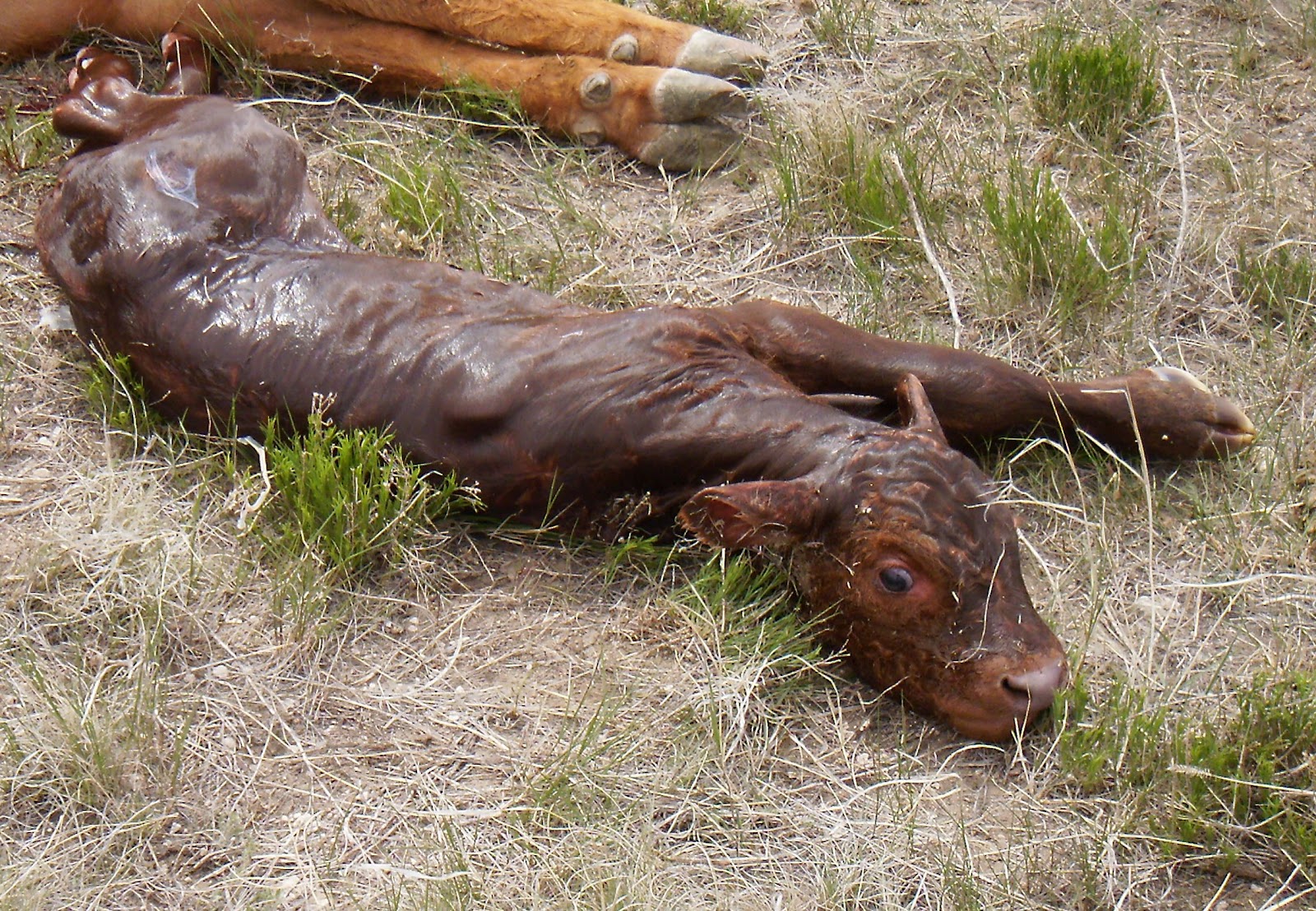 |
| Big Red gets his first view of the world. This newborn, solid red, 130 pound-plus bull-calf was a bit of a surprise. His first-calf heifer mama was exposed to a Lowline Angus bull, so he was expected to be small and black. |
Needless to say, extended parturition digs deep into the
dam’s energy reserves and hard labor, or dystocia, slows both breed-back time
and breed-back conception rates.
 |
| If you look hard, you might see surprise in this first-calf heifer’s eyes as she gets a first look at her new baby. All kidding aside, birthing a big calf is hard on a heifer, which is usually reflected in slow breed-back or low breed-back conception rate. |
We got four big, growthy calves out of the deal so it’s not
as if there’s no up-side, but only time will tell if we’ve spent 12 grand on
good replacement herd cows or on culls.
 |
| If the 16-inch wheel is any guide, the now-dried and day-old bull calf is more than 20 inches at the shoulder. An extremely lively and vibrant calf, he’ll sell well this fall, but that’ll be cold comfort if his mama has breed-back problems. |
This business is an ongoing series of learning experiences.
It always has been, and it always will be. If we learn from our 2012 heifer
calving season, we’ll be ahead of the game. Only time will tell, and in the
mean time, we’ve got much to ponder, plans to make, and management practices to
execute.
Wednesday, May 23, 2012
Counting the cost
In late 1943, as the tide of battle in World War II was
beginning to turn decisively in favor of the Allied Powers, the Big Three
leaders of the Allies – Franklin Roosevelt, Winston Churchill, and Joseph
Stalin – met at Tehran to plan strategies for winning the war. Stalin argued
vociferously for a second front in Europe to relieve pressure on his troops,
who were at the time standing largely alone against the Nazis in the East.
According to David McCullough’s biography of Harry Truman,
when Churchill argued that a premature opening of a second front would cause an
unjustified loss of tens of thousands of Allied soldiers. Stalin replied, “When
one man dies it is a tragedy, when thousands die it’s statistics”
Two years later, at the Potsdam Conference of 1945, Stalin
said directly to Truman, now the American President, “The death of one man is a
tragedy, the death of millions is a statistic.”
This is the reality of war. We can understand and grieve
over the loss of one soldier, or five, or perhaps even a score. But can we
really wrap our minds around the deaths of a hundred, or a thousand, or a
million? I don’t think we can. To paradoxically paraphrase the famous ‘forest
for the trees’ metaphor, we lose sight of the beauty and sanctity of individual
life against the backdrop of a veritable forest of wartime death.
Still, we find that the big numbers are no less important.
It’s the big numbers that we go to war over. We tolerate the occasional combat
loss of one or a dozen or a score of soldiers (The bombing of the USS Cole,
with 17 sailors killed, comes to mind), but larger numbers seem to be a tipping
point. In WWI, the number was 114 when the Lusitania was sunk. In 1941, the
number was 2,896 at Pearl Harbor. In 2001, the number was 2,977.
 |
| Sergeant First Class Kristoffer Domeij was killed in Action in Kandahar Province, Afghanistan, Oct. 25, 2011, on his 14th combat deployment. He left behind a wife and two daughters. |
The big numbers are important. As a nation, there
comes a point when we must fight for our survival. This means war, and war
means many, many thousands of deaths. It’s important that we recognize and memorialize
these numbers, hard as they may be to put into a personally meaningful context.
We do this, not because we can actually grasp the enormity of the cost, but
because we recognize that every single life lost was precious and
irreplaceable, and represented, to the dead soldier, every single thing they
had. Those soldiers died so that we may live to enjoy the fruits of our
Liberty.
Monday is Memorial Day. Though congress made it a three-day
weekend in 1971, Memorial Day is still formally a day to remember those who
fell in the service of our country, and specifically those who fell during time
of war.
Since our country began it’s first war in 1775, one million,
three-hundred-six thousand and twenty-five American soldiers – men and women –
husbands and wives, fathers and mothers, sons and daughters, have fallen in the
service of our country during wartime. In the Revolutionary War, 25,000. In the
War of 1812, 20,000. In the Civil War, 625,000. In WWI, 116,516. In World War
II, 405,399. In the Korean War, 36,516. In Vietnam, 58,209. In the Global War
on Terror, 6,377. In all other military combat action, from the Northwest
Indian war through the Mexican War through the Philippine War through Desert
Storm and through the Yugoslavian Air Campaign, a further 13,008 American
soldiers have fallen. As I write this, the casualty count continues to rise in
Afghanistan.
So those are the big numbers. To borrow again from the
famous metaphor, they represent a big, tragic, hauntingly beautiful forest of
sacrifice. But what of the individual trees?
Even in the depths of our greatest wars, the Civil War and
World War II, fewer than 10 percent of the population took up service and
donned the uniform. Of those, only about one in one-hundred faced real combat.
Today, as we fight the Global War On Terror, fewer than one percent of our
population serves in the military.
I point this out because most of you – perhaps very nearly
all of you – have never served in combat, or know intimately friends or family
members who have done so. Fewer still have suffered the combat death of a
comrade, close friend, or loved one. That very fact lends a powerfully
different perspective to presently popular phrase “the 99 percent.”
Rather than urge you to “think of the fallen” on Monday, I’d
like to offer you a challenge. Sometime this weekend, visit your local cemetery
and look for the grave of a veteran who fell in combat. It’ll take a bit of
walking, but you can do it. Most veterans graves will be marked this weekend
anyway; simply find one whose year of death coincides with wartime. Do the math
and figure out his or her age at death. Then do a little imagining. What could
that person have done with a full life? Would they have married, started a
family? Would they have taken up a trade, or started a business? In the
fullness of time, would they have walked out across the cool, green, springtime
lawn of a cemetery, paused at a grave, and wondered what might have been?
So take up my challenge, or not, as you see fit. I’ll never
know. That’s not the point anyway.
There’s one thing more you can do, but you already know what
it is.
Open winter and below average spring rains could produce drought
Most of the tri-state region falls within the semi-arid
climate type, characterized by short grass or scrub vegetation and annual
precipitation of 400-500mm (7-19 inches). The area south of Kimball, Neb. is
typical. Native vegetation is true shortgrass prairie, not the mixed-grass
prairie of the rest of the Panhandle or the mixed- and tall-grass prairies of
the rest of the state. Annual precipitation in the area has averages, since
1893, 16.8 inches.
In this particular usage, the term average means that half
the time annual precipitation is more than average, and half the time it is
less than average. Some years feature much more rain than average, and we’ve just
experienced a string of above-average rainfall years. Some years feature much
less rain, such as in 2002, when precipitation totaled 4.7 inches for the year.
We’ll talk specifically about native grasslands in this
piece. After all, more than half of the total area of Nebraska is grassland,
and most of it is harvested by cattle. The same holds true for Colorado and
Wyoming.
As of May 22, the Panhandle of Nebraska had received only 52
percent of normal precipitation since January 1, and only 73 percent of normal
precipitation since September 1, 2011.
As a region, the Panhandle of Nebraska and the surrounding
areas of northeast Colorado and southeast Wyoming receive the bulk of their
annual precipitation in the spring and summer, May-September. Thus far the
typical spring rains haven’t materialized, and this raises concerns about a
potential drought.
According to Aaron Berger, University of Nebraska-Lincoln
Extension Educator for Kimball, Banner and Cheyenne Counties, cattle producers
should prepare for drought conditions this year. The combined shortfall of
precipitation since September, coupled with a warm, open winter, have depleted
soil moisture profiles, he said, and forecasters are calling for above normal
temperatures in the coming months.
 |
| Calves scamper in play across the smooth brome of a reintroduced rangeland. This grass will grow little taller unless timely spring rains materialize. |
The prediction for spring and summer precipitation is
presently a wash. Forecasters say that depending on the El Nino pattern’s
effect on the jet stream, our region may receive below-normal, normal, or
above-normal precipitation.
According to Berger, it is prudent for ranchers to plan for
drought conditions, and be prepared to take a number of steps to mitigate the
impact of drought on their operations.
The steps include:
- Delayed livestock turnout to allow maximal grass biomass production before grazing.
- Begin to implement a drought management plan and set conservative stocking rates to protect pasture and rangeland from overgrazing. Stocking rates can be increased if adequate precipitation materializes.
- Identify
cattle which can be culled, fed for slaughter, or moved to better
range/pasture conditions. If timely rains develop, these cattle can be
grazed as usual. If drought becomes established, however, having a
preexisting drought mitigation plan in place will make decision making
much easier when the time comes.
- Begin
to stockpile feed resources which will be needed later in the event of
drought. Contract early to graze cornstalks before drought causes a
frantic rush for feed resources. Consider purchasing wheat straw and/or
corn stover to augment rations and maintain herd body condition.
- Consider
planting dryland forages to augment feed reserves.
- Be
prepared to early-wean calves. Early weaning will significantly reduce cow
nutrient requirements. Properly handled with quality feed, calves can be
weaned at 100 days or sooner.
 |
| A baby antelope peers from his bed in lush green needle grass near Kimball, Neb. in May, 2010. Plentiful spring rains produced a bumper-crop of nutritious grass that spring. |
Bottle calf update - falling into place
After spending a week bottle feeding an orphaned calf,
nature presented us with a solution. A first-calf heifer produced a brand-new
heifer of her own, had plenty of milk, and was in fine body condition.
Orphaned calves will always do better nursing a cow rather
than a bottle, so we had a golden opportunity to get the orphan back on a more
normal diet of cows mama’s milk rather than milk replacer.
There are challenges galore in such a scheme. From the first
moment a cow sniffs, nuzzles, and licks her newborn, its unique smell is
imprinted on the cows brain. The smell of that baby calf is, to the cow, an
ownership mark that identifies her baby far better than any brand, tattoo, or
ear tag. Day or night, wet or dry, cold or hot, pouring down with rain or snow,
mama can identify her calf in any and all weather.
The cow’s instinct is to nurture a single calf. Even when a
cow has twins, the first to be sniffed, licked and nuzzled often becomes “her”
calf, and the second twin becomes other. Sometimes the cow will completely
ignore the second twin, sometimes she will grudgingly accept it, and on
slightly more rare occasions, she will recognize both as her babies.
It’s tough enough trying to match up an orphaned calf with a
cow who’s lost her own calf; it’s even more of a challenge trying to add a calf
to a cow-calf pair. It can be done, but it takes a bit of work and a lot of
cooperation from the cow.
Three days after the first calf was orphaned, 051 had a
pretty little heifer calf of her own. The cow seemed to have lots of milk, and
she was conformationally a remarkably nice cow with an extremely mild
disposition. These three factors were encouraging and led to our attempt to add
the orphan to the new mama’s mix.
After tagging and vaccinating the new arrival I moved them
into the barn with the orphan calf. I dusted each calf liberally with an herbal
concoction which is supposed to make new calves smell attractive to cows. I
doubt it does any good, but neither should it do any harm, and you never know,
someday it just might do the trick.
In her initial confusion, the cow was seemingly curious
about both calves and allowed each to suckle. Both the orphan and his now
step-sister knew just what to do, and I left them that way, nursing contentedly
in the barn.
Things had changed a bit at lunchtime, though, and the new
mama knew with certainty that the heifer calf was her baby and the steer calf
was not. Still, she was only half-hearted about pushing the steer calf away and
would eventually allow him to suckle. Fortunately for the little steer, he was
very persistent. She seemed most pleased when both were nursing at the same
time.
After a few days in the barn and big corral, with both
calves and the cow seemingly satisfied with the arrangement, I turned them out
with the rest of the heifers and their young calves. As I write this, all three
are doing famously.
 |
| A week-old orphan calf nurses from a convenient udder on the EJE Ranch south of Kimball, Neb. |
Of course, the little steer calf isn’t following the script
exactly. He likes his new mama just fine, but seems to see no reason why he
shouldn’t nurse from the nearest and most convenient udder. And so he does. The
first-time mothers all know exactly what he’s doing and that he’s not their own
calf, and most of them push him away now and then, but then they allow him to
nurse for few minutes.
Subscribe to:
Posts (Atom)