Monday, March 21, 2016

Divided by a common language


Before we delve into the whole language, misunderstanding and flawed assumption thing (introduced yesterday), it's a beautiful second day of spring here in the southwest Panhandle of Nebraska. Here are a couple of images.
Western Meadowlark, lookin' for a girlfriend.
Soakin' up the sunshine.

We're supposed to be getting a winter storm tomorrow. That's what spring on the High Plains is all about!

##########

And now, on to the main feature.

Who was it that said the British and the Americans are two peoples divided by a common language?

As it turns out, at least so far as I can tell, the phrase is most often blamed on George Bernard Shaw. However (ain't there always a however?), the story of his coining the phrase is perhaps apocryphal.

Whether the profound utterance of a profound thinker or a bit of doggerel cobbled together in obscurity, it's a great line. If you've ever conversed with a Briton (and conversely, for you British readers, if you've ever conversed with a Yank), you know exactly what the saying means.

So. A few weeks ago over in Sarge's neighborhood, at the U.S. Naval War College in Newport, Rhode Island, a British mathematician gave an Eight Bells Lecture. The speaker was Niall MacKay, and the topic was "A Bayesian Study of the Battle of the Dogger Bank.

You can read about Bayesian Analysis here and here, and about the Battle of the Dogger Bank here and here.

Regarding Bayesian Analysis, it's simply a form of statistical modeling. It can be an astonishingly powerful and useful tool, however, as with all models, its utility is utterly dependent on understanding it and using it correctly, rigorously and honestly.

As for the Battle of the Dogger Bank. Quick aside; the Brits seem to always include the second "the" when referring the battle, that is, "The Battle of THE Dogger Bank." I do not know why. I suspect it is a Brit thing. See the title of this post. Well then. In a nutshell, Five Royal Navy Battle Cruisers and attendant escorts met four (or three, if you discount Blucher, read about it and draw your own conclusions) Battle Cruisers and escorts of the German High Seas Fleet near Dogger Bank in the North Sea on January 24, 1915. The Germans lost Blucher, and Seydlitz was heavily damaged and nearly lost. German personnel casualties totaled 1,223 killed, wounded or captured. On the Royal Navy side Lion was badly damaged and very nearly lost, and a destroyer was damaged. Personnel casualties totaled 47; 15 killed and 32 wounded.

And what, you may be wondering, does any of this have to do with "language, misunderstanding and flawed assumption?"

Well, just watch this. Actually, I don't expect you to watch the whole thing, which is 75 minutes long. Not too long for me, but I find it fascinating. I'm strange that way. The point I'd like to illustrate, which does address the "language, misunderstanding and flawed assumption" bit, begins at 1:08:57 and runs to 1:09:35.


During the Q&A, a fellow in the audience notes that "It sounds as though your (RN) fire control equipment was not up to the Germans."

Yet another brief aside. This is the same fellow who sat through MacKay's entire lecture on Bayesian Analysis as a potentially useful tool in refining the historical understanding of the Battle of the Dogger Bank. He had the first question of the Q&A, which was "What was Churchill doing?" There's always one.

To which MacKay responds that the German fire control was clearly faulty, as evidenced by the terrible flash fire that erupted aboard Seydlitz, which nearly caused the loss of the ship.
SMS Seydlitz afire during the Battle of the Dogger Bank, January 24, 1915. S

Which prompted my mind to say, "'Ang on, 'ang on, t'hell are you on about, mate? In naval terms, fire control is about warheads on foreheads! What's this firefighting nonsense?"

Ah. Language. Misunderstanding. Flawed assumption.

Not at all caused by the differences between the Queen's English and American English after all. Sorry, I cheated. Hate to let a great line go to waste. Anyway, the genesis of this misunderstanding springs from the difference between professional naval terminology and civilian terminology.

To his credit, MacKay quickly recovers, and after a brief detour into shipboard firefighting, returns to fire control.

Both topics, in the context of WWI naval battles, are hugely interesting and fascinating. On the firefighting side we have "There seems to be something wrong with our bloody ships today" and on the fire control side we have excellence on the High Seas Fleet side versus the muddled mess of Pollen and Dreyer and the abysmal state of RN gunnery in 1915.

##########

A couple of thoughts are in order here. Well, whether they're in order or not, here they are.

Firstly, I agree with MacKay that Bayesian Analysis is an exciting and potentially very useful tool to add to the historian's chest. The real utility here is the way the tool works. To oversimplify, you take all the parameters which may have led to the outcome, and then analyze them more or less in reverse to determine the likelihood that they actually caused or contributed to the factual effect in the way you hypothesized.

For instance, and to be extremely over-simplistic, let's say I hypothesize that Blucher was destroyed because of the excellence of British guns, shells, and gunnery, and that Lion was saved by the inadequacy German guns, shells, and gunnery.

The factual outcome is that Blucher sank and Lion did not. But when we analyze British and German guns, shells, and gunnery, we find that my parameters (assumptions) were weighted exactly bass-ackwards. The Brits scored fewer hits with less effective shells fired from less capable guns, and the Germans scored very many more hits with far better shells fired from superb guns.

In this case, my parameters were badly flawed, but the tool allows me to refine them to close in on more likely causal parameters. At the end of the day, this tool, if used correctly, can in some cases bring us closer to the truth of what actually happened, which is of course the whole point of history.

And yes, this is what historians are already doing. I get that. The  potential utility of Bayesian Analysis and other mathematical/computational modeling approaches is twofold. On the one hand, computers allow modeling to be done on huge scales and at great speed. On the other, they offer an opportunity to escape the trap of bias. Both of these things are good, good, good.

The tool can be misused, of course, and MacKay takes pains to point this out from the beginning of his lecture. One must input the correct data (garbage in/garbage out) and apply real and appropriate scientific and mathematical rigor. Or as they say in Great Britain, great rigour.

To that end, MacKay points out, it's up to the wielder of the tool to understand how it works and use it appropriately.

A final thought here then. We expect historians to be honest and rigorous and unbiased. We expect the same of scientists and mathematicians and doctors and school teachers and plumbers.

We're right to expect this, and we're right to realize that sometimes (even perhaps often) professionals fall short. So who checks them? And if such checkers exist, who checks the checkers?

You and I do of course.

And here's the fun and exciting part. None of us are too dumb to check the professionals or to check the checkers.

We've all been told, time and again, that experts are really, really smart. The implication there is that "non-experts" (you, me, and us) just ain't that smart.

Bullshit.

All men are created equal. You believe that, don't you? Sit back, close your eyes, and cogitate on that proposition for a while. Take it to its natural conclusion.

Then pull those harness straps tight, lock the inertial reel, and stand by for some g-warm. 


Sunday, March 20, 2016

Spring hopes eternal...


...and other nonsense and non sequiturs.

Seen in every newspaper office across the land:

Copy editors of the world, untie!

It's been 31 days since I posted here last. Pretty unsatisfactory, eh? I have a long list of excuses. Care to peruse them in list form? I thought not.

Excuses are like arseholes, everybody's got one and they're all full of feces.

Using the British vernacular takes all the vulgarity out of that word, no?

What word? You know, Gilipollas. Mudak. Maladbara. Supak. Zadnik. Chitsiru. Stronzo.

Okay. On to serious business.

At about 10:30 p.m. MDT last night, March 19, our Spaceship Earth reached that point in its orbit which we surface dwellers call the Vernal Equinox. From the Latin vernālis, 'of spring', and aequinoctium, 'the time of equal days and nights'.

There are two of these equinoxes each year, vernal and autumnal, from the Latin (what else?) autumnālis, 'of the season between summer and winter'. Interesting that you've asked the what else question, for if I read my dictionary correctly, the Latin term came from both the Middle French autompne and the Middle English autumpne. Which is neither here nor there, but then. If you take my meaning.
A delightful graphic representation of the whole "sun moves north and south" phenomenon. I stole this image from the interwebs some years ago, and I believe that this may be the original source. 

In looking up a few of the foregoing definitions, I was amazed, delighted, and more than a little chagrined to find that for most of my life, I've incorrectly believed that the term equinox referred to the midpoint of the sun's north-south or south-north journey, which I described in exhausting detail many years ago here. Yes, my flawed assumption was that the term indicated an equal distance from winter solstice to equinox and from equinox to summer solstice (and the reverse, of course). And my long standing assumption was wrong! This is what happens when one is a smug know-it-all and too lazy to check one's assumptions at the door and begin anew with a fresh sheet of paper, as it were.

It's only fair that I take myself to task for making a flawed assumption, for I have never been shy about taking others to task for the same thing. This isn't a matter of one-upmanship, although it can be (and often is) taken that way. It's more about the perils of misunderstanding implicit in the whole "snapping to assumption" milieu (from the French milieux, 'surroundings, especially of a social or cultural nature').

Making assumptions is human nature. Making flawed assumptions is human nature. Being nasty to each other about our shared flawed assumptions is kind of rotten and low and one of the worst aspects of human nature. Sticking doggedly to an incorrect assumption and defending it to the end with meanness, spite, and deception is an even worse aspect of human nature. These modern approaches to intellectual discourse seem to have become coin of the realm.

That bothers me a lot, and it's something I plan to address in the coming days, weeks and months. In my mind, shaped by my betters to be sure, it is the height of folly to get all territorial and aggressive over flawed assumptions. I mean, think of it -- we humans have the ability find the flaws and learn something new. This is exciting! It's also what Richard Feynman, a man I'd never heard of while he lived, called "the pleasure of finding things out."

Such a simple thing. Try to imagine a civilization filled with "oh man, that's cool" rather than "you're wrong and I hate you because you're on the other team, you proservative scumbag."

I'm going to mess around with this blog a bit. My very basic idea is to bring you a taste of "today on the prairie." This will be a dose of daily wonder which will hopefully serve as a baseline of reality against which we can compare, contrast and measure a few different topics and ideas. With any luck I'll find a way to vivisect some of the strange creatures stalking our society and our civilization, revealing the healthy and the cancerous tissues, and do so in a way that's honest, enlightening, and principled.

There's a voice in my head right now muttering, "yeah, right."

We'll see.

But first, a bit of whimsy.

So. First day of spring. It got down to 11 degrees last night. Just now it's 52 and a bit breezy. A fairly pleasant day for the first day of spring. The weather guessers promise a significant winter storm on Tuesday and Wednesday. After an unseasonably warm February, the snow we had two days a go and the predicted storm is more like it!

As I drove through the south unit a few days ago I was reminded of a Christmastime adventure.

Two days before Christmas my phone rang.


“Ah,” said my brother, “We’re stuck down here south of the draw.”


This was not welcome news. I was in town and in the middle of unloading a truck. It was a big chore that needed to be completed and it would take another two hours or so to finish.


More importantly, the “we” referenced in the above report included my Dad, who is not as robust as he once was and who has a pacemaker to keep his heart ticking along regularly. The truck job could wait.


I sped out of town and within 15 minutes was surveying the situation from the county road about half a mile from the scene of the crime. It was pretty clear what had happened. They’d driven in from the north, intending to check stock tanks on the south side of the east-west draw. They’d followed the approximate path of the pasture trail road, but the road itself was invisible beneath a layer of snow. Their course had wandered off track a bit -- no more than 40-50 feet. Unfortunately, that put them in a low spot in the lead into a gully. The smooth, wind-sculpted surface of the snow hid the low spot, where snow depth went from six inches to six feet in only a few dozen yards.


Peering at the stuck pickup through my binoculars I could see that it was well and truly buried. It was deep enough, in fact, to prevent the doors from opening, and was certainly high centered. Sigh.


The most important thing was to get Dad out without requiring a lot of exertion on his part. Deep snow is tough enough for the young and fit, and he was in no shape to wade through the icy quagmire for more than a few feet. Having navigated the snow-choked pasture every day, I had a pretty good idea that I could reach the stranded pair with my trusty 4WD Ranger. It wouldn’t be easy, and I’d have to be careful. But it was doable.


I had to come in from the south. The path was tricky because the snow hid all the low spots, but experience from my hiking gave me a very good idea of the terrain hidden by winter’s blanket. I was able to drive to within about 20 feet of the stuck pickup in snow no more than 6-8 inches deep.


The Ranger is a small pickup, and there was room in the cab for only myself and Dad. Brother and the two dogs would have to ride in back or hike out. They chose to ride. In short order we were back home and thawing out. Extricating Dad’s pickup would wait for another time.


I went back to work unloading the truck. Later I learned that my brother had tried to pull Dad’s pickup put with the hydrabed and very nearly got that one stuck too. In the process he’d lost his cell phone in the snow.


The next day I gave a class in digging out snowbound vehicles. It wasn’t that big a chore, but took some strategic digging and careful driving.


Flash forward to March 15. While scouting grass I drove over to the place Dad’s pickup had been stuck. What a difference 90 days makes! There was no hint of snow, but the winter grass still clearly showed where the vehicle had been mired. I had planned to look for my brother’s lost cell phone and was pretty sure I could find it. I saw it laying in the winter-short grass before I even got out of my pickup.


Mission accomplished!
The scene of the crime, after extraction.
After the digging.
That's the brother's Missus, and not a happy camper.
Wouldja lookit that!


And just a touch more...

Whilst perambulating (I've been visiting with my friends in Herefordshire...) through the spacious aisles of the local junior wally world yesterday I was involved in a midair.

Of course it wasn't a midair; I wasn't in the air or in an airplane. I was in a second rate chain store with my feet firmly planted on the ground. No one was hurt an no metal was bent.

Anyway, I was striding along the southernmost but one front to back aisle of the store, heading roughly 270 en route checkout, shiny new 32GB  thumb drive in my paw, passing out of electronics and into yard and garden to the north, with laundry and cleaning morphing into tasty snack items to the south.

I never saw or heard it coming. Well, that's not right. I did. It just happened so fast that I couldn't avoid it.

One moment I was striding along a perfectly empty aisle, the next moment a small boy appeared from the left, head down and blasting along in full blower. Smash!

At the very last moment, milliseconds before the collision, each of us initiated action to mitigate the physical consequences of the impending crunch.

The boy, a belt-high, tow headed specimen, began to jink right and to duck his head. It wasn't enough, but he gave it the old Kindergarten try.

Sensing the geometry of the impending collision, I shot my left hand down and back and began to turn to the left. As the impact occurred and the boy began to ricochet and spin I was able to stabilize him and prevent a full blown departure from the upright and to redirect his vector toward the center of the aisle and away from a display of shovels, rakes and hoes.

As all violent motion ceased we stood facing each other, about five feet apart.

"Are you okay?"

"Sorry," he said, eyes big as onions.

At that moment the boy's flight lead wheeled her cart out of the cleaning aisle and fixed him with an icy stare. "That's why we walk, Mister!"

The entire episode filled my heart with joy.

Why do you suppose that is?


Life is chock-full of coolness and delight. 

Thursday, February 18, 2016

Sixty hours


Well, Mom's hip replacement surgery went fine. It's what we all expected, but major surgery is major surgery, so there's always a lot of worry. That's behind us now. Big thanks to all you kind readers who chipped in with thoughts and prayers. That means a lot.
With her birthday cake on February 6.

The two-hour drive to Loveland was quite a trial. Mom was having a lot of pain and had been ordered not to take anything by mouth, including medicine, after 11 p.m. the night before.

She been able to kind of keep most of the pain at bay by moving around a bit and not letting her hip stay in one position for too long. In the car that was impossible. Once we reached the hospital and she was stumping around on her walker she felt better, and some of the chairs in the waiting room are designed to ease this kind of pain, so it was a relief to arrive.
Reading Agatha Christie in the waiting room.

Unfortunately, when she went into pre-op she had to lay down on a gurney, and the worst thing for her pain was laying down on her back. They finally let her sit up, but it was tough for a while.
Lots of pain.

She went into surgery on time and was out an hour and 50 minutes later. The surgeon reported that all had gone well and as expected. Two hours later, after the spinal block had worn off, she was delivered to her room.
Little kids playing in the waiting room.

Surgical center
The "Big Board." Mom is 326.
She was still a bit woozy from the meds but was very pleased to have the old, awful chronic pain replaced by surgical incision pain.
Chronic pain replaced by surgical pain.

In an interesting contrast to her previous hip surgery, she'd been awake throughout this round. Well, for some values of awake. She remembered talking with the surgeon and anesthetist, conversations between members of the surgical team, and the sound of sawing and pounding (shudder!). She also said that the operating room featured a collection of antique mason jars arranged atop the cabinets, just like the collection she has in her kitchen at home!

She was up and to the bathroom on her own within an hour of being delivered to her room. It was painful for her and hard work but she's determined to be in charge of her recovery, which is a good sign.

I'd planned to stay with her for a few hours before heading home for the night but I soon realized that I was a bit of a distraction. She was in a rather paradoxical condition -- really pleased and relieved to have the surgery behind her and the chronic pain gone but also exhausted, having surgical pain, and a bit loopy from the pain meds and anesthesia. As long as I was in the room she wanted to visit but she needed rest more than anything, so I bowed out and headed for home.

The next morning she texted me and said not to come over. "There's no need for you to drive all that way just to hold my hand." She also mentioned that she'd be in and out of the room with physical therapy and occupational therapy, and was concerned that if I visited I might be "left alone." 

So I stayed home on Tuesday.

Wednesday morning was a bit of a madhouse. It started with a call from the truck driver who was delivering a load of hay. He'd planned to come on Thursday, but the weather forecast called for very high winds across the region, and so he wanted to deliver a day early. Which I understood and agreed to.

Then Mom called. They'd planned to release her in the afternoon, but her blood pressure was quite low and they wanted to see it come back up before they'd let her go. She was disappointed and didn't want to spend another night in the hospital.

Then the hay showed up. Then the tractor -- which is equipped with a loader and is required to offload hay from the truck -- sprang (sprung? springed? spronged?) a hydraulic leak.
Floor-dry soaking up hydraulic fluid

It wasn't a terrible leak; an o ring had failed in the control level plumbing in the cab. The system was bleeding but not exactly bleeding out. Hydraulic fluid on the floor of the cab is a pesky menace though, extremely slippery and tending to coat everything. It's mostly a messy nuisance, but slippery clutch and brake pedals make for risky operation.
She's a good tractor.

I persevered though, and had 75 tons of hay offloaded in about 90 minutes. It wasn't pretty, but it was good enough.
Seventy-five tons of hay back there.

Another call from Mom brought the good news that she would be discharged at 4 p.m. It was quarter to two, so there was just enough time to make the trip.

My brother Justin and I hopped in the MKC and dashed on over.

Mom was in great spirits when we arrived, already dressed and rarin' to go. We fumbled through the usual blizzard of discharge paperwork and were quickly on the road.
Leaving the horsepistol.

As evidence of the taxing nature of major surgery, Mom quickly fell asleep and slept soundly and hard until we pulled up at the ranch. "We're here already?"

We'd left the ranch at 6 a.m. Monday morning and were returning at 6 p.m. Wednesday evening. That's sixty hours if my plutifier is working right. Quite amazing when you think about it. 
Home and on the mend.


Monday, February 15, 2016

Hipster


It's 0439 as I write this. In two hours I'll be driving my Mom to the hospital in Loveland, Colorado, for to have her hip replaced.
An example xray stolen from the interwebs. This one shows a narrowed joint space in the left hip and more normal joint space in the right.

She had the starboard one done in 2014, now it's time for the port one.
Here's Mom's right hip before surgery. No joint space and the femoral head is disintegrating.

Past time by far, actually. She's been in a hell of a lot of pain and for far too long.
Here's the one-year follow up. Nice new metal and plastic hip on the right, but the joint space is gone now in the left.

If her previous experience is a reliable guide, she'll get almost instant relief from the pain and vastly improved mobility. She recovered much more quickly than is the norm from the first surgery. She's likely to do the same this time.
And here's the one from last month. That joint is failing fast.

Major surgery is a big deal and fraught with risk. They do these things with a spinal these days which makes me feel better -- general anesthesia can be pretty taxing on the whole system. At 75 her reserve tank isn't quite as full as it once was, and there's less margin for slop. These things have become rather routine here in the 21st century, but there's still a lot of worry.
Hanging out sheets a couple of weeks ago, in a damme snow drift, with a destroyed hip joint.

Knife is scheduled to drop at 1030 local.

Saturday, February 13, 2016

Buncha disndat


Seems like it's been forever since I posted anything. I guess 16 days isn't forever though. I've had a lot of stuff to post about, and I've taken more than enough pictures and videos, but just haven't found the time.

Really don't have the time this morning but I'm waiting for some laundry to dry and that's excuse enough.

We got hammered with a pretty significant winter storm on Groundhog Day. Nothing unseasonal, mind you, but quite enough snow, ice, wind and cold to keep me jumping. As I've noted before (ad nauseam), everything is harder in the winter. Keeping cattle checked and fed and stock tank ice chopped isn't that taxing and doesn't take all that much time, but navigating through blowing and drifting snow is particularly time consuming.

I got myself stuck several times over the last couple of weeks and had to do some digging out. Also had a battery go south. So, you know, stuff.

Here's how it all began...


And here's a bit of the middle...


Couple of other bits of stuff. Dang Achilles tendinitis flared up. Of course. In the middle of digging out, which was immediately followed by dead battery, which led to hiking out. Sheesh!

Boy, am I in full whine this morning!

The icing on the cake was another damme birthday.

However, my 16 year old niece Julia rescued me. Her birthday card said:

"So you're another year older. Look on the bright side... Okay, there is no bright side. There's a bright light, but you're gonna want to stay away from that."

Just the medicine I needed!

Then it commenced to warm up a couple of days ago.
Is that a sunshine?

A lot of the snow melted. Last night there was a freezing fog. It persisted into morning. Morning freezing fog is spectacular. Especially when you know it's going to burn off and warm up.
Medusice
Pretty is just a word.
Sun fighting through.
God art.
So pretty I hate to use the gate opener.
Almost no ice left. This thing was frozen solid a few days ago.
Cowrillas in the mist.

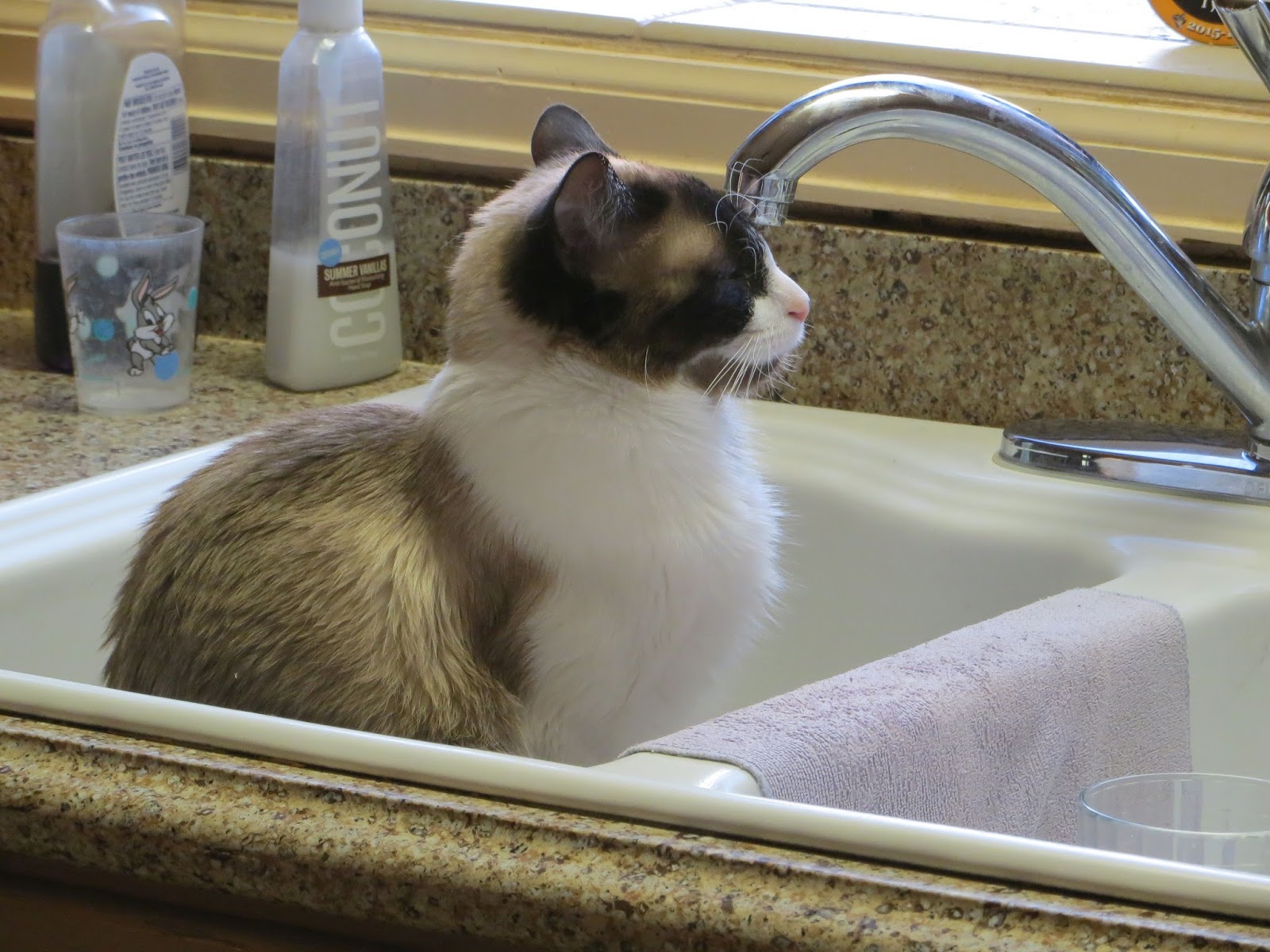
Frankie (who is a girl) approves of the weather change.

She does not, however, approve of my commentary.
Yes, she's relaxing in the kitchen sink. Your point?!?

This kind of beauty just plasters a smile all over my face.


And to put a bit of icing on the cake (groan)...

One swallow does not a spring make, but how about five gooses?


Hope ya'll have a superb weekend.