Thursday, April 5, 2012

So many "best" things


The wind howled across the Panhandle and much of the tri-state region, filling the sky with dust and swirling vortices, halting most truck traffic on the roads, and generally making life difficult. In the calving pastures cows continued to graze while calves hunkered down wherever they could get out of the gale. The livestock were noticeably agitated by the wind and plunging barometer. The temperature rose during the day to a high of nearly 80, and the warm wind sucked moisture from the ground as a precipitation-less month neared completion.

There are some unpleasant things to bear in a life lived on the shortgrass prairie of the southwest Panhandle, and the howling wind is one of them. Though the wind is tough to take, it’s early spring, and the contrast of nasty wind days allows us to enjoy the nice days all the more.

When the windy days come, I try very hard to be the optimist and see the silver lining. It keeps the flies down, I tell myself, and the mosquitoes as well. It recharges the local atmosphere, keeping the air clean and fresh. Sooner or later it even stops blowing.

The wind even blew the roof off of the on again-off again meth lab down the road. As most of us have learned to our chagrin, those inclined to law-breaking love the peace and solitude of the country. But the weather can be hard on their ramshackle enterprises, and while a roof flung across 10 acres of wheat stubble makes a huge mess, it also interferes with drug production. A bit of poetic justice there.

There are periods of calm on most windy days, and the windless moments of morning and evening can be beautiful, particularly in the spring.

As the sun rose over the eastern horizon Sunday, much of the EJE was enveloped in a thick, cool fog bank. As I headed out to check cows and calves I drove through a close, fuzzy landscape, illuminated by the faint glow of sunshine fighting through the thick wad of water vapor draped across the prairie.
The sun begins to win its battle with early morning fog on the EJE Ranch.

Visibility varied between 200 and 500 yards; good enough to find my way around and to find cattle, but poor enough to make me work at it and cover more ground than usual.

As vexing as it can be, there’s something beautiful about a morning fog. The dim light and thick vapor bring the horizon close and dampen sound waves, transforming the environment into a quiet, private space, one in which you can imagine yourself completely separated from the rest of humanity. If the fog is heavy, it dampens your face and clothing and coats both your vehicle and the greening prairie grasses with beads of water. As parched as this March has been, the tiny droplets are a blessing to the thirsty landscape.

The dim quiet of the early morning, the precious moisture, the greening grass, the smell of warming earth and growing things – mornings like these are some of the best things in my life.

As I drove across the pasture, searching for what I knew to be there, dim shapes finally loomed in the fog and morphed into cows. Finding the main cow and heifer herds was easy, as was checking on the well-being of young calves. But since cows tend to isolate themselves from the herd when birthing nears, finding them on a foggy morning can be quite a trick.

After counting the main herd and coming up one cow short on my tally, I set off in search of 540U, a four year-old red cow. Eventually I found her in the confluence of two shallow draws more than a mile away from the rest of the cows. Sure enough, she was licking a newly-born little red heifer calf. Finding the new pair in the fog, seeing that all was well, and seeing the minutes-old calf struggle to her feet and totter to the teat – well, that was simply another one of the best things in my life.
A brand-new heifer calf in the midst of her first meal on a foggy Sunday morning on the EJE Ranch.

As the sun warmed the morning and the fog dissipated, the sound of meadowlarks flowed through the springtime air, bright and sweet, like a touch of honey in an icy glass of fresh tea. I drove slowly along the pasture trail road, up and down the surprisingly steep hills of “flat” Nebraska, and slowly drank in the peace and beauty of the morning. Another best thing.
“Where’s my mom?” this day-old calf seemed to be asking the other morning on the EJE Ranch.

As I passed the cow herd I spied a young black steer calf, not yet two days old, curled up in a small depression near a clump of yucca. I swung the pickup toward the calf – just to check – and as I neared he bolted to his feet and came running toward the pickup. I’d tagged him the day before, just a few hours after birth, and as he galloped toward me I realized that he associated the pickup with his mama. He trotted up to within a few feet and looked at me expectantly, pausing long enough so that I could snap a few pictures. As I drove away he gave chase, and after a few dozen yards, began to bawl lustily. This provoked the expected reaction from his mama, who had been grazing a few hundred yards away. Her head came up and she dashed toward he baby in a cloud of dust, bellowing with concern. In moments the pair were relieved of their momentary confusion, the calf quietly nursing and the cow warily eyeing the pickup. Another best thing? You bet. I drove out of the pasture and into the rest of the day with a big smile plastered across my face.

Reporting on the pink slime scam


If the consequences of an action, especially the use of technology, are unknown but are judged by some scientists to have a high risk of being negative from an ethical point of view, then it is better not to carry out the action rather than risk the uncertain, but possibly very negative, consequences. – wordiq.com

Sounds great, doesn’t it? Rather like the physicians Hippocratic Oath, which states in essence, “first, do no harm.”

Like many statements that sound superficially good and noble, a simple review of unintended consequences shows that the world is not as simple as the sloganeers make it out to be.

Here’s an example: “If it would save the life of one child it would be worth it.” In general, we understand that by “it,” the sloganeer is talking about banning some object, product or activity.

If a child chases a ball into the street and is struck and killed by an automobile, then according to the precautionary principle, the consequences of future child/automobile interactions are unknown, but are clearly risky, and therefore it is ethically imperative to ban automobiles.

Now to the, er, meat of my argument.

Last week The Business Farmer published two stories on the so-called “pink slime” ground beef product. The first, under the by-line of The Nebraska Farmers Union, argued that, a) 70 percent of ground beef is pink slime, b) pink slime consists of waste beef trimmings formerly only used for pet food and cooking oil, c) pink slime is treated with ammonia to make it safe to eat, d) that pink slime is not fresh ground beef but a cheap “waste product” additive, and e) that the USDA official who signed off on introducing the processing technique sometime in the late 1980’s wouldn’t be allowed to serve in the same capacity under today’s ethics rules.

Readers unfamiliar with food production – which includes probably 95 percent or more of Americans – could to some extent be excused for concluding that the pink slime story exposed an awful crime being perpetrated against American consumers; that greedy corporate beef processors are adding rotting meat sprayed with deadly ammonia to their ground beef products.

Clearly, if there ever was a cause to employ the precautionary principle, this one is it, right? No scientist in his or her right mind could say that there’s no risk involved in selling rotted, ammonia-tainted ground beef to consumers.

Of course, the Nebraska Farmers Union message, as usual, was long on propaganda and woefully short on facts.

As the Business Farmer’s second story on the subject showed, “pink slime” is in fact lean, finely textured beef (LFTB). It is in fact made from beef trimmings, which when passed through a centrifuge, allow lean beef to be separated from the fat. The trimmings in question are fresh, and come from the excess fat trimmed from steaks and roasts, which always include a significant quantity of lean meat. Prior to the introduction of the centrifuge processing, it was physically and economically impossible to recapture lean meat from trimmings. Recapturing this lean meat actually increases the lean meat yield of each carcass and therefore reduces the cost of ground beef.

Because ground beef has a larger surface area than intact cuts such as steaks and roasts, it carries a greater risk of contamination to the naturally occurring pathogens present in the slaughtered cattle and in the processing facility. Because of this, ammonium hydroxide is added to the LFTB, raising the pH of the product and killing or slowing microbial growth. In the quantities used to treat the product, ammonium hydroxide is completely safe for human consumption. Similar chemicals such as salt, potassium chloride, and smoke have been used for centuries to treat and cure other meat products such as corned beef, bacon and ham.

As to the alleged ethics violations of the then- Undersecretary of Agriculture, this was a simple red-herring introduced to the Nebraska Farmers Union propaganda piece.

Hysterical anti-ag propaganda serves no good purpose. At best it raises unfounded consumer concerns; at worst it raises consumer doubt about the veracity of published news. One can imagine consumers becoming accustomed to ignoring “scare stories” to the point that they also ignore factual stories at their great peril.

That ideologically based propaganda makes it to the news page and onto television, radio and internet is a function of the First Amendment to the Constitution, which prohibits the government from abridging free speech. This is a wonderful thing. But with every enumerated right comes a non-enumerated corollary – the responsibility of reason and skepticism that every man and woman must exercise to enjoy the full measure of their natural liberty.

Hats off to the Business Farmer for openly and honestly printing both sides of the story. The New York Times didn’t do so, and neither did ABC, CBS, or NBC.

When I was your age...


When I was a youngster growing up on the EJE Ranch my siblings (four brothers and one sister) and I had a year-round set of chores to do. The chores varied with the season and included daily and weekly tasks and participation in the various ranch-wide jobs that everyone helped with – branding, weaning, loading cattle, moving cattle, etc.

The chores were a responsibility and were not in any way optional. I think I would have been badly confused if someone had told me I could opt out, or only do my chores when I felt like it. We learned early that each of us shared in the responsibility of husbanding the ranch livestock and in various aspects of maintenance and upkeep.

Don’t get the idea that we, my siblings and I, were perfect little automatons though. We did a lot of whining and complaining; mostly in low-key grumbling but occasionally, when we felt we were being particularly badly used, in loud and vocal complaints. We knew very well that town kids didn’t have to do chores or to negotiate for “time off” for sports or other extracurricular activities. One of my brothers even hinted darkly that he was “…gonna call the humane society.” following a particularly strenuous day of hauling and stacking alfalfa hay.

When we compared our ranch responsibilities against the life of leisure led by our town-kid peers, we easily saw a couple of interesting and non-disputable facts. Yes, we worked hard, but we were also a vital part of a real ranching operation. We were proud of this distinction regardless of how much we grumbled at times. We also knew that none of us worked as hard as our dad did when he was growing up, and that he, in turn, had had it relatively easy when compared to the work that his dad, our grandfather, had been responsible for in his youth.

This last weekend (Mar. 10-11) was the beginning of a week-long spring break for seven of my nieces and nephews, and they and their parents descended on the ranch for a visit and some “farm time.” At one point during the visit my brother and I were reminiscing about morning chores and a couple of the kids started asking questions. Two of the boys, aged 13 and 11, opined that the work we described didn’t seem that hard. So I threw down the gauntlet.

“Do you two want to find out? You can help me in the morning and I’ll let you do the chores we did when I was your age.”

Surprisingly, they agreed. Somewhat more surprisingly, they didn’t back out the next morning.
“Up, up, up!,” I hollered as I snapped on the lights in Riley and Tyler’s room. “Chore time, chore time, up and at ‘em!”

“Already?” asked Riley.

“It’s still dark out!” complained Tyler.

“Sun’s just coming up, time to get to work,” I answered. It was 6:45 a.m. on Sunday morning, and because of the change to daylight saving time, we’d turned the clocks ahead in the night, effectively shortening it by one hour.

Grumbling and mumbling, I rushed the pair through their morning ablutions. Being city kids, they didn’t know how to dress, so I made sure they wore their jeans and boots and a coat and gave each a pair of work cloves.

“It’s cold out,” said Riley as he shivered in the pre-dawn coolness. The air was still and without a hint of breeze, and the temperature was 35.

“This is warm compared to yesterday,” I said, “and a lot warmer than most winter mornings when I was your age.”

“Yeah, whatever,” said Tyler. Change isn’t always better.

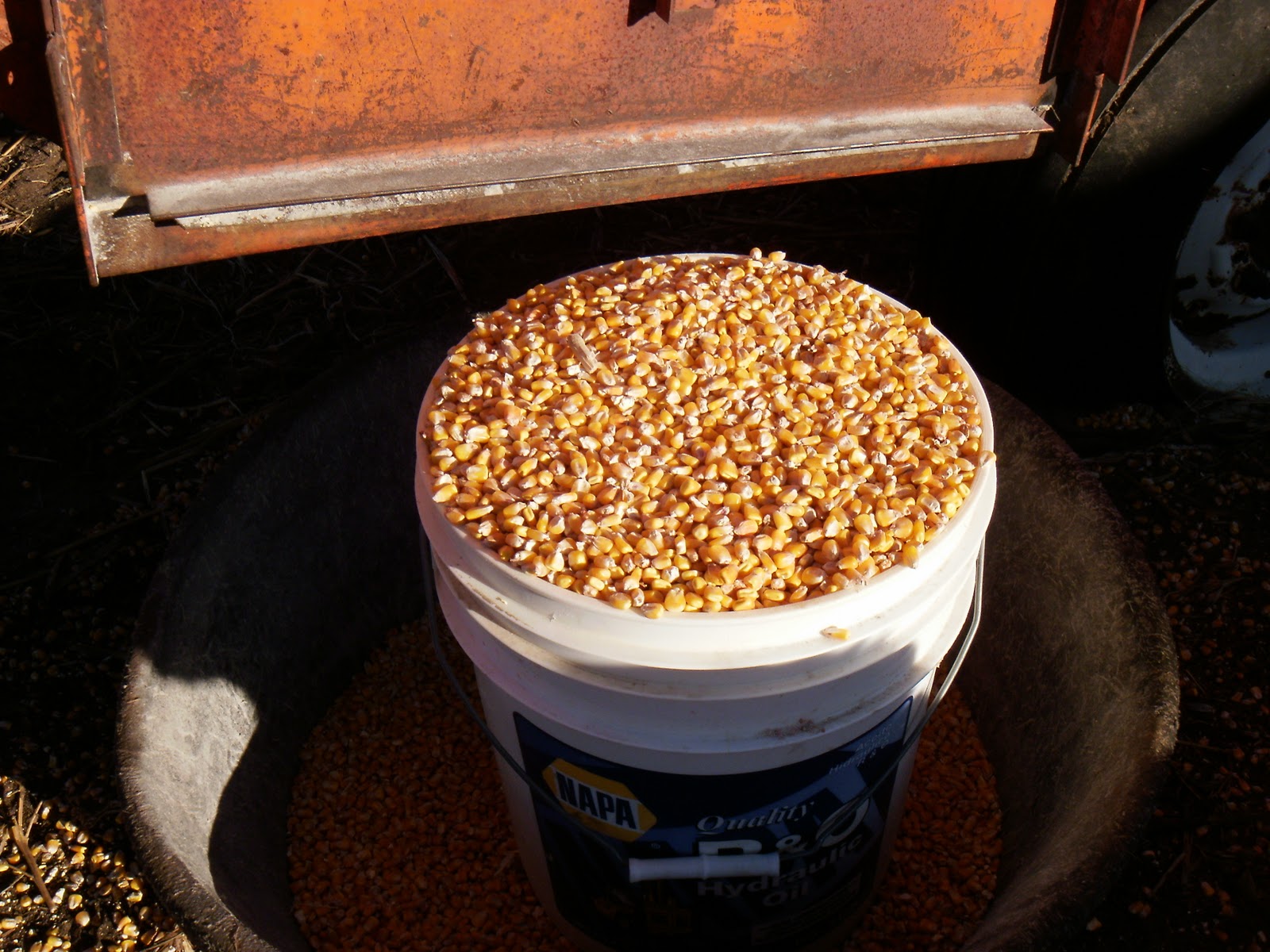
“Gotta feed the calves first,” I told them. We always fed there in the far corral, so you guys each take two full buckets of corn, carry them over there, then bring them back here and pour ‘em in the feed bunks inside this near corral.”

“Hey!”, said Tyler, “this stuff weighs a ton! How are we supposed to carry it clear over there and back?”

“It doesn’t weigh a ton,” I said, “only 35 pounds per bucket. Just pick it up and carry it one step at a time. And don’t trip and spill it!”

After much moaning and groaning and only a tiny bit of spillage they managed to get the corn fed.

Huffing and puffing, they set their buckets down and turned toward me, thinking they were done.

“Put the buckets back where you got ‘em,” I said, then come back here so you can feed some hay.”

With a dark look they muttered off toward the barn, empty buckets swinging, then returned.

Neither was thrilled about feeding hay, and neither had ever used a pitchfork. After some time they got the hang of it and finished distributing hay along the feed rack. Now they were surely done, right?

Both boys just looked at me, gape-mouthed and incredulous, when I described their next task, checking water and breaking ice. There was no ice in the corral stock tank, so I let them each take 25 sledge-hammer swings against an old tractor tire.

The physical work had shaken loose the sleepy cobwebs, the boys were now wide awake and sweating just a bit.

“Okay,” I said, now walk through that pen you just fed and come tell me which one is sick. I know,” I said, raising my hand, “you don’t know what to look for, just take a close look at each one and tell me which one you think is sick.”

After 10 minutes and an extended whispered conversation, they reported back.

“They all look the same to me,” said Tyler.

“How are you supposed to tell?” asked Riley.

As it turned out, there hadn’t been a sick animal in the pen. I pointed out the signs of good health to the boys, then described what a sick animal might look like, how it might behave. “The point is, you have to assess the health of the animals every time you look at them. It’s a habit you have to develop in this business. But you guys did a good job looking. In fact, you did a good job with the chores. You ready to start doing this every day?”

They rolled their eyes and headed back to the ranch house for their breakfast.
Six of the seven grandkids present over the weekend at the EJE Ranch pose in the bed of the 1946 Ford pickup. From l-r, Jake, Gracie, Faith, Riley, Julia and Tyler. The kid’s Grandma and Grandpa, Mick and Peggy Evertson, are seated in the cab of the pickup.

Emergence


There was a solid hint of green apparent as I hiked the native shortgrass prairie of the EJE Ranch Tuesday morning. There’s not a lot of grass growth yet, but it’s coming, and the leaf buds on shrubs and trees are beginning to grow fat.

Even though we’ve had a comparatively mild winter it felt good to stretch my legs and work up a good hiking sweat in the pre-spring sunshine. The wind was a bit annoying but the warm temperatures kept it from cutting the way most March winds do in this part of the country.

Springtime hikes can be pleasant and this one was especially so.
A windmill turns briskly in the morning breeze as the prairie south of Kimball begins to green up as spring approaches.

December 23 seems like a long time ago.

If you've ever thought about or studied the physical nature of time and of our subjective perception of time, you'll recognize that the first sentence of this essay doesn't really say anything. By the way we usually count the passage of time, and if you read this on the date of publication, 75 days will have passed since Dec. 23. Seventy-five days can be a very brief or a very long period, depending on your perspective.

It's been both for me.

I've been very busy each day, attending to ranch chores, researching and writing, caring for a new and rapidly growing border Collie puppy, serving on a local committee, hiking the shortgrass prairie and snapping thousands of images with my trusty digital camera. The NFL playoffs and Super Bowl have come and gone, Major League Baseball held their winter meetings and started spring training, the NASCAR season began in spectacular fashion; Danica got wrecked but finished the race and my favorite Wisconsin driver won the 500.

Those things all seemed to proceed at a normal pace and I found a lot of joy in each event, in every day.

On the other hand, I've been fighting a closed-head brain injury since Dec. 23, and suffering from post-concussion syndrome. A little less joyful.

I've had generalized memory problems, trouble recognizing faces and people, and big chunks of missing memory. Most irritating has been my struggle to write. Where once the words seemed to flow from a bottomless well, I've had to fight hard to put simple sentences and paragraphs together since the injury. My flowing well became a creaky, leaky hand pump, and I've had to work very hard indeed to produce the thoughts and the concepts to write about and then to fit words into a ghastly semblance of what I'm trying to say.

That part of the last 75 days has been a struggle and seems to have lasted a very long time indeed.

But my brain seems finally to be wiring itself back to a semblance of normalcy. My thoughts are becoming more clear and less cluttered. On the one hand, it's been an amazing experience. On the other, it's been quite frightening. Knowing that there's something wrong with your thinking and lacking the ability to "snap it back to normal" is unsettling, to say the least.

Hopefully I'll continue to emerge from the morass of mushed-up thinking. I believe I'm making good progress. Already the words flow more easily, the gaps in memory are almost unnoticeable, and most faces are associated with familiar names. As spring approaches the lengthening days and warmer sunshine seem to be a tonic for my addled brain. Or perhaps spring’s approach is just a coincidence, and the physicians are right – it just takes time.

So I'll just keep banging on, taking it one day at a time, and see how things progress. As If I have any other choice.

Iron Reptile


Ask most Americans – most people in the industrialized world in fact – how ranchers go about the business of raising cattle in the 21st century, and most would imagine that the horse continues to play nearly the same major role in ranching today that it did at the turn of the 20th century. That romantic notion of the cowboy on horseback raising cattle on a sweeping, fenceless range is continually reinforced with the television airing of every Western ever filmed, and by countless books and magazine articles.

And while the horse and cowboy continue to be vital assets on a shrinking number of back-country ranches where their special abilities are absolutely indispensable, the reality of the situation is that the horse hasn’t been the backbone of most working ranches for a very long time. In fact, most horses are now owned by non-ranching entities – people or families who own one-to-several horses for pleasure rather than for work. Many of these folks own small acreages and even more 21st century horse owners board their animals.

There are a number of reasons for this change, but the main one is the internal combustion engine. Once the word got out that, in all but the roughest country, automobiles could be used to gather herds, the utility of ranch horses became questionable and the slow decline of ranch horse populations began.

Unfortunately for the romantics – and for many working horses – the advantages of the automobile mostly outweighed the advantages of the horse. The automobile, starting with the Model T Ford, was just as fast as the horse and in the hands of a skilled driver could be just as quick. The car required no hay or tack; no care other than topping off gas, oil and water, stayed where you parked it, was ready instantly when called on, could haul a larger load farther, and could take up tasks that the horse could not.

Over the years the Model T morphed into four wheel-drive pickups, powered three- and four-wheelers, and miniature utility vehicles, each of which has all the attributes of a powered automobile and can do nearly all the ranch work previously done by the horse.

Sigh.
Sunny, a 33 year-old EJE Quarter horse

The romantic in me can’t help but miss the horse. I grew up on a horse and worked cows on a horse and many of my fondest memories feature hard-working horses on the family ranch.

But the realist in me also recalls the misery of riding out in pouring rain and bitter cold, the long hours of eating dust in the drag, of brushing out and rubbing down at the end of the day while hunger gnawed at my guts, the thuds and falls and bruises of the morning “rodeo” required to work the frisky kinks out of my mount before the day’s work could begin.

Where romance meets reality the bottom line comes into play, at least if we plan a second century of raising cattle on the EJE. For our operation, the costs of keeping a working remuda employed outweigh the benefit. Our horses are in a state of permanent retirement. We’re glad to have them and they brighten our days, but they’re ornamental now, and mostly “just for lookin’ at.”

Last Saturday we had the task of moving a group of near-to-calving heifers from their winter pasture to the home-place calving paddock. The trip was six miles, and four of those miles were along a county road.
As seen from the saddle of the Gator, a group of soon-to-calve heifers move along a Kimball County road Saturday on their trek from winter pasture to calving paddock.

We set off, the Boss in his pickup and I in the John Deere Gator. Getting started was a matter of turning a key – there was no time spent gathering horses, brushing out, saddling, etc. At 45 mph, the trip from home to pasture took about seven minutes; by horseback the same trip would have taken 30-45 minutes. The gather was swift as well, and the Gator negotiated the rough spots with ease. Trailing the heifers home took longer, of course, because we moved at the pace of the heifers. Being young animals they left the county road often to explore stubble and dormant wheat along the way, but the Gator had no trouble negotiating roadside ditches clotted with snow and the heifers were returned to the road every bit as easily and quickly as they could have been by horse and rider. At the end of the excursion we turned the heifers into the calving paddock and parked the vehicles. Job done.

The Gator is a fantastic ranching utility vehicle. At calving time its low profile, lights, and very quiet engine make it the perfect choice for checking cows. There’s plenty of room to carry supplies and the seat has plenty of room for a helper. When it comes to fixing fence the Gator is in many ways superior to a pickup. It can carry plenty of supplies while negotiating fence-lines a pickup simply can’t reach. It has four wheel-drive, a low-range gearbox, and a locking differential. It can get in and out of remarkably tight places, and its low-pressure flotation tires don’t disturb the grass. The Gator is even light enough that I can lift and shift it by hand on those rare occasions when I blunder my way into being stuck. It’s no feather, mind you, and shifting it takes effort, but I can still get it done.
A comfortable cockpit with plenty of room for gear, including a rifle, rucksack, and even a GPS.

If I seem to be singing the virtues of the Gator to the detriment of the horse, I don’t mean to. It’s just that I’ve found the Gator to be more useful in my particular ranch application. Were the terrain on the ranch a bit rougher, and were it forested with closely spaced trees, a horse would be indispensable.
While the horse munches her morning corn, the Gator is fueled, loaded, and ready to check cattle.

But that’s not the case on the EJE, and I’ve found that the utility of the Gator far exceeds the utility of a horse or even a four-wheeler. And at the end of the day, the Gator is safer, too.

In my perfect world, the horse would be the go-to vehicle. But that perfect world would have no deadlines and require no quick trips to town. I’d also be wealthy enough to employ a wrangler to keep my remuda in shape.

In my real world, I’m glad to have a Gator. It fits my needs and makes my life a lot easier.

And whenever a beautiful day comes along with a hole in the schedule and the excitement of nieces and nephews to drive an adventure, we can still slap leather to a few horses and play at being cowboys. Maybe even get some useful cow-punchin’ done, too.

Tuesday, December 20, 2011

Alright, we both knew I was going to do it...


At some level, I can't help myself. I'm in love with the English language, with lyrical prose, with attempting to employ those things to share the experiences I love. Perhaps that indicates only that I'm in love with myself; with my thoughts and my deeds and my words and my world view.

Stephen King (and about a zillion other successful writers) says that one should write for (to?) the ideal reader; an imaginary construct representing not only those you are writing to, but those you are trying to give the experience of joyful reading.

My ideal reader is a fuzzy, ill-defined construct at best. It might even secretly and subconsciously be me. Ah, nothing like pondering the unknowable. But I digress. 

I’ve written about this subject before.

Five years and some months ago, as weather autumn ended on an especially lovely October Saturday and winter arrived in the night with cold and snow, I shared the experience in a column in a different newspaper. The opening line of that column was, “Every season has a last, best day.”

Light and shadow cast by High Plains December sunlight
This year autumn seemed to linger here in my part of the world, the southwest corner of the Nebraska Panhandle. Oh, we’ve had a taste of winter – the sub-zero temps and snow of early December – but in the main our 2011 fall has been extended, dry and balmy.

Winter weather usually arrives here before calendar fall expires. In itself, that's little different than anywhere else in our hemisphere, at least north of the tropics. The farther north you go, the earlier winter arrives and the longer it lingers into calendar spring. Our planet’s weather doesn’t seem to care much about our calendars, though in a a lovely and ironic twist, we rely utterly on nature – the celestial mechanics of Earth’s axial tilt and it’s orbit around the sun; the moon’s orbit around our planet – to write our calendars.

On Sunday, with the shortest day of the year rapidly approaching (winter solstice will occur at 10:30 p.m. MST tomorrow, Dec. 21), one would normally expect the weather conditions to be cold and windy, with perhaps even a lot of snow on the ground.

But Sunday was absolutely gorgeous. It was warm, the sky was deeply blue with only scant, fleecy cloud cover, the ground was mostly clear of snow, and a light southerly breeze was wafting gently across the prairie. It was definitely time for a hike. Having been laid low with a month-long cold and an injury to my yet-to-be repaired starboard calcaneal Achilles insertion, I’d been gimping and wheezing around for far too long.

I prepared carefully. Hiking the prairie in December is potentially dangerous, particularly in and around the rock-strewn gullies I love to explore. Snow and ice lurk in the permanent winter shadows, and where the season’s slanting sunshine does fall, thin mud layers form atop frozen soil. A wrong step on treacherous ground can lead to a slip, fall and tumble – and potentially – a mobility reducing injury. An injured, immobile hiker will be in big trouble when the early sunset allows the true, cold character of the December prairie to reassert it’s iron grip.

For a prairie hiker, one who relies on his feet to get him in and get him out, boots and socks are of penultimate importance. I wear Ingenious socks and Danner boots. They’re top of the line and priced accordingly but, oh my, are they ever worth the cost.

I double-checked my rucksack to ensure the appropriate survival gear was there; first aid kit, fire starter, hard candy, spare water, a hand-cranked emergency cell phone charger. I added a sealed bag of dry clothing, a trio of insulating poncho liners, and extra gloves. The additions boosted the weight of my ruck to 51 lbs, a not inconsiderable load for a 50 year-old hiker.

I grabbed my rifle, pistol, GPS hand held and camera and headed out.

Why carry the shootin’ irons? There are a number of reasons. First and foremost, while the Second Amendment to the Constitution of the United States guarantees me the right to keep and bear arms, it does not spell out the ethical responsibility of owning and operating a lethal device. That's on me. I take it seriously. The skill set required to carry and use firearms, including the rigor of a maintaining a responsible mindset, requires practice. Every thing I do on a hike is predicated on weapon safety and discipline. Another reason is that the rifle and pistol and their ammunition, like the bulging rucksack, increase the load I carry, and that increases the exercise quality of my hike. I could carry rocks and a crowbar for exercise enhancement, but I’d have to give up the discipline of responsibility. Bad trade. Finally, I might have to employ my weapons in their lethal capacity. The chance of such a thing happening is tiny, but a weapon locked up miles away is useless should such a situation arise.

Shouldering my rucksack and taking up my rifle, I set out. Muscles and joints complained at the unaccustomed load and my foot-eye coordination was terrible. I kept stepping on small rocks and other foot-twisting features of the prairie landscape. My heart began to hammer and my ragged breath was that of a fat old man struggling up a short flight of stairs. I was anything but agile, nor were my efforts worthy of the beauty of the day or the joy of the task.

But slowly, oh so slowly, my mind and body responded to the challenge. After the first mile my tread became sure and steady, as my feet coordinated with my peripheral vision. My heart rate stayed up but my breathing became even and smooth. The cool air flowing in and out was, as always, a wonderful sensation. The slanting rays of December sunshine were warm and comforting and the sweat of exercise flowed freely. I began to revel in every moment. In my world, this was living.

High Plains December sunlight has a nearly Mediterranean quality
There was precious little green in the landscape, and what there was came mainly from fading yucca. But on closer inspection, there was still active chlorophyll at the base of many grasses and forbs. Above ground level though, the prairie wore her autumn coat; dull and whitish-brown, yet gloriously beautiful as it glowed with feathery brightness in the slanting sunlight. The air was clean and clear and devoid of any smell, the fading season having driven away the fragrances of fall – sumac and stink grass and sage. Insects were absent from the scene, as were birds of prey, though sparrows and larks abounded.

As I hiked and breathed and poured with sweat, the peaceful beauty I’d been unconsciously craving began to steal gently into my heart. The frown of human concerns vanished from my face, replaced by a giddy, happy grin. An intense joy bubbled up from deep inside. I knew with certainty how indescribably blessed I was to be there, to bear witness to the natural beauty surrounding me.

I thought about the lines I wrote five years ago. Was it indeed the last best day of the season? Who knows? Who cares? It was or it wasn't. Naming the day isn’t important, and neither is predicting the future. I was there to witness the moment, to sop up every bit of the wonder I could hold. Being part of the here and now is far more significant, far more fulfilling than self-absorbed speculation. Being in the moment, unbound by yesterday or tomorrow, is potent medicine.

And it’s amazing medicine. I walked an uneven prairie at age 50, gimpy with a painful injury but alive and kicking nonetheless. The pain was distracting but vital, a component of experience and a tool to remind me that I’m mortal and limited. I won’t always be here, but I was still there on Sunday. I breathed deeply and easily, my heart sent blood coursing through my veins, I bore the pain. I was far, far from my mortal limits, the pain a gift, and very small compared to the pain endured by others.

I stopped and slowly turned around, drinking in a complete prairie horizon and soaking up the soft autumn light. Peace. It may have been December, with the discomfort of cold winds on the near-future weather menu, but those things were not there in that moment. Re-centered, I could go in beauty. It was enough. Perhaps it was everything.

I climbed to the top of a steep hill and took in the view. To the north and south, wind turbine blades slowly rotated far away, on the edge of the world. I dropped my load and sat, leaning back against my rucksack, rifle across my knees. The breeze was cooling, evaporating moisture from my sweat-sodden clothing, causing the beginnings of a shiver. A muted growling of high bypass turbofans tumbled down from the sky. The contrails were far overhead, stark white lines across deep, towering blue.

As evening came on and the air quickly cooled, I watched clouds begin to creep in from the west. The bright, white sun went first orange, then red as it neared the horizon, painting the southwest land and sky with glowing sunset colors.

As the cold crept in it became time to go. I donned a sweatshirt and light gloves and took up my ruck and rifle. I’d come four miles and the same distance would return me to my parked pickup. As I set off, I realized the pain and swelling had increased in my right foot. Perhaps I’d overdone it a bit, but I doubt I’d caused any additional injury. As I moved and stretched muscles and joints and regained my hiking rhythm the pain receded to a dull ache. After a time I returned to my starting place and the GPS confirmed the distance traveled at just over eight miles, with a cumulative elevation change of nearly 6,000 feet over that distance. Who says Nebraska is flat?

As I drove away I murmured a prayer of thanks for the day and the experience. Without a doubt, I am profoundly blessed.

Monday morning the world had changed. It was cold and damp with fog and freezing rain in the air and ice on the ground. The horizon was close and tight and gone were the long vistas of yesterday. I shivered in the freezing damp as I fed calves and chopped ice. A light snow began to fall, and snowflakes gently dotted my face with gossamer kisses. In the still, bovine-tinged air, the crunch of chewing corn came clearly across the feedlot. Light snow began to coat the backs of the calves as they stood lined up at their breakfast table.

The prairie I hiked Sunday was hidden from view now, hushed and hunkered down, waiting. Winter is coming, bringing ice and snow and bitter cold. But right there, right then, the day was sweet.

Every season has a first best day.

Sunday, December 18, 2011

Words aren't enough

The temperature hit 60 this afternoon (Dec. 18), less than 80 hours before calendar winter begins with the solstice. I hiked six miles across the shortgrass prairie in this balmy weather, and I'd love to describe the beauty of the experience to you. But I can't. The right words haven't yet been invented, nor am I a good enough writer. These pictures will have to do, but they only nibble at the edge of actually being there. My life is incredibly better than I deserve. Click the images for a larger view. May each of you have a surfeit of days of joyful wonder.

Me an' my shadow

Spent Tenpetal Evening Star, Mentzelia decapetala

Someone forgot to police up his brass

Light, shadow, sky, water

Stuff of life

Sun, water, ice, carbon

Where are the polar bears?

Sweeter than champagne, and even (temporarily) bubbly

Warning, treacherous footing here

Backlit grass seedpods

No sun all winter = deep freeze

Lichens thrive

Grass, yucca, snow, sky, clouds, sunshine

Spent Stemless Hymenoxys, Hymenoxys acaulis

Sun-kissed late-autumn prairie

Old bower in leafless sumac -- baby birds raised here in the spring

The reason I can hike here

Thursday, December 15, 2011

cow thinking


If you’ve ever owned or worked around cattle, you’ve probably had occasion to wonder what they’re thinking.

What is this heifer thinking as I capture her image?
For instance, we’re backgrounding two pens of calves on the ranch this year. Each morning – and most evenings – when I feed them their grain ration, there are three calves outside the west pen. It’s always the same three calves.

Is this calf thinking of escape? Wondering if feed is going to appear like it did yesterday morning? There’s plenty of room for her to squeeze out of the pen, but is escaping even a consideration for her?
“Hey, look! The corn’s back!” Human thinking. Not bovine thinking. Loose cables on the feed rack, too.
I know how they get out. There are a couple of loose cables along the feed rack, and they simply inch their way through the loose spots as they try to find one more morsel of corn or bite of hay. Little by little they push their way through. First the head, then a foreleg, then another foreleg, and hey-presto, they’re through the feed rack, on the outside looking in. So to speak.

They’re not trying to escape. They never stray from their pen-mates, nor from the feed rack, where they continue to placidly feed, nose to nose with their fellows. They’re comfortable in the feeding pen. They’re with their peers in a mini-herd, there’s plenty of food and fresh water close at hand, they have shelter from the cold December wind and plenty of warming sunshine, and there are no predators to be found.

Returning the three amigos (amigos y amiga, two steers and a heifer) to the pen is a breeze. I simply open the gate and get out of the way and they file back in, usually kicking up their heels and seemingly pleased to be back where they belong.

I can’t help but wonder why, if they want to return to the pen and their pen-mates, they don’t crawl back in the way they crawled out.

Calves tucking into their morning ration.
But that’s human thinking, and when I apply it to the three amigos, I’m anthropomorphizing their behavior, thinking of them as creatures who possess the same thinking and reasoning set that I have. I’m humanizing them, to use a less scientific word.

It’s something we all do, to a greater or lesser extent. For an over-the-top example of anthropomorphizing non-human creatures, check out the web-sites of PETA or the Humane Society of the U.S. (HSUS) and see what they have to say about farm animals. Ingrid Newkirk, the founder of PETA, famously said “A rat is a pig is a dog is a boy.”

In the sense that rats, pigs, dogs and boys are living organisms, she’s right. And I agree completely with both PETA and HSUS that animals should always be treated humanely. Of course, plants are living organisms, as are bacteria, biting flies, disease-laden mosquitoes, rattlesnakes, dust mites, cold and flu viruses, city pigeons, zebra mussels, flying carp, cane toads, etc. By Newkirk’s reasoning, surely these organisms deserve human rights as well. The phrase “hoist on her own petard” comes to mind.

We differ completely, however, on the definition of humanely.

By humanely, PETA means human; that all animals are endowed with the same fundamental rights as people. HSUS is no different, though they come across as less radical. Both PETA and HSUS profess to believe that humane treatment means giving all animals basic human rights and allowing them to live completely wild, natural lives. But why not plants, pathogens, and bugs? Why not dangerous or “icky” animals? One can argue that rather than providing for animal rights, PETA and HSUS are far more interested in exercising control over people.

Agricultural producers, and most reasonable people in general, do not believe that animals are human and are somehow deserving of basic human rights. They do believe that livestock and wildlife should be husbanded, though. That is, mankind should respect animals and ensure that they are cared for or managed in the ways that suit their different natures.

When it comes to food animals, this means seeing to the health needs of livestock through preventative health programs and veterinarymedical intervention when animals become ill. It also means keeping livestock well fed and watered, sheltered as necessary, and humanely slaughtered when the time comes.

When it comes to wildlife, this means population control through hunting, to stave off overpopulation and starvation, as well as habitat management.

The difference in the two approaches lies in the basic assumptions we make about the nature of animals. PETA and HSUS, as well as millions of non-activist people, anthropomorphize animals. A few do this in the extreme, but most humanize animals to a lesser extent.

Pet owners are a good example. Most think of their pets as members of the family, and most tend to treat their pets as nearly human – talking to them, ensuring that they have adequate (sometimes elaborate) nutrition and shelter, and seeing to their health needs. Some pet owners spend thousands or even tens of thousands of dollars on very high level veterinary care such as advanced diagnostic tests and surgeries. But nearly all pet owners, even though they genuinely love their animals and tend to think of them in human terms, understand that they are animals and not people. They feel a big responsibility to care for their pets, and struggle mightily with emotion-laden end of life issues. But when their pets are suffering, be it from the infirmities of age or from disease or accident, and recovery is unlikely, most choose to have their pets put down. It’s the humane thing to do.

They, like you and I, would never have Granny euthanized because of old age, nor a sick or injured family member, no matter how dire the circumstance or how poor the prognosis.

We recognize the fundamental difference between humans and animals.

But many others struggle when it comes to understanding the basic differences between people and pets – and by extension – other animals. As the world-famous “Dog Whisperer” Cesar Millan famously said, “The most common mistake in America is that we humanize dogs. There's nothing wrong with loving a dog like a human, but it's important for them to become dogs first and become fulfilled as a dog. I rehabilitate dogs, and I train people. That's what I do.”

Here is where a problem lies for livestock producers. Because there are so few of us, we find it difficult to get our animal husbandry message out to the population at large. We are at most two percent of more than 300 million people. The animal rights activists are organized and well funded, and they flood the media and airwaves with anti-livestock production propaganda. The 98 percent of Americans who’ve rarely, if ever, set foot on a farm or ranch feel a tug on their heartstrings in response.

But most, as I’ve noted, understand the fundamental difference between animals and humans. Most understand the utility of food production, which they depend upon for survival, and most enjoy and embrace the availability of safe, abundant, and nutritious meat.

What they don’t understand is the level of  respect shown to livestock by producers, feeders, and processors. For the producer, this respect is quite similar to the feelings pet owners have for their dogs, cats, and other pets. The vast majority of producers care deeply about the well being of their livestock and take seriously their responsibility to husband their herds. Though there are still some in the food animal industry who do not care about or who mistreat livestock, and a few examples get wide play in the media, these people are a tiny minority and do not represent the industry as a whole. Just as the murders and child molesters covered extensively by the media do not represent humanity as a whole.

The livestock industry is slowly getting better at getting their positive message out, but it will be an ongoing struggle. We are so few, and the people we feed – who are mostly two or more generations removed from the farm and ranch – are so many.

Producers should try to keep this in mind as they interact with their non-ag friends, neighbors, and visitors. And they should consider showing off their operation when the opportunity presents itself. As is often said, seeing is believing, and visitors will go away with a new appreciation for the livestock producer and the way he cares for his animals.

And yes, I’ll be tightening the cables at the feed rack. Probably tomorrow.

Tuesday, December 6, 2011

Pressure dancing


If you’re a regular reader of my columns, you’re probably surprised to see the word ‘dancing’ in the title of this piece.

And I am such an unskilled, inexperienced dancer that I’m probably violating federal regulation in writing about it.

But have you ever heard of pressure dancing?

Pressure dancing is the phrase that comes to mind when I think about low-stress cattle handling.

Low-stress cattle handling is like a dance. The handler leads, the cattle follow. The handler guides, the cattle respond. They dance across square miles of prairie rather than square feet of ballrooms, communicating and coordinating their movements in a choreography unlike anything most people have ever seen.

Cattle are herding prey animals. They congregate in herds, and with eyes located toward the sides of their heads, they have a wide field of view and very acute, dichromatic distance vision. This makes them very good at spotting potential predators.

To the human eye, it’s easy to tell the difference between the substance of this cattle chute and the shadows cast by its various components. To a cow, however, equipped only with dichromatic vision, the difference isn’t so clear.
The way they respond to potential predators is the key to cattle handling in general and to low-stress handling in particular.

Cattle don’t automatically flee potential predators. If they did, they’d be constantly galloping across the landscape. To a cow; a fluttering plastic bag, a man, a pickup truck, a bear, a wolf – all are potentially predators at first sight.

Rather than flee at first sight, cattle assess the threat level and behavior of potential predators before taking the action they deem appropriate to remain relatively secure.

If a potential predator is spotted at long distance, cattle will simply keep an eye on it and wait to see how things develop. They’ll also alert the rest of the herd to the presence of the potential predator through visual, rather than audible, communication.

This communication system is nothing more than body language, but it’s intricate and complex. In fact, for those who’ve studied it, it’s in many ways quite beautiful. A change in posture. A slight raising or lowering of the head. A particular switch of the tail. A quiver of musculature along the back or flank. The flicker of an ear. It looks meaningless, even superficial. Yet those cues can alert in moments every cow scattered across a square mile, turning their attention to a single object faster than you can scan the horizon.

Familiarization with such ‘cow talk,’ with those visual cues, is a big part of low-stress handling. It’s part of what’s called “reading” cattle. It takes time, study and experience to even begin to be able to read cattle.

Another important part of reading cattle is understanding that while they’re instinctive herding animals, the herd isn’t a homogenous unit made up of identical parts. Cattle group together for many reasons, including for the level of individual safety that comes with numbers. But even though they group together as a collective herd, each animal is an autonomous individual. This is a critical thing to understand.

The low-stress cattle handler understands most of the how and the why of cattle behavior, and is familiar with (though not fluent in) their body language form of communication. The low-stress handler uses this knowledge to guide, rather than drive, cattle.

Guiding cattle works through the application of mild, indirect pressure -- by moving inside the animals’ comfort zone. When the herder violates the comfort zone, the cattle respond by moving away from the herder until they’ve reestablished their comfort zone. If the pressure was mild, the cattle move slowly and calmly. If the pressure was too vigorous, the cattle flee.

Cattle, both as groups and as individuals, have different sized comfort zones, depending on the situation, just as people have different comfort zones under different circumstances. For instance, you might feel perfectly comfortable sitting next to a complete stranger in a movie theater, yet be very uncomfortable if the same stranger stood as close to you in an empty parking lot. In the theater, you would stay in your seat. In the parking lot, you would move away from the stranger.

When moving cattle in an open field, say from pasture to a set of corrals, the low-stress handler places himself so that the cattle are generally between himself and the ultimate destination. He then moves back and forth in a line perpendicular to the direction he wants the cattle to move in. While moving back and forth, he crosses through the comfort zones of individual cattle, who respond by moving away from the handler and toward the destination.

Initiating herd movement in this fashion can be done on foot, from horseback, from a pickup truck, or from an ATV. “Reading” the cattle’s body language tells the handler how close to come and how quickly to travel. A well-trained handler can corral all but the wildest herd of cattle by himself and on foot, even if those cattle are spread out over a square mile or more. He has only to read the cows and apply appropriate pressure. Of course, he has to be willing to spend the time and walk the not-inconsiderable distance required.

“Pushing” the cattle by moving too quickly or by pushing too far inside the comfort zone will cause the animals to “raise the threat level” and become excited or stressed. It takes time and experience to learn where the line is drawn between guiding and applying stress. One useful tool is called the “rule of stop.” To put it simply, if an animal stops, turns sideways toward or looks directly at the handler, it’s time for the handler to stop and wait while the animal(s) adjust their positions relative to the handler back to a comfortable one.

The same rules generally apply when working cattle in a corral or pen, with a few minor differences. Comfort zones are smaller in a confined area, but the cattle are more sensitive to comfort zone violations. This is where reading body language, having the patience to take your time,  and heeding the rule of stop can make the difference between quietly sorting cattle or having a full-fledged rodeo. Again, it takes time and repetition to develop reading skills.

Another couple of things to keep in mind. In general, cattle only vocalize when under some form of stress, whether it’s a cow searching for a lost calf or an animal actually being predated. They don’t often communicate vocally, nor do they like loud noises, which they usually take as evidence of a dangerous threat. Therefore, yelling or whistling to move them isn’t a very good tactic. They may indeed move away from the sound, but they’ll be more stressed.

Occasionally it’s appropriate for the handler to vocalize, and this is generally when working a group of cattle in the confined area of a pen or corral.

As we noted before, cattle have a wide field of view, about 340 or more degrees, and possess excellent dichromatic distance vision. This is in part due to the wide spacing of their eyes, and it’s a fantastic tool for a herding prey animal to have. But it comes at the cost of poor near vision and depth perception. In a crowded pen or corral, individual cows can lose track of the handler, even when the handler thinks he’s in the plain sight of the animal. With enough experience, a skilled handler can read by a cow’s body language whether or not they can see him. The important thing to remember here is that if the animal has lost sight of the handler, she can easily be startled when she suddenly “spots” the handler, particularly if he’s well inside her comfort zone. This will not only increase stress, but is likely to induce a flight reaction. The cow may try to crowd in with others, jump a fence or charge a gate, or if she feels trapped, she may try to run right over the handler to escape the immediate threat and reestablish a comfort zone.

Therefore, in a close environment where one or more cattle may have lost sight of the handler, it’s appropriate for the handler to advertise his presence vocally by keeping a patter of talk going. It doesn’t matter want the handler says, but it’s important how he says it. His cow-talk should be in a low key monotone. Something like, “Okay girls, you’re all fine, just me back here, nothing to worry about, I’m just going to move over here a bit…” You get the picture. This kind of low key vocalization allows the animals to be aware of where you are, and how close, even if they’ve lost sight of you. Therefore you can nip a potential stressor in the bud by just talking quietly.

Finally, and back to vision again, I’ve noted above that cattle have dichromatic vision, poor near vision, and poor depth perception at close distances.

Dichromatic vision simply means that instead of seeing in three main colors like we do (red, green, and blue), cattle see in two main colors (yellowish-green and blue-purple). Combined with poor depth perception and near vision, confined cattle have trouble telling light, shadow and reality when it comes to corral fences and gates. Where there is strong sunlight and shadow present, they often miss open gates and try to cross through solid panels or closed gates. When they see a dark blob on the ground, they can’t tell weather it’s a dangerous hole or a shadow. The key to low-stress handling in these situations is patience, provision for good lighting and shadow elimination to the extent possible, and backing out of the animal’s comfort zone until they’ve found a path that feels safe to them.

Is that a shadow on the ground or hole you might step into, causing you to break your leg? You and I can easily tell it’s a shadow, but a cow, with her poor near-depth-color vision can’t really tell the difference.
One final thought – cattle can definitely sense your emotions. You are in charge, and if your can’t be calm and professional when working your cattle, you might as well give it up for the day until you can control your emotions, or hire cattle handlers who can control their emotions and be professional.

By the way – I may have coined the term “pressure dancing.” I can’t seem to find any citations on the internet.

##########

Be well and embrace the blessings of liberty


Thursday, December 1, 2011

Close, but no disaster


I can reel off dozens of reasons I love being a fourth generation rancher.

I grew up in the EJE Ranch south of Kimball, Neb., and from the earliest age I can remember, I got to explore the entirety of the ranch, both alone and with brothers and friends. Over the last 50 years I’ve become intimately familiar with the landscape in all seasons, in good years and bad years, on the most beautiful days imaginable and under the harshest conditions the High Plains can dish out.

That long-term relationship (which included twice-yearly working visits while I served in the navy) is among the top reasons I love what I do.

There are many others, but I don’t have time or space this week to do them justice, and I don’t want to produce some ridiculously inane top-ten list.

But at the top of the list – by a wide margin – is the fact that ranching drives humility deep into the core of my being. With a very big hammer. That’s simply the way it is.

I feel pretty good about the quality and quantity of my ranching knowledge. Not very many people can ask me a ranching question – no matter how detailed or arcane – which I cannot answer with relative ease.

Nevertheless, very few days go by when I don’t learn an unexpected lesson. A good, solid, valuable lesson.

I hauled bred heifers to winter pasture last Thursday. There were only 24, so three trips with the stock trailer did it.

And I did it the right way. I checked the pickup and trailer when I hooked up. Engine, fine, pickup and trailer brakes fine, lights working correctly. The tires on both pickup and trailer were inflated properly and had no obvious nicks, cuts, or wear. Good to go. Though my dogged attention to detail has been known to drive people to distraction, there’s a real upside to the navy training that taught me to take care of my equipment and pay attention to detail. After all, I’d be transporting $12,000 worth of cattle on each trip.

As those of you who’ve read my columns on low-stress handling can attest, it’s a method I believe in and use. So loading the rarely-stressed, calm cattle, eight at a time, was an easy one man job.

And all went well on the first trip.

When I came home to pick up the second load, I backed the trailer too quickly and bumped the rear door frame against the loading chute, bending it enough to make sliding the door closed a problem. Not an insurmountable problem though, and I managed to close the door.

The remainder of the second trip went well. After unloading the heifers, I decided to fix the bent door frame using the time-honored sledgehammer technique. I left the rear door closed, climbed inside through the side door, and soon had the frame straightened and the door sliding like new.

I flew back home, loaded the last eight heifers, rechecked the tires and connections, and headed back to the winter pasture. As I arrived and drove through the gate, a flash of movement in the right-side mirror caught my eye.

It was the trailer side door swinging open. The one I had forgotten to latch after fixing the bent door frame.

I was initially terrified. I could picture eight crumpled heifers in my mind, spread out along the road, battered, broken, and surely dying.

I quickly jumped out of the pickup and latched the door, relieved to find that there were still eight heifers aboard.

After dropping them off I could only scratch my head in wonder. How could it be that they hadn’t simply walked off the trailer as I loaded them? Why didn’t they jump or fall out during the jostling of the trip? How could I (and the heifers) have been so lucky? And perhaps most importantly, how could I have been so dumb?

I don’t know the answers to those questions. Coincidence, lucky break, smart cattle, divine intervention? Maybe all of the above.

Everything worked out in the end, which is important.

But pulling a boneheaded stunt like that was a very humbling experience.

Those experiences seem to happen when my hat starts to get too small. I know a lot, but there’s a big difference between what I know and what I think I know.

And that’s a darned fine lesson.