The next few post are going to be recycled from my other blog. I don't have time to maintain two blogs, and I don't have the time, or really, the interest, to go dashing about chasing new readers. Serious bloggers are probably gasping at this point.
I'm serious about what I write about, and I want to share it with interested readers. But I'm 51 years old, I'm in a most-likely losing battle with b-cell lymphoma, and I don't feel like I have unlimited time to become a perfect, trendy blogger.
So what you see here is what you get here. To borrow a phrase from my nephew, "...it's how I roll." If you haven't been here before, I'm a cow-calf operator from Nebraska -- that is, I'm an agricultural producer.
Climate hasn't been in the major media, at least not in a big way, for a while now. I think it's critical to understand that there's a difference between climate reality and climate politics. This, and the next few posts, represent my attempt to illustrate climate reality. I refuse to argue with cliches or sloganeering, however, feel free to comment and if you have a reasoned and objective argument to make, perhaps we can discuss it.
In a scientific paper published Oct. 20 in Nature, ‘Solutions for a
cultivated planet’, researchers laid out an argument that agriculture is
destroying the planet through land clearing, pollution, and the generation of
greenhouse gasses, and will therefore be unable to feed a growing human
population. In this series we’ve looked at a number of the assumptions the
research team based their conclusions on, and offered a number of science-based
refutations.
Like any human enterprise, modern production agriculture is not perfect.
Unlike some (perhaps many) human enterprises, modern agriculture, with the
invaluable assistance of land grant university and food industry research, has
vigorously sought solutions whenever problems have surfaced. The proof of this
is in the unprecedented quality, quantity and safety of the food supply as well
as in the vast improvements in conservation and ecology practiced by farmers
and ranchers in the U.S., and increasingly, in other countries.
Perhaps part of the reason agriculture has been under attack over the last
few decades is fear. Most people in the developed world (about 99 percent in
this country) are at least two generations removed from working with or in
agriculture. Yet it is on agriculture that they rely utterly for their
sustenance. Biased and sensationalistic news reporting of flawed science tends
to enhance this fear. We’ll look at biased and misguided news about agriculture
in a future article.
This time we’ll define climate and weather, take a close look at climate
history around the globe, and explore some ideas about modern agriculture’s
ability to feed the world under a warming climate and under a cooling climate.
One of the difficulties many of us have in thinking about and trying to
understand the ongoing climate debate is that we tend to think that present
conditions represent a sharp change from those of the near past, and that
conditions of the near past were ideal and reasonably permanent. For
instance, the American history taught nearly universally in this country is
that Europeans essentially invaded the Americas, displaced the indigenous
population, and denuded the landscape to make way for farms, destroying “old
growth” forests and driving many native plants and animals to extinction.
This narrative is in some sense true, but heavily pejorative, and lacking
essential context. Human populations have waxed and waned for more than 100,000
years, and whenever populations have grown, humans have pushed out into new
territories. This scenario has played out countless times in every corner of
the globe – including the pre-European Americas, where several civilizations
were built by Asian and Pacific settlers, crested in good times, and eventually
succumbed to the encroachment of new settlers arriving from the west.
Changing the landscape by farming is very different than “denuding” the
landscape. Farming did bring environmental challenges, but most of these have
been more than adequately addressed and those remaining are being mastered.
It’s unrealistic in the extreme to think that the U.S. population can grow to
311 million without providing a food supply for those millions. Growing food
alters the landscape, but it does not destroy the land or the ecology of the
region, or of the planet. The planet is dynamic; landscapes and bio-populations
change over time naturally. Humans are a natural bio-population and alter the
landscape, as so do beavers with their dams, termites with their mounds, CO2 and CH4(methane) production, and a host of other organisms such as bacteria and fungi.
In fact, no natural bio-population leaves the landscape untouched; rather, they
live in symbiosis with the land.
What every crest and trough of human population, and every expansion and
contraction of humankind into and out of territories has in common is a very
tight correlation with climate change. Most of us tend to think the climate is
essentially stable for very long periods of time. Most of us have lived through
year after year climate conditions which seem unendingly similar and ordinary.
Remember, though, our lives are short in geologic time scales. We’ve all heard
of ice ages and tropical ages, extremes which happened long ago and may happen
again in the distant future, but we imagine that they will never visit our
present world or the world of the foreseeable future.
The best scientific evidence we have shows that ice ages, or glaciations,
and warm periods, or interglacials, have been common on Earth for at least 2.67
million years. Science has a hard time finding climate evidence earlier than
that due to the ever-changing geology of the planet. In the last 730,000 years,
there is solid evidence of 10 glacial periods separated by interglacial
periods. We are presently in an interglacial period which began about 13,000
years ago.
The causes of these warming and cooling cycles are immensely complex, but
major factors appear to be solar activity, variations in the Earth’s orbit,
nuclear and thermal activity deep within the planet, and the active geology of
the planet’s crust (plate tectonics, etc.). The atmosphere and the oceans
certainly contribute to climate, but react to climate driving forces. They do
not in themselves drive climate. It is fair to say that Sun, orbit, internal
structure and crust drive climate, while the oceans and atmosphere make weather.
Over the last 20-25 years, a small but vocal group of self-appointed
experts, politicians, and news reporters have continued to sound the
“human-caused climate disaster” alarm, claiming that man-made carbon dioxide
will set off an irreversible “runaway greenhouse effect.” Their science, which
relies heavily on computer modeling, makes little if any sense. Their
predictions stubbornly refuse to come true. After not falling for more than 30
years, the sky continues not to fall. Yet somehow, governments continue to pour
hundreds of billions of dollars into an effort to mitigate human influence on
the climate. This is perhaps the epitome of hubris, that some believe man more
powerful than the Earth or the Sun.
We humans tend to think we perform mighty deeds, and some of them are indeed
remarkable, such as the ability of a tiny fraction of the population to feed
all mankind. Nevertheless, our power and our abilities are as nothing when it
comes to changing the climate.
But that doesn’t mean that climate won’t change. If history and geology tell
us anything, it’s that climate often changes quickly – over only a few years –
and those changes profoundly impact all forms of life on the planet.
Climate and weather are not the same thing. Weather is the state of the atmosphere
at a particular place and time, hence the old saying that “all weather is
local.” Weather can mean a blizzard here, sunshine and warmth there, a
hurricane on one coast and cool rain on another. Climate, on the other hand, is
the conditions which prevail over time. For instance, the Earth is presently
emerging from the Pleistocene Ice Age, which ended about 13,000 years ago.
Since that time the climate has been generally warming, though there have been
prolonged periods which were sharply cooler and periods which were considerably
warmer.
In our everyday perspective, 13,000 years seems a very long time ago. In
fact, little recorded human history exists from before that time. Yet the
Pleistocene Ice Age lasted for nearly 100,000 years. During that time, Homo
sapiens – modern man – walked the Earth, though usually in the more
temperate regions of the planet and along the edges of the glaciers. The
earliest known recorded human history exists as cave paintings dating back
about 35,000 years. Before that, little more than bones and primitive tools
exist to tell the story of early man.
In the 13,000 years since the last ice age, there have been periods of
warming and periods of cooling – times during which the planet was much warmer
than it is today and life, including human life, rapidly expanded – and times
when the planet was much cooler than it is today and when cold, disease,
famine, starvation and extinction events drove life savagely back. Using a
plethora of techniques, including ice-core sampling, geologic study, advanced
chemistry and physics, scientists have identified 14 such periods.
The last warming, called the Medieval Warming Period, lasted from about 900
A.D. to 1,300 A.D. and brought the world out of the Dark Ages. Global
temperature averages were about 1.5-2.0 degrees Celsius (C) warmer than
they are today. Human populations more than doubled, food was plentiful, wealth
grew. This was the time in which most cathedrals were built in Europe and the
Vikings colonized Greenland and Vinland, present day Newfoundland.
The Little Ice Age began about 1,300 A.D. and lasted until 1850 A.D. Though
this was a cooling period, Europeans settled the Americas and the United States
was born. Global temperatures fell overall, to an average of about 3.0 degrees
C colder than today. While there were exceedingly harsh winters, there were
also hot summers and drought. Though America was growing, it grew at a slow
rate as outbreaks of famine and disease took their toll. The “starving time” of
1609-1610 which killed more than 80 percent of the residents of Jamestown
Colony coincided with one of the coldest winters of the period. The Little Ice
Age was a global ice age, and despite exploration of the New World and other
reaches of the globe, it was an exceedingly tough time to be alive. Global
human populations fell off, famine and disease was common, life spans fell and
infant mortality soared.
In 1850 the Earth entered what is today called the Late Twentieth Century
Warming. As with most warming and cooling periods, this period was
characterized by fluctuations in warming and cooling, rather than a steady rise
in global temperatures. There was warming from 1850-1940, cooling from
1940-1976, and warming from 1976 to 1998. Nevertheless, it was on balance a
warming period. During this time there was remarkable growth in the human
population and wealth, relatively little famine, a marked decrease in disease,
amazing gains in technology, and unfortunately, remarkable gains in the
lethality of warfare. Climate-wise, this period was on balance a time of very
easy living.
In 1998 the global climate began to cool once again, and has fallen about
0.1-0.3 degrees C over the past dozen or so years. Thus far the cooling has
caused no major disruption for life on the planet. There is no way to know
whether the present cooling will continue or whether it is merely a blip in a
generally warming interglacial period. Only time will tell.
As climate changes, will modern agriculture be able to feed a growing
population? This is an interesting question.
If the present cooling trend eases and global climate continues to warm or
stay stable for several thousand years, the answer is almost certainly yes. The
real threat most humans will face will be war, rather than hunger.
It is possible that warfare or even over-zealous governmental control could
spell the end of modern agriculture, at which point starvation would ensue. But
it’s at least as likely that agriculture will continue to imperfectly improve,
and that the human population will reach sustainable equilibrium.
But if the climate begins to cool, and Earth begins once again to slide into
a glacial period, the answer is no. Crops, livestock, and humans need sunshine,
liquid water and micronutrients to grow. Although some equatorial populations
would survive, just as in the last ice age, technology, and most of the human
population, would not.
The Earth, the climate – they will do what they are going to do regardless
of our wishes. For now, perhaps it’s better to set aside silly notions about
our capacity to destroy the planet and concentrate on being better neighbors,
and continue to improve the lot of both humanity and the planet.
Next time: The trouble with carbon
Wednesday, May 30, 2012


Monday, May 28, 2012
Big Red
It seems I’ve written a lot this calving season (a lot too
much, you may be thinking) about calving out heifers.
Well, here’s a bit more, and hopefully the last of it for a
while.
We’ve had an up and down heifer-calving season on the EJE
this year. Of course, when compared to the “olden” days, when replacement
heifers were routinely bred to herd bulls and even the mention of “calving out
heifers” brought an involuntary shudder from everyone at the coffee table in
the local café, it’s been a delight.
In an historical context, our 2012 heifer calving experience
has been delightful. That’s due in part to the modern practice of
breeding first-calf heifers, either naturally or through artificial insemination,
to “calving ease” or “heifer” bulls. Bulls whose EPD’s (expected progeny
difference) show a statistically significant probability of expressing a
calving ease trait in their progeny. In non-ranching jargon, bulls who are
expected to sire calves which birth easily.
But what would have been a delightful experience 20-30 years
ago was up and down this year. It wasn’t a train wreck, mind you, we saved all
the calves and only had to pull one. Along the way, though, we lost a brand-new
mama cow. When you add up all the cost factors associated with raising a
replacement heifer, it’s no exaggeration to say that that one dead heifer cost
us close to $3.000. And that’s a down, whether it’s 1982 or 2012.
 |
| A day-old calf out of a crossbred black first-calf heifer and Lowline Angus bull. |
Last summer we exposed our heifers to a pair of mature Lowline
Angus bulls. Their progeny were expected to be small – around 70 lbs at birth –
and conformationally formed for ease of passage through the birth canal.
Calving ease isn’t all about low birth weight. And since the bulls were
purebred Angus, their calves were expected to be black.
The group was carefully segregated in a nice pasture six
miles from the home place and at least two miles – with multiple stout,
well-maintained fences in between – from the nearest cow herd.
Nevertheless, at least three neighbor bulls came visiting.
So early this calving season we had a couple of big calves
born to heifers. One was born naturally, a big, ugly-gray bull-calf. The other
was a black heifer calf with an enormous, blunt head. This one required
assistance. The pull wasn't very difficult once the head was out, but the young
mama cow had used up most of her energy trying to push that big, square head
through an oval opening. Then she hip-locked, requiring a bit of tricky
manipulation.
Both calves weighed in excess of 120 pounds at birth, and
bearing such big calves took quite a toll on each heifer, though both seem to
have recovered well.
Last week, after most of the remainder of the heifers had
produced a steady stream of easy-birthing little black calves, a pair of
tail-end-charlie heifers produced enormous, 130 pound-plus, red bull calves.
Sheesh! Both heifers birthed without assistance, but it was nip and tuck for a
while.
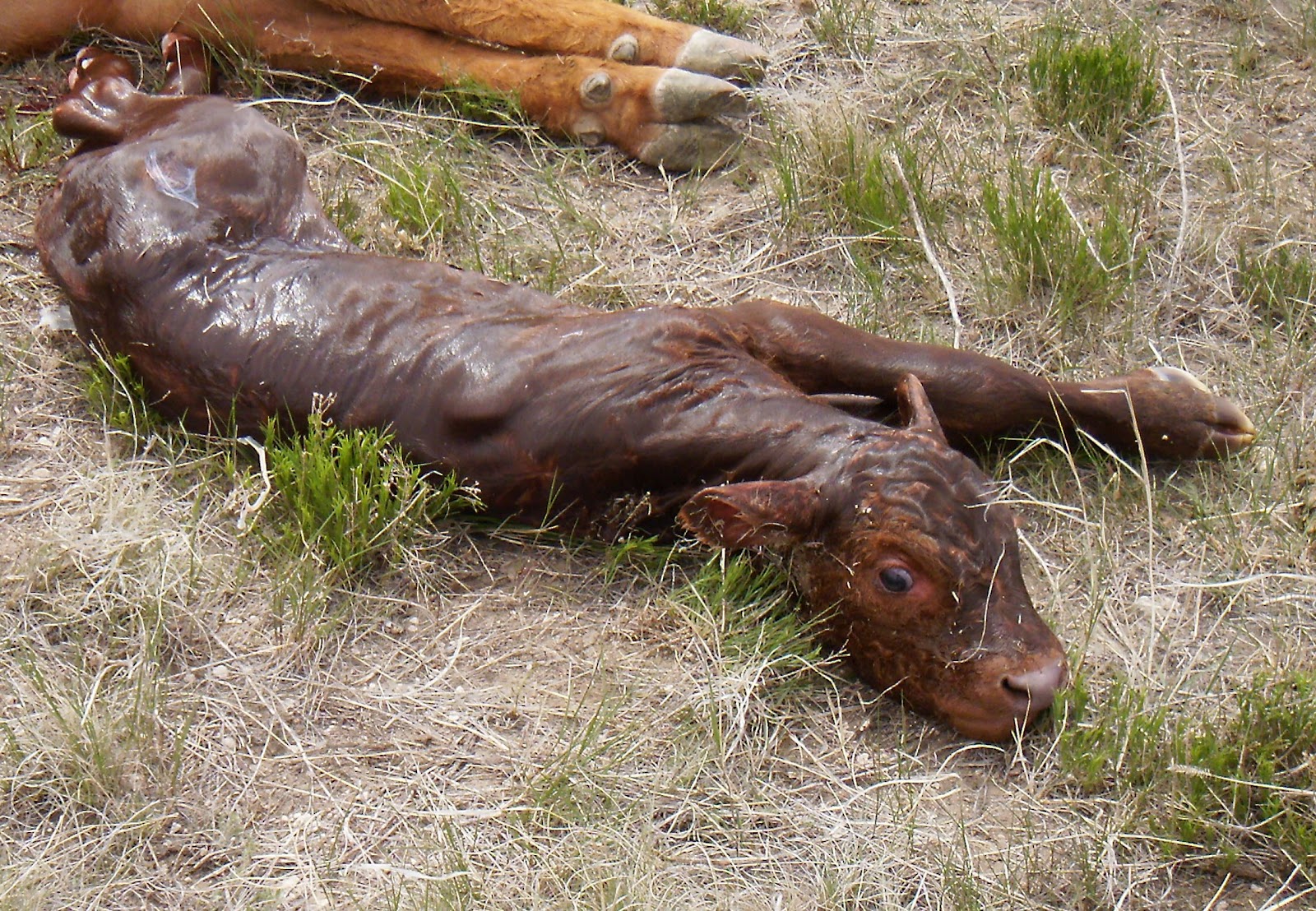 |
| Big Red gets his first view of the world. This newborn, solid red, 130 pound-plus bull-calf was a bit of a surprise. His first-calf heifer mama was exposed to a Lowline Angus bull, so he was expected to be small and black. |
Needless to say, extended parturition digs deep into the
dam’s energy reserves and hard labor, or dystocia, slows both breed-back time
and breed-back conception rates.
 |
| If you look hard, you might see surprise in this first-calf heifer’s eyes as she gets a first look at her new baby. All kidding aside, birthing a big calf is hard on a heifer, which is usually reflected in slow breed-back or low breed-back conception rate. |
We got four big, growthy calves out of the deal so it’s not
as if there’s no up-side, but only time will tell if we’ve spent 12 grand on
good replacement herd cows or on culls.
 |
| If the 16-inch wheel is any guide, the now-dried and day-old bull calf is more than 20 inches at the shoulder. An extremely lively and vibrant calf, he’ll sell well this fall, but that’ll be cold comfort if his mama has breed-back problems. |
This business is an ongoing series of learning experiences.
It always has been, and it always will be. If we learn from our 2012 heifer
calving season, we’ll be ahead of the game. Only time will tell, and in the
mean time, we’ve got much to ponder, plans to make, and management practices to
execute.
Wednesday, May 23, 2012
Counting the cost
In late 1943, as the tide of battle in World War II was
beginning to turn decisively in favor of the Allied Powers, the Big Three
leaders of the Allies – Franklin Roosevelt, Winston Churchill, and Joseph
Stalin – met at Tehran to plan strategies for winning the war. Stalin argued
vociferously for a second front in Europe to relieve pressure on his troops,
who were at the time standing largely alone against the Nazis in the East.
According to David McCullough’s biography of Harry Truman,
when Churchill argued that a premature opening of a second front would cause an
unjustified loss of tens of thousands of Allied soldiers. Stalin replied, “When
one man dies it is a tragedy, when thousands die it’s statistics”
Two years later, at the Potsdam Conference of 1945, Stalin
said directly to Truman, now the American President, “The death of one man is a
tragedy, the death of millions is a statistic.”
This is the reality of war. We can understand and grieve
over the loss of one soldier, or five, or perhaps even a score. But can we
really wrap our minds around the deaths of a hundred, or a thousand, or a
million? I don’t think we can. To paradoxically paraphrase the famous ‘forest
for the trees’ metaphor, we lose sight of the beauty and sanctity of individual
life against the backdrop of a veritable forest of wartime death.
Still, we find that the big numbers are no less important.
It’s the big numbers that we go to war over. We tolerate the occasional combat
loss of one or a dozen or a score of soldiers (The bombing of the USS Cole,
with 17 sailors killed, comes to mind), but larger numbers seem to be a tipping
point. In WWI, the number was 114 when the Lusitania was sunk. In 1941, the
number was 2,896 at Pearl Harbor. In 2001, the number was 2,977.
 |
| Sergeant First Class Kristoffer Domeij was killed in Action in Kandahar Province, Afghanistan, Oct. 25, 2011, on his 14th combat deployment. He left behind a wife and two daughters. |
The big numbers are important. As a nation, there
comes a point when we must fight for our survival. This means war, and war
means many, many thousands of deaths. It’s important that we recognize and memorialize
these numbers, hard as they may be to put into a personally meaningful context.
We do this, not because we can actually grasp the enormity of the cost, but
because we recognize that every single life lost was precious and
irreplaceable, and represented, to the dead soldier, every single thing they
had. Those soldiers died so that we may live to enjoy the fruits of our
Liberty.
Monday is Memorial Day. Though congress made it a three-day
weekend in 1971, Memorial Day is still formally a day to remember those who
fell in the service of our country, and specifically those who fell during time
of war.
Since our country began it’s first war in 1775, one million,
three-hundred-six thousand and twenty-five American soldiers – men and women –
husbands and wives, fathers and mothers, sons and daughters, have fallen in the
service of our country during wartime. In the Revolutionary War, 25,000. In the
War of 1812, 20,000. In the Civil War, 625,000. In WWI, 116,516. In World War
II, 405,399. In the Korean War, 36,516. In Vietnam, 58,209. In the Global War
on Terror, 6,377. In all other military combat action, from the Northwest
Indian war through the Mexican War through the Philippine War through Desert
Storm and through the Yugoslavian Air Campaign, a further 13,008 American
soldiers have fallen. As I write this, the casualty count continues to rise in
Afghanistan.
So those are the big numbers. To borrow again from the
famous metaphor, they represent a big, tragic, hauntingly beautiful forest of
sacrifice. But what of the individual trees?
Even in the depths of our greatest wars, the Civil War and
World War II, fewer than 10 percent of the population took up service and
donned the uniform. Of those, only about one in one-hundred faced real combat.
Today, as we fight the Global War On Terror, fewer than one percent of our
population serves in the military.
I point this out because most of you – perhaps very nearly
all of you – have never served in combat, or know intimately friends or family
members who have done so. Fewer still have suffered the combat death of a
comrade, close friend, or loved one. That very fact lends a powerfully
different perspective to presently popular phrase “the 99 percent.”
Rather than urge you to “think of the fallen” on Monday, I’d
like to offer you a challenge. Sometime this weekend, visit your local cemetery
and look for the grave of a veteran who fell in combat. It’ll take a bit of
walking, but you can do it. Most veterans graves will be marked this weekend
anyway; simply find one whose year of death coincides with wartime. Do the math
and figure out his or her age at death. Then do a little imagining. What could
that person have done with a full life? Would they have married, started a
family? Would they have taken up a trade, or started a business? In the
fullness of time, would they have walked out across the cool, green, springtime
lawn of a cemetery, paused at a grave, and wondered what might have been?
So take up my challenge, or not, as you see fit. I’ll never
know. That’s not the point anyway.
There’s one thing more you can do, but you already know what
it is.
Open winter and below average spring rains could produce drought
Most of the tri-state region falls within the semi-arid
climate type, characterized by short grass or scrub vegetation and annual
precipitation of 400-500mm (7-19 inches). The area south of Kimball, Neb. is
typical. Native vegetation is true shortgrass prairie, not the mixed-grass
prairie of the rest of the Panhandle or the mixed- and tall-grass prairies of
the rest of the state. Annual precipitation in the area has averages, since
1893, 16.8 inches.
In this particular usage, the term average means that half
the time annual precipitation is more than average, and half the time it is
less than average. Some years feature much more rain than average, and we’ve just
experienced a string of above-average rainfall years. Some years feature much
less rain, such as in 2002, when precipitation totaled 4.7 inches for the year.
We’ll talk specifically about native grasslands in this
piece. After all, more than half of the total area of Nebraska is grassland,
and most of it is harvested by cattle. The same holds true for Colorado and
Wyoming.
As of May 22, the Panhandle of Nebraska had received only 52
percent of normal precipitation since January 1, and only 73 percent of normal
precipitation since September 1, 2011.
As a region, the Panhandle of Nebraska and the surrounding
areas of northeast Colorado and southeast Wyoming receive the bulk of their
annual precipitation in the spring and summer, May-September. Thus far the
typical spring rains haven’t materialized, and this raises concerns about a
potential drought.
According to Aaron Berger, University of Nebraska-Lincoln
Extension Educator for Kimball, Banner and Cheyenne Counties, cattle producers
should prepare for drought conditions this year. The combined shortfall of
precipitation since September, coupled with a warm, open winter, have depleted
soil moisture profiles, he said, and forecasters are calling for above normal
temperatures in the coming months.
 |
| Calves scamper in play across the smooth brome of a reintroduced rangeland. This grass will grow little taller unless timely spring rains materialize. |
The prediction for spring and summer precipitation is
presently a wash. Forecasters say that depending on the El Nino pattern’s
effect on the jet stream, our region may receive below-normal, normal, or
above-normal precipitation.
According to Berger, it is prudent for ranchers to plan for
drought conditions, and be prepared to take a number of steps to mitigate the
impact of drought on their operations.
The steps include:
- Delayed livestock turnout to allow maximal grass biomass production before grazing.
- Begin to implement a drought management plan and set conservative stocking rates to protect pasture and rangeland from overgrazing. Stocking rates can be increased if adequate precipitation materializes.
- Identify
cattle which can be culled, fed for slaughter, or moved to better
range/pasture conditions. If timely rains develop, these cattle can be
grazed as usual. If drought becomes established, however, having a
preexisting drought mitigation plan in place will make decision making
much easier when the time comes.
- Begin
to stockpile feed resources which will be needed later in the event of
drought. Contract early to graze cornstalks before drought causes a
frantic rush for feed resources. Consider purchasing wheat straw and/or
corn stover to augment rations and maintain herd body condition.
- Consider
planting dryland forages to augment feed reserves.
- Be
prepared to early-wean calves. Early weaning will significantly reduce cow
nutrient requirements. Properly handled with quality feed, calves can be
weaned at 100 days or sooner.
 |
| A baby antelope peers from his bed in lush green needle grass near Kimball, Neb. in May, 2010. Plentiful spring rains produced a bumper-crop of nutritious grass that spring. |
Bottle calf update - falling into place
After spending a week bottle feeding an orphaned calf,
nature presented us with a solution. A first-calf heifer produced a brand-new
heifer of her own, had plenty of milk, and was in fine body condition.
Orphaned calves will always do better nursing a cow rather
than a bottle, so we had a golden opportunity to get the orphan back on a more
normal diet of cows mama’s milk rather than milk replacer.
There are challenges galore in such a scheme. From the first
moment a cow sniffs, nuzzles, and licks her newborn, its unique smell is
imprinted on the cows brain. The smell of that baby calf is, to the cow, an
ownership mark that identifies her baby far better than any brand, tattoo, or
ear tag. Day or night, wet or dry, cold or hot, pouring down with rain or snow,
mama can identify her calf in any and all weather.
The cow’s instinct is to nurture a single calf. Even when a
cow has twins, the first to be sniffed, licked and nuzzled often becomes “her”
calf, and the second twin becomes other. Sometimes the cow will completely
ignore the second twin, sometimes she will grudgingly accept it, and on
slightly more rare occasions, she will recognize both as her babies.
It’s tough enough trying to match up an orphaned calf with a
cow who’s lost her own calf; it’s even more of a challenge trying to add a calf
to a cow-calf pair. It can be done, but it takes a bit of work and a lot of
cooperation from the cow.
Three days after the first calf was orphaned, 051 had a
pretty little heifer calf of her own. The cow seemed to have lots of milk, and
she was conformationally a remarkably nice cow with an extremely mild
disposition. These three factors were encouraging and led to our attempt to add
the orphan to the new mama’s mix.
After tagging and vaccinating the new arrival I moved them
into the barn with the orphan calf. I dusted each calf liberally with an herbal
concoction which is supposed to make new calves smell attractive to cows. I
doubt it does any good, but neither should it do any harm, and you never know,
someday it just might do the trick.
In her initial confusion, the cow was seemingly curious
about both calves and allowed each to suckle. Both the orphan and his now
step-sister knew just what to do, and I left them that way, nursing contentedly
in the barn.
Things had changed a bit at lunchtime, though, and the new
mama knew with certainty that the heifer calf was her baby and the steer calf
was not. Still, she was only half-hearted about pushing the steer calf away and
would eventually allow him to suckle. Fortunately for the little steer, he was
very persistent. She seemed most pleased when both were nursing at the same
time.
After a few days in the barn and big corral, with both
calves and the cow seemingly satisfied with the arrangement, I turned them out
with the rest of the heifers and their young calves. As I write this, all three
are doing famously.
 |
| A week-old orphan calf nurses from a convenient udder on the EJE Ranch south of Kimball, Neb. |
Of course, the little steer calf isn’t following the script
exactly. He likes his new mama just fine, but seems to see no reason why he
shouldn’t nurse from the nearest and most convenient udder. And so he does. The
first-time mothers all know exactly what he’s doing and that he’s not their own
calf, and most of them push him away now and then, but then they allow him to
nurse for few minutes.
Tell your story, part...
Here’s a topic I’ve discussed many times in this column. In
the face of a strongly biased major media, it’s very hard to over-emphasize the
need for farmers and ranchers to counter the prevailing “green,”
anti-agriculture narrative.
A couple of weeks ago I had the opportunity to tell my story to more
than 100 fifth and sixth graders from the Kimball and Harrisburg elementary
schools. About 15 of the kids were from farming or ranching families; the rest
were town kids. I was asked to talk both about my ranching activities and the
prairie ecosystem. How would you tell 10, 11, and 12 year-olds about your ag
operation? It’s a fun question to think about. Here’s how I did it.
 |
| Members of the Kimball FFA Chapter talk to fifth and sixth graders at the Historic Brookside Farm just north of Kimball, Neb. |
The event was the Kimball-Banner County Farm Bureau’s annual
Ag Day, held at Brookside Farm just
north of Kimball. The farm is listed on the National Register of Historic
Places and is, according to the Nebraska State Historical Society, “a rare, well
preserved collection of buildings and structures which reflect changes in
agriculture from timber claim to twentieth century technology and small scale
farm diversification.”
Ag Day at Brookside Farm begins with a presentation on the
history of agriculture in the U.S. in general and at Brookside farm in
particular. Then the kids break into groups of 10-12 and visit a dozen stations
where local farmers, ranchers, and other ag professionals discuss and
demonstrate specific facets of production agriculture. Topics include local and
regional crop production, agricultural products, farm safety, ecology,
livestock production and animal husbandry, and farm- and rangeland ecosystems.
Other stations include livestock and farm and ranch equipment.
I started off with a mistake you’ll want to try to avoid in
such a situation. I was late. Caring for sick calves, tagging a newborn, and
feeding a bottle calf took longer than I anticipated. It was a good excuse, but
I was still late. I was able to work my explanation for tardiness into my
introductory remarks though.
My topic was rangeland ecosystems. I came armed with grass
and plant specimens freshly collected from the ranch, including warm and cool
season grasses, wildflowers, shrubs, and succulents.
My talk was generalized and designed for youngsters, but I
covered some important topics. Fifth and sixth graders are naturally bright and
curious, however, they’re not very impressed with canned lectures. So I mixed
my explanations of the shortgrass prairie ecosystem with fun facts and thought
provoking questions.
While talking about the differences between grasses and
other plants, I asked each group whether they thought corn and wheat were
grasses or one of the other plant types. Each group had at least a couple of
kids who guessed correctly.
And speaking of the differences between grasses and crops, I
said, if a farmer raises crops, what does a rancher raise? Cattle, of course
was the most common reply. This setup question allowed me to explain that while
I do raise cattle, my real crop is grass, which the cattle harvest and turn
into beef.
While speaking of beef, I was able to talk about the
realities of food production, including the fact that to be consumed for food,
animals have to be slaughtered. Kids are no dummies, and by age 10 they know
that fact. But kids are very quick to pick up on evasive or disingenuous
explanations (more often called fertilizer, more or less), and I think it’s
best to be scrupulously honest when talking about what we do.
Another topic I covered was the enormous size of our country,
3.8 million square miles, and that less than half, about 1.5 million square
miles, is used for farming and ranching. The land area of towns and cities for
all 312 million Americans, at roughly 94,000 square miles, is less than three
percent of the total.
The kids had good guesses about the percentage of ag
producers in the country, somewhere between 1-2 percent. They were bemused to
find that in Nebraska, cattle outnumber people by roughly 6-1.
They were also fascinated by the notion that if every person
in the country was somehow placed in
the Panhandle and distributed evenly, each would have 775 square feet of space.
The kids asked a lot of good questions, a testament to their
curiosity as well as the education they are receiving. It was a beautiful,
calm, sunny day, and all in all a wonderful experience.
Bottle calf
The romance of raising cattle played a large role in my
decision to take up the profession, and I don’t think I’m unique in that. Those
of who choose to raise food animals for a living aren’t in it for the money
alone. If we were, we’d be sorely disappointed. Few of us generate the kind of
income that leads to great wealth. When I need a good laugh, in fact, I try to
calculate my profit on a dollars-per-hour scale. I’m smiling ironically now as
I write those words.
The non-monetary rewards of ranching are just as important
as the cash income. Owning land and livestock allows for a great deal of
independence. We punch no time clocks, arrange our own schedules, and make our
own decisions. With our independence comes the responsibility of conserving our
land and husbanding our livestock. This combination is the epitome of romance
as defined by Webster: “…an emotional attraction belonging to an especially
heroic era, adventure or activity.”
When the weather is beautiful, the grass lush, the cows
contented and the calves at play, it’s hard to imagine any other lifestyle so
brimming with delight and satisfaction. The price of our enjoyment comes at a
cost though. Reality seldom allows our perfect days to last for long.
 |
| An hours-old calf waits patiently, and in vain, for his mother to recover. |
The other morning one of our heifers had a nice little
bull-calf, born into an ideal world of sunshine and gentle breezes, and onto a
bed of burgeoning cool-season grasses. The calf was strong and healthy, and
except for one small detail, the scene was beautiful.
The detail? Unfortunately the new mama cow had suffered a
prolapsed uterus.
The condition is caused by uterine contractions and
straining as the animal attempts to slough off and expel the uterine lining, or
placenta, more commonly known as afterbirth.
A prolapsed uterus in a first-calf heifer opens a veritable
Pandora’s Box of concerns and decisions. The first and most obvious is the need
to call the vet to treat the immediate problem. Uterine prolapse is a
life-threatening condition and is considered an emergency.
The second decision – more properly a string of decisions –
is what to do with the cow.
Cows with a history of prolapse are at greater risk of
future prolapse. They are generally slower to breed back and have lower
conception rates. These facts must be weighed in deciding whether to keep the
cow in the herd or to cull and replace her.
In the case of our heifer, she was a genetically and
conformationally sound cow, ideal for our herd, and so the decision whether to
keep or cull was a bit more complex. We had to consider her strengths, which
were manifest, against our best guess of the likelihood that she would suffer
future conception difficulty or prolapse. The cost of purchasing or developing
a replacement cow had to be weighed as well.
The second decision string could wait, however, until the
prolapse was repaired.
Our vet arrived dressed for the occasion, wearing shorts, a
tee shirt, and sneakers. To the uninitiated, this might seem strange attire,
but repairing a prolapsed uterus is a messy job. On a warm spring day, her
outfit made perfect sense.
After securing the cow on her chest with a halter and rear
leg restraints, the vet administered an epidural anesthetic, thoroughly washed
and disinfected the everted organ, then carefully replaced it and sewed it in
place. After placing an intrauterine bolus of antibiotic, she dosed the cow
with penicillin to ward off infection and ocytocin to help reduce uterine
inflammation. We removed the restraints from the cow and the vet departed. We
left cow and calf laying side by side in the warming morning sun.
The cow was slow to get up, which was understandable given
the circumstances. She still hadn’t arisen by late afternoon, but in such cases
it’s often best to give the animal time to work things out on her own schedule.
Then the reality of nature intervened, and the cow died just
as an evening thunderstorm arrived.
The scene was the antithesis of romantic; a hungry baby calf
curled up at the flank of his now-departed mama, being pelted with stingingly
cold rain in the gloomy light of a stormy and fading day.
I picked up the now-soaking calf and took him to the barn,
where he’d be protected from the weather and nocturnal coyotes, fixed him a
bottle of colostrum mix, and fed him. He was remarkably quick to nurse from the
bottle. As he nursed, I couldn’t help but admire his soundness and energy and
the wonder of his nursing instinct. We’d lost a good cow but saved a nice calf,
and I rather enjoy bottle calves, despite the additional cost and labor they
bring. Losing the cow hurts, but a healthy and enthusiastically nursing calf
eases some of the sting.
Thursday, May 10, 2012
Sensation over substance
In a world where the major media was less a politically
active industry with a goal of reporting objective news, the so-called “pink
slime” story which recently played out across the newspapers of America would
have never made it past the editor’s red pen.
But when it came to reporting on pink slime, as told in
print and across the airwaves and internet, the story was mostly an attack on
red meat, woefully short on facts, rife with distortions, and calculated to
instill a sense of intense unease regarding food safety in the minds of
consumers.
The term pink slime was coined by microbiologist Dr. Gerald
Zirnsteinmay in a 2002 e-mail. It began to gain world-wide traction when
British celebrity chef and food activist Jamie Oliver campaigned against the
product in early 2011.
In March of this year Time magazine reported, “It’s
unhealthy enough to earn a ban from fast-food giants McDonald’s and Taco Bell,
and it’s banned for human consumption in the U.K. But is the notorious “pink
slime” beef good enough for your children, to be served up in their school
lunches?” Such slanted and opinion-loaded phrasing is representative of the way
the rest of the major media reported on the subject.
The major media rarely makes openly false statements in
their reporting, but they do use words and phrases to skillfully project a
certain point of view. Time used the words “ban,” “unhealthy,” and “notorious,”
then raised the specter of poisoning innocent children.
So what’s a food-animal producer to do when faced by such
deceptive and slanted reporting? Fortunately, the story just didn’t have “legs”
with an increasingly media-skeptical public. Still, the best thing a producer
can do is to study the topic, gather facts, and be prepared to respond with
calm objectivity when non-producers ask questions.
Here’s the rundown on pink slime. In the processing industry
it is called Lean, Finely Textured Beef (LFTB). It’s been produced since the
1980’s and is an FDA/USDA approved, nutritious meat product which has been
consumed by countless millions of Americans for more than 20 years with no
record of ill effect. The product is made by placing beef trimmings, which
contain fat and lean meat, into a heated centrifuge, which spins at high speed
and forces most of the fat out, leaving behind the lean meat. The lean meat is
treated with ammonium hydroxide, which lowers the pH of the meat making it an
unsuitable host for bacterial growth. The ammonium hydroxide also changes the
lean meat from a deep red color to a pinkish color. The color change is a
simple chemical process and is essentially the same process which gives many
cured meats a similar hue. Think of corned beef, ham, sausages, etc. As LFTB
recaptures lean beef and adds to the overall beef supply, it also serves to
keep beef prices down for the consumer.
 |
| These beef trimmings are the precursor to Lean, Finely Textured Beef or LFTB. Such trimmings are spun in a heated centrifuge to separate the lean meat from the fat. |
Unfortunately, nearly all major media stories shouted that
the process was taking waste product intended for pet food, adding ammonia, and
forcing it on children through the school lunch program. “Who knows,” to
paraphrase countless major media stories on the subject, “what all this pet
food and ammonia is going to do to the poor children?”
There are a lot of problems with this line of baseless
supposition. It’s hard to know where to begin to deconstruct the narrative. But
let’s start with the pet food.
Some meat products are processed into pet food, including
organ tissue, connective tissue, bone meal, beyond-shelf-life cuts and ground
meat – and before the advent of the centrifuging process – meat trimmings.
Prior to the advent of the LFTB process there was no economical way to recover
the lean meat from trimmings, so much of it went into the pet food stream. But
meat trimmings were never a “waste product.”
Now what about the ammonia? Pure molecular ammonia (NH3),
whether in gas or liquid form, is extremely caustic and very small quantities
can cause burns externally or death if taken internally.
As most of us probably learned in high school science
classes, combining elements and molecules alters the properties of the end
product. Ammonium hydroxide is not pure ammonia. It is a solution of ammonia
and water, and when applied in the concentrations used to produce LFTB, it
merely lowers the pH enough so that bacteria such as E. coli cannot survive in
the food product. Adding water doesn’t simply dilute the ammonia, it changes it
chemically into aqueous ammonia, also known as ammonium hydroxide.
Another meat-curing compound is common table salt, or NaCl,
sodium chloride. Rather than lowering pH, sodium chloride dehydrates meat so
that bacteria cannot survive in or on it. It also adds flavor, and most of us
flavor a wide variety of the food we eat with table salt. French fries, for
instance. But if you poured pure sodium on your fries there would be an
explosion and you might be badly injured. If you attempted to season your fries
with pure chlorine, which is a gas at standard temperatures and pressures, it
would quickly kill you by destroying your lungs and depriving you of the
ability to breathe. In combination, however, salt not only makes your fries
more palatable, it serves your body as a vital electrolyte and is essential to
your continued survival.
The process of curing meat has been going on for longer than
our recorded history. Some curing agents include smoke, which contains many
curing compounds, sugar, sodium nitrite, and potassium chloride.
All processed meat sold commercially in the U.S. must pass
muster with the USDA and FDA. Both the process and product must be tested and
approved and the meat product must clearly carry an inspection stamp or label.
LFTB has been approved and widely consumed for more than 20 years.
Saturday, May 5, 2012
Animal Welfare vs Animal Rights
It’s been a busy week on the EJE Ranch. For the first time
in decades we’ve had a number of calves – about a dozen – suffering from
bacterial scours.
The illness was most likely caused by a pathogenic strain of
E. coli. Escheria coli is a naturally occurring symbiotic intestinal bacteria.
Symbiotic gut bacteria are present in all animal species and are a vital part
of the digestive process. Animals – including cattle and people – which lack
normal intestinal bacteria generally die of malnutrition unless healthy
bacteria are introduced to the gut and are able to flourish.
Occasionally, however, normal intestinal bacteria mutate
into pathogenic strains and cause illness. In the case of pathogenic E. coli,
the bacteria actively attack the lining of the gut causing diarrhea. The
bacteria migrate from the gut throughout the blood stream causing systemic
bacterial toxicity. The diarrhea causes dehydration and the injured gut lining
becomes less efficient in extracting vital nutrients, causing malnutrition.
Unchecked, the illness can lead to death in as little as a day.
Fortunately, the illness can be treated by attacking the
bacteria with antibiotics, which by killing pathogens support the animal's own immune system, and by replacing
fluids, electrolytes, and other nutritional supplements. Anti-inflammatory and
anti-pyretic medications can also be given.
Administering these supportive therapies takes a lot of work
and a lot of time. Each calf is on an individually prescribed
antibiotic regimen. The sick calves need to be hydrated with an electrolyte
solution 4-6 times each day. Two of the most ill are also receiving an
anti-inflammatory/anti-pyretic injection intravenously. The calves are also
generally left in their natural environment rather than in a sick pen. This is
better for the calves, though it means more time, effort, and fuel expended.
Two of the calves were sick enough to be treated at the local vet clinic. Every
aspect of treating sick calves adds expense and erodes profit.
Which brings us to the question I was asked the other day,
and the point of this post.
An acquaintance who happens to be emotionally invested in
the notion of animal rights and food justice asked me why I would spend the
time and effort to succor sick calves when they’re ultimately destined for
slaughter. Though I rarely agree with the reasoning behind this person’s
arguments, the question is a good one and I genuinely appreciate the asking.
In general, most producers would respond with the valid
argument that treating ailing livestock is an investment in profitability. You
can’t sell a dead calf, so you invest in making the animal well with the aim of
ultimately securing a profit on your investment. Livestock producers must remain
profitable, else they become ex-livestock producers.
But there’s another argument, and in my mind a fundamentally more
important one. Most of us genuinely care about the welfare of our animals. When
they are ill we want to make them well. We made a decision when we entered our
profession to husband our livestock – to provide for their needs and to ensure
to the best of our abilities that they live a good life while they are in our
care. To that extent, we are emotionally invested in the well-being of our
animals, though most of us prefer not to describe our feelings in such “mushy”
terms.
On the reasoning, non-emotional side, we recognize the need
for the production of food animals and we are proud to supply our fellow humans around the globe with
safe and nutritious food. We also recognize that if there were no demand for
meat, far fewer food animals would exist. There would likely be no cattle,
swine, sheep, or fowl living in our country except in scattered wild
populations and in zoos. In that light, even though our livestock will eventually
be slaughtered and sold as food, we provide them with an existence they
wouldn’t otherwise have.
Livestock producers believe in and practice animal welfare.
We do so because we’ve objectively weighed the evidence and find that producing
food animals is necessary and proper. We take our obligations to both the
consumer and the animal seriously. We understand that our livestock are not
human beings, and if treated as such they would soon perish.
Those who believe in animal rights equate animals with humans.
As Ingrid Newkirk, founder of PETA famously said, “A rat is a pig is a dog is a
boy.” This is demonstrably an emotional rather than an objectively reasoned
idea.
It is also inconsistent with the actual practices of those who espouse
the ideology. The same folks who argue that every living entity is endowed with
the same fundamental rights as human beings routinely slaughter – at least by
proxy – untold billions of insects, reptiles, amphibians, bacteria, and plants,
simply to feed, clothe and medicate themselves. Surveys consistently show that
while a great many animal rights activists claim to be vegetarian or vegan,
most of them, at least occasionally, consume meat.
There’s nothing wrong, and everything right, with people
holding divergent opinions. This is one of the wonders of humanity
In the
case of animal welfare vs animal rights, one argument is objectively fact-based
while the other is purely emotional. There's a difference. It's wonderful that there's a difference, that humans have both reason and emotion. But to understand the world, it's vital to understand the difference and understand that emotion and reason can and must coexist.
On balance, I believe that those who practice animal welfare
do considerably more good for animals – and for their fellow human beings –
than those who believe in animal rights.
A postscript:
Thus far we’ve treated 12 calves for bacterial scours. One
calf, the first to become ill, died. One other came perilously close to death.
The little black steer calf, number 237, was flat out for
five days, extremely ill and too weak to stand on his own. Over the course of
his treatment he rallied and flagged. In addition to administering his
antibiotic injections, I gave him electrolyte solution and milk replacer six
times daily through a gastric tube. On several occasions he seemed near death.
Ultimately his survival depended on his immune system and on his ability to
maintain energy. My efforts, while vital, were only supportive. Recovery was
up to him.
On May 1, he seemed a bit more alert and energetic. After
giving him his noon electrolytes I lifted him to his feet. At first he wouldn’t
stand, as had been the case for most of his illness. But eventually I was able
to position his feet so that he could stand. He was wobbly and I had to hold
him up for a few minutes. I rubbed his back, gently at first, then more
vigorously, in an effort to simulate maternal attention. I stepped back and
watched him stand for a few more minutes. He wobbled and nearly fell, standing
shakily with head down and ears drooping.
But then he raised his head and looked around. Encouraged, I
stepped toward him, intending to rub his back again. As I approached, he
stepped away. He took several tentative, wobbly steps, but he didn’t go down. I
quickly drove off, located his mama, and pushed her toward her still-standing
calf. As she approached and nuzzled him, he sought her udder and began to
nurse. Gradually – and still weakly – his tail began to twitch, then slowly
gyrate.
As livestock producers, we understand that some of our
animals will die despite our best efforts. This is the reality of life and
death, and it’s no different in the human world.
Wednesday, April 18, 2012
More than winning...
...to borrow a phrase from Tom Osborn
A big part of the rancher’s job is to select the
correct cows and bulls for the breeding herd, and then stay out of the way at
calving time and let nature work as intended. When intervention is needed, it’s
vital to have the skills, knowledge and equipment to assist the cow properly.
Paradoxically, there’s great satisfaction in watching your cows calve naturally
every year, but there’s enormous joy in being able to pull off successful
intervention. It’s a little like snatching victory from the jaws of defeat, to
use a trite sports metaphor. And to use another, less trite and perhaps more
meaningful, it’s more than winning.
By the time we’d gently teased an exhausted 005 heifer into
the calving barn, I’d lost nearly all hope of saving the calf, and was
beginning to wonder whether we’d even save the cow. As she stood there in the
obstetric pen, head secured by the head catch but hanging very low, I mentally
kicked myself. Why had I waited so long?
Her breathing was rapid but very shallow. She stared at a
fixed point on the straw in front of her nose and wouldn’t even follow my boot
tip with her eyes. She seemed to be quietly resigned to her fate.
At the other end things looked even worse. A pair of
enormous hooves protruded from the birth canal, and eight incredibly long
inches of cold, lifeless calf tongue. I began to wonder whether we’d better off
calling the vet right now and getting the heifer into town for a fetotomy – the
procedure which will likely save the cow’s life but leaves the dismembered
corpse of the dead calf scattered across the cold concrete of the veterinary
working pen.
As I felt the sadness and despair rise in my heart my mind
went back over the preceding hours. The heifer started calving at 10:30 when
she expelled her bag of waters. At the same time, her sister heifer 006 was
doing the same thing a few hundred yards away. I watched them both on and off
for about three hours while running back and forth, clearing up a slate of
piddly little chores.
About 1:30 p.m. 006 delivered her first baby, a huge, gray
bull calf. Since the heifers had been exposed to Lowline Angus heifer bulls,
her calf should have been little and black. But a pair of neighbor bulls had
paid the heifers a visit one day last July, and one of them was obviously the
sire. The little 006 heifer had had a hard labor and didn’t get up for almost
an hour. But she did get up and mothered her new baby, so everything was fine
in that part of the EJE world.
 |
| A first-calf heifer with her unexpectedly large calf on the EJE Ranch south of Kimball, Neb. |
On the other hand, 005 was having a harder go of it. Time
and again she would have the front feet of her calf expelled and be right on the
edge of delivering the head. But then she’d stop pushing, get up and sniff
around, then lay back down and start again. After five or six cycles, we
decided to get her in an pull the calf.
Once she was in position and the obstetrical chains were in
place the first part of the pulling went well. With a fairly mild tug the head,
shoulders and chest popped out, and surprising me greatly, the half-delivered
calf began to bawl.
The calf’s bawling was both a relief and a prod. He was
alive, which was great, but he needed to get out of there sooner rather than
later.
Unfortunately, he became hip locked, and after a bit more
pulling the cow lay down on her left side. This put the calf on his left
side, so he was twisted at the hips in the birth canal. After getting him
turned around and with a bit more pulling, he finally slipped out.
He was gigantic, and a bull calf. I released the cow from
the head gate and pulled the calf around so she could see and smell him. She
was obviously interested, but also obviously exhausted.
We left the pair alone for a bit and went and had supper.
After two hours the cow was still down but had shifted around several times and
was half-heartedly licking and nuzzling her new calf. She couldn’t get up yet,
though she tried. She was quite weak and uncoordinated in her rear end and
almost certainly had a bit of birth-trauma nerve damage. The calf needed
nourishment, though, so we milked her out and tubed the calf with it’s first
meal of colostrum, then left the pair for the night.
In the morning they were both up, the calf nursing hungrily
and the cow contentedly licking and nuzzling her new charge. The cow had some
lingering nerve damage from the difficult birth, but she’s been getting better
each day and is almost back to normal as I write this on Monday.
 |
| Three days after a tough delivery, heifer 005 stands placidly chewing her cud in the calving barn on the EJE Ranch south of Kimball, Neb. |
 |
| This big bull calf seems to have survived his tough birthing experience just fine. |
In retrospect, I’d have liked to been quicker in making the
decision to pull the calf. The big front feet were a warning sign, and so was
the difficult birth experienced by her herd-mate 006. Likewise, the oh-so-close
but not quite successful attempts 005 went through should have prompted me to
get her in.
On the other hand, 006 did have a normal, though difficult,
parturition. And a normal, unassisted delivery is best for both cow and calf.
You can also do a lot of harm to both the calf and the cow by forcing things
too soon.
But there’s a point – and it varies in each case – when
assistance becomes necessary to save the calf and keep the cow in the best
shape possible. I’m afraid I delayed too long in this case and got lucky. But I’ll
take lucky. And I’ll file this experience away for future reference.
Practicum offers outstanding training for Wyo-Braska cattlemen
I graduated from the 2007-08 class of the High Plains Ranch
Practicum. I found it to be highly informative and extremely enjoyable. The
class began in June, 2007 and met eight times over the next seven months,
ending in January, 2008. I’ve used knowledge and skills gained during the class
nearly every day on the family ranch south of Kimball, Neb.
Two Ranch Practicum courses will be offered this year. The
central Wyoming course will be based at the Natrona County Extension Office in
Casper, Wyo., with the Scott Ranch Providing field sites.
The southeast Wyoming/western Nebraska course begins and
ends at the Panhandle Research and Extension Center (PHREC) in Scottsbluff and
features six classes at the Sustainable Ag Research and Extension Center
(SAREC) near Lingle, Wyo. For a complete listing of dates and locations visit
the Practicum Web-site at http://hpranchpracticum.com/
The PHREC/SAREC classes begin June 12 and the Casper classes
begin June 19. For complete schedule information visit the Practicum Web-site
and click on the agenda link.
The High Plains Ranch Practicum has been approved by the
Farm Service Agency for meeting the education requirements for borrowers. It
may also be taken for college credit through the Animal Science or Agronomy
Departments at the University of Nebraska-Lincoln or University of Wyoming
The cost of the High Plains Ranch Practicum is $600 for one
person and $900 for two from the same ranch and willing to share materials. All
educational materials, noon meals, and breaks are included. Participants are
responsible for their travel and any lodging expenses.
Application deadline is May 4, 2012. Applications received
after this date will be assessed a $50 fee. To apply, submit a completed form
(downloadable from the Practicum Web-site) and a $300 deposit to Extension
Educator Aaron Berger, 209 E. Third St., Kimball, NE 69145. Enrollment is
limited and applicants will be notified of their status no later than May 18.
Make checks payable to the University of Nebraska-Lincoln. The balance of the
Practicum cost will be due at the first Practicum class. A 50 percent tuition
scholarship is available to current or potential ag producer participants who
complete course requirements. For more information on scholarships visit the
Practicum Web-site or contact Aaron Berger, 308-232-3122 (aberger2@unl.edu), or
Dallas Mount, 307-322-3677 (dmount@uwyo.edu).
The Practicum teaches a systems approach to ranch management,
stressing three key tools: Unit Cost of Production Analysis, Grazing Plan, and
a Balanced Scorecard approach to Business Planning.
Participants will have the opportunity to develop:
- Individualized unit cost of production
- Grazing strategies and systems
- Methods of managing risk
- Evaluate calving and weaning dates
- Livestock nutrition and cow body condition scoring
- Family business and working relationships
- Understanding Range and Forage Resources
 | ||
| Rangeland Ecologist Pat Reece (center, kneeling) discusses plant species inventory as part of range condition grading at Bead Mountain Ranch south of Gering, Neb. During the 2007-08 High Plains Ranch Practicum. |
 |
| The High Plains Ranch Practicum class scores cow body condition at the Sustainable Agriculture Research and Extension Center (SAREC) near Lingle, Wyo. in 2007. The course is jointly sponsored by the Universities of Nebraska and Wyoming. |
Thursday, April 5, 2012
Adventures
As the grass greens up across the EJE ranch (despite a lack
of March precipitation) and the calves begin to hit the ground in increasing
daily numbers, so begin the annual set of adventures associated with calving.
As short-sighted as I tend to be, living mostly in the
moment and only rarely opening my thoughts and perspective to the future (and
very occasionally to the past), I often find myself thinking, at least while
it’s going on, that calving season is the best time of the year.
In many ways it is. Springtime rebirth across the shortgrass
prairie. Grasses and forbs are greening after their long winter nap, shooting
up luxurious new growth and racing to flower and pollinate. New calves are
being born, but so are new deer and antelope and coyotes, and 13-lined ground
squirrels and all manner of mammalian, avian, reptile and insect life. The air
is filled with the scent of warm earth, manure, growing plants and pollen;
filled also with the song of the Meadowlark, the rustling (or howling) of the
breeze (gale), scurrying footsteps from tiny to large, and the booming and
whirring as flocks of tiny prairie birds take to the air. Lord, it’s a
wonderful time.
I took my Border Collie puppy (though at eight-and-a-half
months, she’s nearly full-grown) Nona out to check cows the other day. She was
her usual curious self as we began, looking closely at the cattle and clearly
intent on herding them if she got the chance.
But checking cows during calving time is different than at
other times of the year. Each cow needs a close inspection, so there’s a lot
more driving, turning, and jouncing over rough terrain than usual. Soon Nona
had quieted considerably and retired to the back seat of the pickup. Intent on
my task, I paid her little attention.
Until she vomited, that is. Poor Nona had become miserably
car-sick. I stopped and let her out and kept an eye on her while I cleaned up
the mess. She seemed to be pretty dizzy and wobbly for a few minutes, but was
soon back to her normal form, both ready to play and ready to herd some cows.
I’d finished with the cow-checking and was ready to head
home, but Nona was reluctant to get back into the pickup. She’s formed a
negative association with the vehicle which we’re both struggling with. But
we’ll get it figured out.
The next day one of the mature cows had a nice, healthy
heifer calf. Cow and calf were doing well and the calf had been up and nursed
when I found them. But for some reason, there was another cow in attendance,
trying desperately to mother the new calf. She was irritating the new mama and
confusing the calf a bit, but as she has yet to have her own calf and has no
milk yet, the calf soon knew for sure who her real mama was.
This is a somewhat unusual situation but far from unheard
of, and speaks to the flood of hormones coursing through a cows system as she
nears parturition. The hormones were probably telling the interloper that she
should have a baby on the ground and care for it. She’ll bear close watching
but the problem will almost certainly be solved once she finally has her own
calf – soon, hopefully.
As I got out to tag and vaccinate the new calf both cows
acted quite concerned, as do nearly all new mamas. The calf bawled when I gave
her the vaccination, and the non-mama stuck her face against my chest, sniffed
mightily, and then casually flipped me away from the calf.
I tend to forget, or at least disregard, how very strong a
1,200 lb. cow can be. Her simple toss of the head flipped me completely over
and landed me in an undignified heap about 10 feet away. I was irritated at
being interrupted more than anything, and not injured in the slightest. I
walked back to check the calf for horn buds and both cows backed off, still
eyeing me closely. Just another calving-time adventure.
The calving pasture for the mature cows is a very nice place
for cows to give birth. It’s two miles long and features plenty of hills and
dales for shelter. Cows, who like to isolate themselves from the herd when
their calving time is near, have little trouble locating a nice, quiet, private
spot.
 |
| EJE cows like to calve in this secluded spot, making calving-time an adventure for the Segundo. |
A downside to the pasture is that it is cut in numerous
places by north-south gullies, cuts, and draws. As I found to my chagrin last
year, after only a moment’s inattention you can find your pickup seriously
stuck. Last spring as I was driving along what I was pretty sure was a safe
route, eyeballing a group of cows on a distant ridge, my pickup suddenly
slammed over the edge of a four foot-wide, four foot-deep cut. Needless to say,
it took a lot of walking, a lot of explaining, and an assist from the tractor
to pull the pickup out.
 |
| Trust me, this is the wrong place to take your pickup while checking cows on the EJE Ranch. |
Another downside, at least for me, is that several cows
always pick the bottoms of gullies for their calving spot, usually in areas
filled with boulders and choked with yucca. And where a close pickup approach
is 50 yards – mostly down a steep slope.
So I’ve done a lot pf climbing and scrabbling and chasing
this spring, and come to prickly grief in yucca patches more than once.
Subscribe to:
Posts (Atom)