Monday, October 21, 2019

Corpsman Chronicles XXVI: The Battle of Blogger Dank


Once upon a time in the west (several meanings of west here) I had an interesting conversation about World War One naval battles. The title of this post is obviously a play on words regarding the name of one of those battles, the Battle of Dogger Bank, though as I recall the conversation revolved specifically around the Battle of Jutland. But perhaps you see what I did and why.

##########

First the strenger Vortrag, or argumentum ad intellectum pertinens poneretur. You needn't peruse the lecture; you may safely skip down to the next row of octotherps (crosshatches). No I will not call them by that other name.

Only at your peril may you trust the message of any particular human making authoritative pronouncements. Particularly if they throw out a bunch of high-sounding foreign phrases or big scientifical-sounding words. Do not trust the message on the strength of your perception of the speaker's authority or expertise!

"Well of course," the generic reader might say. "Common sense. I never do that."

Yet the majority of first-world humans do exactly that, almost all the time.

If you dig into the literature and carefully read sound, science-based papers on human behavior, you'll find that the evidence shows most first-world humans are convinced they are smart enough to assess the validity of a verbal pronouncement based solely on the base pronouncement and without assessing the actual evidence backing the argument.

All humans who are not fundamentally cognitively flawed have an enormous capacity to be smart. Almost all first-world humans spend almost all of their thinking time in the mode of the good subjects of the naked emperor.

None of this makes first-world humans bad. Nevertheless, most first-world humans have trained themselves to -- when it comes to thinking (and to steal a phrase from the greatest president of all time) -- behave stupidly.

In the first world, where two or more millennia of Western thought provide the basis for civilization, the burden of maintaining society falls directly upon the individual. Today most first-worlders believe this not at all. "I am so small and civilization is so large..." To modern thought the proposition seems absurdly paradoxical. Nevertheless, the alternative is a state of being which is fundamentally and profoundly paradoxical.

How to fix the world then? To put it bluntly and in good old sailor talk, fuck the world. Unfuck yourself before you fix the world. That's the only way you can understand the problem and formulate a strategy which is helpful rather than harmful.

It's a lot of work though. And we first-worlders really aren't into that whole work thing.

Now why would anyone trust this argument?

##########

On with the show.

Summer of 1986. And into the fall of 1986. USS Boat and the Boat Battlegroup had ventured across the pond to firetruck with the Soviets in a NATO exercise called Northern Wedding. It was kind of a big deal, and from my perspective I was getting full measure of that sailor stuff I so enjoyed.

Before the deployment had even really begun, I drew a medevac which I wrote about previously.

##########

Northern Wedding was a great deal of fun as far as I was concerned. It was also a great deal of work. I did a lot of flying and got to learn and practice more ASW than I'd done in the previous six years combined. I continued to work mostly nights on the roof, and it was sometimes quite unpleasant up there what with steaming around north of the Arctic Circle. It seemed I was always either in a wet suit for flyin' or foul weather gear for roof-rattin'. The pace of operations kept most of the crew busy as hell, and that's the kind of busy that can really blow the cobs out. It was great.

Now the thing that prompted this edition of a self-indulgent trip down memory lane is that when I checked over at Sarge's place the other day, there was a big, beautiful picture of SMS Seydlitz, just beat to shit and in some peril of sinking at the pier following the Battle of Jutland 103 years ago (can that be right?).
Source: Sarge's Place.

The image snapped me instantly back to Northern Wedding and the port of Wilhelmshaven, which was then located in West Germany. I understand they've since relocated the place and I've no idea what country it's parked in these days. Anyway, I stood on that very pier away back in 1986, and believe it or not, looking at that very image.

##########

Before I get to that, let me do this.

I flew another medevac on the first or second day of the exercise. I remember exactly zero details of the patient I transported or of his malady or injury. Given that fact I suppose it was relatively minor, though I'm sure it was a big deal to the patient. Anyway, I offloaded said patient at the Royal Norwegian Air Force Base at Stavanger.
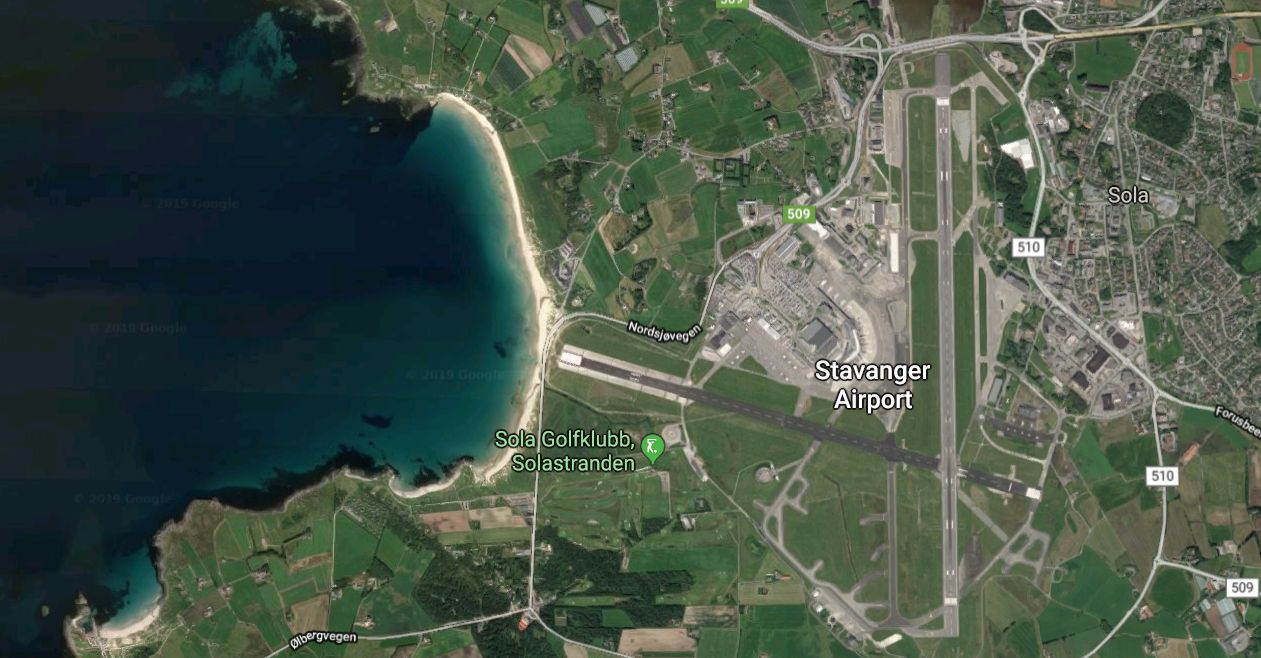
Even then it was a joint-use facility, a fighter/recon/maritime patrol base which also hosted rotating NATO air assets (99.9 percent U.S. and U.K.), as well as a modern civilian international(ish) airport. And mostly because Norway, RNAFB Stavanger was actually located at Sola, 10-15 miles from Stavanger. Foreigners. Hmmph.


No, actually I jest. It was only a curiosity in the Land Where No One Is Named Quisling Evermore, and it didn't matter where we deposited the medevac patient, so long as it was the "right" place. And it must have been that place because to the best of my recollection I never got rang up for misplacing the fellow.

However I do remember that the weather, which was a little not so bad when we launched in the early evening, was absolute dogshit by the time we landed. It was such a howling gale they stuffed us in a hangar rather than risk losing a dozen ramp rats trying to tie the big Sea King down on the transient line. Which meant we'd have to RON!


The next morning we hit the Norwegian Officers Mess for breakfast. As far as they knew we were five Flaggoffiserer, or at least a handful of korporaler. No one was about to care anyway, we were just another bunch of branbill-ing amerikanerne. Breakfast was a buffet, and there were platters heaped high with fried eggs and toasted black bread. And herring prepared at least 31 ways, including a tasty fermented concoction with onions, mint, and sjokoladebiter. It was really quite a good breakfast. For certain values of good. And certain values of breakfast.

There was a big crowd and only a single fellow taking money at a cash register, so there was a line. I went off to hit the head and when I returned the rest of the crew had made it past the money taker. When it was my turn I reached deep into my flight suit chest pocket for some of the dollars I'd turned into Kroner the night before. The kassaapparat gnome didn't speak American and I didn't habla Norsk, so I just held out a fistful of shiny coins. He pulled out several, then quickly cast a shifty-eyed glance around before pulling out several more of the biggest, shiniest ones.

Later when I asked the other guys what they'd paid for breakfast they weren't sure but shared similar observations. None of us spoke the language or knew how the money worked, so we had no idea how much we'd spent. When we got back to the ship we did some counting, adding, subtracting, and checking with both mom and a math teacher. All together the five of us had paid about $190 for breakfast. We were pissed of course but you had to see the humor in getting screwed by a major (ahem) NATO medsammensvoren for a pile of stinky fish and cold fried eggs. It's not just a job, it's an Adventure!

I hope that wasn't too much goggleNorsk and that you understand I'm being kaustisk og ironisk. The Norwegians were in fact very valuable partners. In my personal experience though, they tended to be, from my 1986 American perspective, insular, standoffish, and cranky. Obviously I didn't meet every single one. No doubt there were a great many who were just rude. The girls were quite Scandinavian though, so there's that.

The Norwegians I know and love today tell me that if I think they're bad, I should check out the Finns. I actually treasure the Finns I know, which probably speaks to the nature and depth of my pathology. YMMV.

##########

Okay, back to Wilhelmshaven. We'd been operating hard. I was in that exhausted state where I kept saying "bring it on" but also kept tripping over knee-knockers and bumping my head. The world had gone as chewy as saltwater taffy. I existed in the moment and cherished each moment, including our night check Flight Deck Battle Dressing Station (FDBDS) ceremony of consuming a single warm beer at the beginning of our watch.

Wait, what?

It was actually Egyptian Coca-Cola. Which should inform the reader of how goofy-tired we all were.

Anyway, we pulled into Wilhelmshaven, anchoring out as was always the case.


To my pleasure, I drew Beach Guard for the duration of the port visit.


As far as I was concerned, Beach Guard was a treasure, one of the few gold-plated really good deals provided by an unsuspecting navy.

Beach Guard duty meant being a member of the Beach Detachment (Beach Det) which was the formal and administrative presence of the command ashore whenever the ship was in a foreign port. The Beach Det was always housed in a structure (sometimes temporary) hard by Fleet Landing, which was the place where the Carrier's liberty boats disgorged and retrieved the crew going ashore for liberty.

At the Beach Det "shack" there was always a crew on duty, 24/7. There was a Beach Det Officer, who was essentially the OOD or Officer of the Deck/Day ashore. There was a Petty Officer of the Watch, usually a First Class/E-6, and a watch section consisting of (usually) an E-4 or Third Class Petty Officer and a couple of E-3's, who were variously Seamen, Enginemen, or Airmen, depending on whether their rating was Deck, Engineering, or Aviation. The shack always had tables and chairs, a radio for comms with the ship, several big-assed coffee pots and a half-dozen 30 pound cans of coffee, a bunch of stokes stretchers and folding liters, bales of gray wool blankets, and a great big cruise box of medical equipment and supplies.

At Wilhelmshaven the Beach Det shack was located in what appeared to me to be a temporary (perhaps WWII-built) frame structure. It was a single story and set back from the water only a few dozen yards to the south-southwest of fleet landing.
Red circles are Beach Det shack left and fleet landing right. The frigate wasn't there in '86, but there was a Can parked a bit farther to the left.

I thought the building likely to have been an administrative office at one time. It featured three entrance doors, each with a small concrete stoop or porch; each door opened on to a large front room with two smaller rooms and a head in back. The three sets of rooms were each isolated from the others -- there were no connecting doors or passageways. Beach Det had the run of the building and set up in the center section. The section farthest from fleet landing was used for Shore Patrol mustering and other SP business. The section nearest fleet landing was reserved for medical and napping. Believe it or not, some of the Beach Det sailors got tired during their marathon eight-hour watches. I tended to spend my watches mainly in the center section with everyone else and the coffee. I had no desire to isolate myself in aseptic splendor and had no need to hang out with the medical gear unless there was a patient involved who required my attention.
The Beach Det Shack as it looks today(ish). They've changed it a bit but it's really as I remember, except for the wheelchair ramp or whatever it is on the right.

The Beach Det roster also always included a couple of MDR's, or Medical Department Representatives. The MDR's were usually experienced corpsmen with demonstrated medical skills as well as demonstrated ability to think on their feet, make sound decisions, and work well with both the ship's command structure and foreign authorities. It's actually a somewhat rare skill set in many medical departments, in part because medical tends to be somewhat cloistered and specialized and just a little bit separate from the rest of the command's divisions and departments. Also, the tooth-to-tail ratio in medical resembles the Army's tooth-to-tail ratio. In the Army, relatively few shooters or infantry (teeth) are backed up by relatively very many support personnel (tail). In medical, very few people do hands-on patient care stuff; these are supported by very many techs, clerks, and fetchers. Not everyone in medical had the qualifications, and this is why there were seldom (never in my experience) more than two corpsmen assigned to Beach Guard.

In general, a carrier's Beach Det was massive, because the entire group, from the Beach Det Officers down to the most junior slick-sleeves, rotated in eight hour watches. Rather than rotate back and forth from the boat, the entire party was almost always housed in a hotel, which was usually but not always located close to Fleet Landing. If the hotel wasn't within easy walking distance, vehicles would be rented and drivers would be added to the Beach Det roster. Beach Det could be rather a large circus. While all those dozens of sailors rotated watches, usually standing only one watch per day and with at least one day in three entirely free during any particular port visit, the corpsmen were port and starboard, 24 hours on and 24 hours off. Which was great, because if you do the math, that's every other day off, baby!

You might wonder why all the fuss about a presence ashore, and it's simply this. The boat is out there, swinging on the hook. Many of the crew are here, in a foreign port. When things happen ashore involving the ship's personnel -- good or bad -- there must be someone available ashore who can immediately represent the command in a face-to-face setting. It's really pretty darned important, though I tended to view my part exclusively through the lens of "good deal for me-me-ME."

And speaking of ME, what's all this description and setting the stage shit? This is all about ME, innit?

As the senior MDR (and dickhead) I got to pick which days I was on and which days I was off. Well, more precisely, I got to pick whether I stood duty the first day or not, and everything flowed from that. We'd be in Wilhelmshaven for eight days. If I picked day one, I'd work 1,3,5, and 7. The other guy would catch 2, 4, 6. and 8. The first and last days would be shorter than the rest, with the day one duty commencing usually not earlier than late morning and day eight duty ending usually not much after midnight. So it was pretty much a wash. The deciding factor was that it seemed like the most interesting stuff happened on the first day, and I had a desire to be present when serious medical stuff was most likely to go down. I always felt like I was the most qualified and had the best ability to handle serious medical shit. Whether it was true or not, that's how I saw it and I picked my watches accordingly. Though I never let an inflamed sense of duty keep me from charging headlong into liberty on my days "off!" Anyway, I picked "on" for day one (and therefore three, five, and seven, just to beat a dead horse).

So day one was cool. As usual, a few intoxicated, semi-conscious, and vomit-covered amateur sailors were being returned to fleet landing within 90 minutes of arrival. Things got more interesting after the sun went down, but not too interesting. There were a lot of inebriated sailors flowing back to the boat, but they were almost exclusively happy drunks who'd had a grand time of liberty. As I recall the overnight was really quite boring.

As the sun came up I was sleepy as hell and doing touch-n-goes over my forty-leventh cup of coffee. I got up and announced an excursion to stretch my legs. Outside I turned right and began to walk briskly down the roadway fronting the pier. The third building I came to, on my right as I walked, was a larger two-story building which had a neat sign in front that said something in German which made me think it might be a museum.
The building in question is now a parking lot (red circle to the left). The small building to the far right with a red circle on it is the Beach Det shack.

I walked over to check but the door was locked. Well, it was early in the morning. I cupped my hands to a window glass and peered inside. What I saw looked very much like it could be the displays of a German Navy museum. There were some ensigns, pennants, and lots of navalish pictures hanging on the walls. I resolved to come back later when the museum was open. When that would be I had no idea, and I didn't see anything like an hours of operation sign, either on the front door or on the big sign out front. I was sure I could ask around and find out. Probably.

I continued my walk until I reached the locks that allowed passage into the inner basin of the naval harbor, then turned and retraced my steps. This time I paid more attention to the German destroyer, now on my right, parked at the pier just down from the Beach Det shack. It was a sleek looking vessel, in an odd shade of gray to my eye, with gun mounts fore and aft, what I took to be torpedo tubes amidships, and something that might be a missile launcher aft.
Locks to the left, large red circle. Smaller red circles along the pier are, from left to right, location of the destroyer, museum building, Beach Det shack.

As I came abreast of the destroyer's deckhouse I noticed a German officer standing out on the bridge wing looking at me. He waved, and I fired off a snappy salute. I was in uniform after all. Dress Blues and looking firetrucking sharp if I say so myself. The fellow returned my salute and I continued on my way.

At 0800 I was properly relieved, so I made my way to the hotel and crashed. In the evening I went out walking and took in some sights.


I ran into some squadron buddies and we hit a likely looking restaurant for dinner. Inside I met and was smitten by a gorgeous waitress and secured a tour guide/dinner date for two evenings hence. This served to reinforce to my fellow squadron members the fact that Doc was something of a superman and an international player par excellence. Well and good, but I'd actually surprised the hell out of myself.

I'll touch on that experience another time. The hour grows late and I want to send this to scheduling and hit the rack. And I haven't even approached the whole Seydlitz story! But here we go.

The next morning after relieving my fellow Beach Guard corpsman the Bundesmarine equivalent of the Naval Base's Command Duty Officer stopped by while making his morning rounds. I wasn't paying much attention as he exchanged pleasantries with the duty officer. That was officer shit and had nothing to do with me. However, the two naval officers, one American and the other German, stepped over to where I was busy reading my partner's overnight notes in the logbook. I glanced up, then shot to my feet.

"Petty Officer Evertson is our Beach Det Corpsman," he said to the German officer, before turning to me. "This is Fregatten-Kapitan (some German-sounding name), Doc."

"Pleased to meet you, Sir," I said as we shook hands.

He smiled warmly and asked if I was interested in a tour of the base's naval museum. His English was accented but he was easy to understand. The penny dropped.

"Ah, yesterday morning!" I said. We had exchanged salutes. "Yes, I'd very much like to visit your museum. When does it open?"

As it turned out, the museum was open only by appointment, but the Fregatten-Kapitan had some time to spare and would be pleased to give me a tour. I was genuinely honored and took him up on the offer.

"Just three buildings down on the right, Lieutenant," I said.

"I'll send a runner if we need you, Doc," he said. "Enjoy!"

I had assumed the Fregatten-Kapitan was a, well, Captain-Kapitan, or equivalent to an O-6. He was actually, however, nobbut a lowly Hinge, or Lieutenant Commander/O-4. He gave me a hell of a tour though, including the part when he lifted a framed picture off the bulkhead, image identical or very closely related to the image of SMS Seydlitz above, and walked me and the heavy picture out onto the pier to show me exactly where the ship had tied up after Jutland way back in 1916. At that time 1916 was a mere 70 years in the past.
Red circle marks the spot where Seydlitz tied up in 1916 and where a German Navy Hinge and I stood 70 years later. The other red circles are, from left to right, site of the former museum building, Beach Det shack, fleet landing.

One thing I found very odd at the time was that there was exactly zero information or displays in the museum regarding WWII. I'm afraid I pestered the poor Fregatten-Kapitan on the subject, which may be why he pulled the picture off the wall and dragged me out on the pier -- to shut me up! I had no idea at the time how denazification had shaped post-war Germany, and I could be pretty tone deaf in my curiosity.

So that's pretty much it for this part of the story of my visit to Bill's Towne, but I should share the story of the beautiful German girl with you kind readers. I'll do that in the near future.

If I don't get abducted by aliens.


Sunday, October 20, 2019

Corpsman Chronicles XXV: Why helos don't have ejection seats


It was 1982. Reagan was president and in the Navy the money was flowing in like the sea through a 16-inch shell hole below the waterline. At Naval Air Stations around the globe Helo Bubbas were working up Combat Search and Rescue (C-SAR) procedures at a feverish pace.

The failed hostage rescue mission in Iran had cast a broad shadow.


The heavies in Warshington didn't want untrained U.S. forces making more stupid mistakes.


The word came down to train and train hard. Money was no object. In my neck of the woods at NAS Oceana we got more helos, more crews, and more maintainers. Flight hours doubled, doubled again, then doubled again. Machine gun mounts came out of storage and old, fat, veet-nam guys appeared to show us how to mount them. Armor kits came out of storage and were bolted on. M-2 and M-60 machine guns appeared and all the aviators -- including the drivers and even some of the girls -- learned the care and feeding of .50 and .30 caliber machine guns. As you might imagine, the Sea Kings could be real pigs when full of gas and loaded down with armor, guns, and a shitload of ammo. At least in comparison to the way they flew in bare-bones SAR mode, when as stripped down Golf models they were pretty sprightly. But if the mission became real world C-SAR, you were taking a pig to the dance so you'd better be able to dance with her.

We started flying with sidearms on dedicated C-SAR hops and some of us flew armed all the time. It seemed to me a prudent habit to develop. The issue piece was the Smith & Wesson Model 59, a double action/single action (DA/SA) automatic pistol chambered in 9 millimeter and featuring a double stack magazine with a 14 round capacity. We added rifles to the mix as well in the form of a couple of M-16-A1's, each with a pair of cloth bandoleers of 20 round magazines. Some of our scenarios included putting a pair of crewmen on the ground to search for and locate the rescuee, and they needed more firepower than a pistol in such situations. We shot thousands and thousands of live rounds.

It was great fun. There were a lot of moments when we'd look at each other, faces split in enormous grins, and channel Flounder from Animal House.


One day we flew a C-SAR profile which we called a snatch. The idea was that an aviator was down in dense tree cover ("triple canopy jungle" as we described it) with bad guys closing in. Our training site was the Navy Dare complex near Manteo in North Carolina. It was a live fire range so we could blaze away.

To rescue the survivor we'd zip in at low altitude, hover over the survivor's smoke while blazing away with an M-60 aft and an M-2 forward, send the jungle penetrator down, haul up the survivor, then haul ass. Of course we couldn't have a real live human on the ground, not with a bunch of half-trained monkeys on the guns, so the penetrator was pre-weighted with 170 pounds of sandbags. We'd fly over the site, toss out a smoke, then make an orbit and come in hot and do our thing. Did I mention this stuff was fun?

As we came hard into the hover with lots of flare and g on the airframe the tail rotor departed the aircraft and the helo immediately began to spin violently. There was exactly one option for survival and that was to dump the collective and put it down immediately. Which is exactly what the HAC did. Straight down through the 40-foot trees. We hit the ground no more than five seconds after losing the tail rotor.

It was an incredibly violent experience. We three in the back were on gunner's belts but we bounced around like rocks in a blender. When all violent motion had ceased and the rain of rotor blades and tree limbs had abated we all unassed and met about 50 yards in front of the nose of the helo. Of what used to be a helo but was now a smoking wreck. All five of us were absolutely beat to shit, but the broken nose I'd collected was the worst injury.

When the range crew showed up to look at the bodies they expected to find they instead found us smoking cigarettes and laughing uproariously. I can't begin to describe how funny everything was at that moment. It was less funny at medical two hours later when the mishap investigation began, and even less funny when the adrenaline wore off and our bodies reminded us of the beating we'd taken.

As things turned out the cause was mechanical rather than human. The investigation was brief and the findings straightforward. We were all back on the flight schedule within a week or two, and we had a replacement helo on station sooner than that.

Now what does any of this have to do with ejection seats?

Well, the following video is quite interesting. One of the reasons the concept was never fielded is that most of the time when helos crash they're already out of the envelope for the system as described. It's usually better and more survivable just to ride the pig in and see if you can limp (or swim) away.

It's a pretty cool video though.

Saturday, October 19, 2019

It got late early


So here's a placeholder. I should have a more better post up later this morning. Unless I get kidnapped by aliens again.

Australian Rock. Turn it up!


Friday, October 18, 2019

More work


It was remarkably warm, still and beautiful here today. These October days are a delight.


I took advantage of the nice-nice to do some work-work.


Fence work, stock tank work, well maintenance work.


Late this afternoon I was just about out of juice but had enough left to shift 120 twenty-foot joints of 1.5 inch water well pipe.


That tuckered me out.


Now that I've established an excuse...


This will be an exceedingly short post.


With a few pictures.


And not a lot else.


Except road killed pork-queue-pines.


It just don't get no more lame.


Thursday, October 17, 2019

Corpsman Chronicles XXIV: Beer and circuses


It was early September, 1982. It was a Friday, and in Virginia Beach the weather was just gorgeous. It was warm and balmy and humid, but the oppressive heat of summer had taken a few days off. For the moment it was simply a wonderful day to enjoy existing. In only a few days I'd be off on deployment.

On this Friday I had the duty at NAS Oceana's Branch Medical Clinic. I was just one of the duty section, somewhere in the middle of the stack rank-wise. Having decided to straighten up and fly right I was an E-4 and had just learned that I'd made the cut for promotion to E-5. I'd be frocked a day or two before we hit the boat.

The Chief of the Day was an HM1 named something like Smart, only different, and who, IIRC, had just made the cut for Chief Petty Officer. He was therefore in possession of a special log book, called a charge book, which was chained to his body, and on this day he was pulling a little wooden toy duck around on a string. In those days it was called CPO Initiation. As I understand it, CPO Initiation was found to be murder-death-kill at some point and therefore is no more. Which is fine, I suppose, seeing how I'm no longer in charge of the entire navy. Butt I digress.

BTW, HM1's unofficial super not-so-secret call sign (which would be a nickname anywhere but on a Naval Air Station) was "Notso."

Ahem. Back to the facts, ma'am.

This duty section was loaded with medical skill and talent. We actually had three Aircrewmen/Paramedics. Jim was senior and had just made E-6. Which was a bit of a waste in a way because he'd be off in a few days to AOCS. In a couple of years time he'd be flying Intruders. The junior Aircrewman/Paramedic was an E-3 who had just made E-4 and was an Aircrewgirl, though the proper name for the position remained Aircrewman. Her call sign was High-Beams, and there's a reason for that which I won't detail. It wasn't anything bad, but, well, stuff. And there was me.

High-Beams had only just bagged her Paramedic certification. As Jim had done with me, I'd rather taken her under my wing and she'd proved to be a crackerjack. She was so way better than me that it's hard to describe. Much smarter, less apt to brute force problems, much more open minded and with a lot more situational awareness.

The Flight Surgeon on duty was an O-3 Lieutenant called "Blinky". He was a tall, thin drink of water in spectacles which magnified his eyes a great deal, to the point where most people noticed that he seldom, if ever, blinked. It freaked some people out. He was sharp though and a very good Flight Surgeon. I liked him a great deal, and I was always pleased when he was the duty doc.

The only other guy I remember from this particular duty section was a fellow with a Hispanic-sounding name. He claimed to be 100 percent Chicagorican and got really irate when the clinic nurses tried to assign him as the clinic's Spanish translator. "I ain't a Mexican, Lieutenant, and I don't speak Mexican!" His "polite-company" call sign was Super Mex (shortened to Super, of course. Or was it shortened to Mex? I fergit.). When it was just beers and friends he answered to Belly, which was short for Pepper Belly. Remember, it was 1982. The world wasn't completely awash in psychotic NPC's. No, seriously! It wasn't. Belly was an FMF Corpsman and was on orders as well. He'd soon be heading South to join 1/8 at Camp Lejeune.

Other then the people I've mentioned, two events stand out in my mind from that Friday night. The first one was chow.

Some folks brought their own chow from home. Notso, for instance, usually brought a kid's lunchbox stuffed with sammiches and ding-dongs. Occasionally people would throw coins in the gedunk machines back in the staff lounge. Sammiches, chips, canned soup and pasta, microwave popcorn, candy, soda pop, etc. It wasn't all that horrible, and believe it or not, those gedunk machines were my first introduction to the physical and gustatory reality of the bagel ("what the fuck is wrong with this doughnut?"). Very rarely someone with a chow pass would actually venture over to the Galley. Quite often we'd all pick a place close by and send someone with a list and cash to buy chow. BK or Wendy's, Taco Bell, KFC, etc. Other times we'd call for delivery. White Lotus was fantastic but took a looooooooooooooong time. Worth the wait though. There were also local Mom & Pop sub shops that delivered, and of course the perennial favorite, Dominoes.


This night it was Dominoes. I remember being very hungry and so very pleased when the pizza arrived. I believe Jim and I each ordered a large pizza (leftovers for breakfast), and I rather imagine I ordered pepperoni and mushrooms. Pretty sure that's the only thing I've ever ordered from Dominoes. When the driver had finally been paid and lavishly tipped it was time to chow down.

However...

The tower radio erupted with the Crash and Smash song.

"OCEANA C&S, OCEANA C&S, OCEANA C&S, ROLL-EM OUT ROLL-EM OUT ROLL-EM OUT, RUNWAY FIVE RIGHT!"

A precautionary roll out meant we had to respond to the base of the tower in a field ambulance, and by "we" I mean me and a driver. So much for chow. Shit!


However, something cool happened. Jim grabbed the keys and both of our pizzas and shouted, "C'mon Evert, let's go!"

So we did. Before we pulled out of the parking lot though I realized we had no drinks.

"Stop by my car!", I shouted, and Jim did so. It took me no more than 10 seconds to pull a six pack of Meister Brau out of a cooler in the back. It was warm, and it was Meister Brau. As if that was a problem or something. Two minutes later we were eating pizza and drinking beer at the base of the tower. Before we'd finished our first beers an F-14 suffering from a combined hydraulic failure took the short field gear on 5R.


We finished the beer and pizza about the time the crash alert was rescinded and we tooled on back to the clinic well satisfied.

By our interpretation of regulations, which stated that one could consume 1-2 beers with chow at the club when in duty status, we determined that we weren't in violation. And quite possibly we weren't, however, it might not have been the greatest head work of all time. That said, we got away with it, and that simple thing often defines operational reality in Naval Aviation. Or it did, back in the Glory Days.

A couple of hours later it was getting close to rack ops time. Over night everyone in the duty section would pull a two-hour watch in rotation so that there'd always be a pair of corpsmen awake and at the desk while everyone else was racked out. Everyone was subject to instant (more or less) recall if needed, and it was usually needed on a Friday night. Breaks of naval air. But every once in a while, if the stars lined up correctly and you were in the proper place in the rotation you could get 6-7 hours of real shuteye. You could never count on it but it was a nice surprise when it happened.

So, time to hit the rack.

However...

The phone rang with an ambulance call. Motorcycle accident on Dam Neck Road, not far from the main gate of the Dam Neck Fleet Training Center, no more than about four miles down the road.


This time Belly was the driver and High-Beams was the Paramedic. IIRC the call had come from Virginia Beach Dispatch, which was a civilian agency. We were closest and had a pretty tight working relationship with our non-military community partners, so such calls were far from unusual. The MVA sounded awful though, and police on scene had called for Nightingale (Norfolk General's medevac helo, an MBB-105 iirc), so I hopped in the back of the ambulance to provide extra hands.

When we got there it was a real bad deal. The motorcycle rider (a sailor stationed at Dam Neck) had been travelling westbound at a high rate of speed and had failed to make the very slight curve in the otherwise straight road. He hit a tree head on right where a small creek exited the woods and flowed under the road. The bike bounced off the tree, the sailor did not. Somehow, some way, he was stuck to the tree. He wasn't impaled on anything, he was just stuck there, as if glued in place.
Red circle is the crash site. The treeless strip on the north side of the road is a power line right of way. Heliochopters don't play well with power lines, especially at night. The farm at left was where the cops wanted to set up an LZ for Nightingale.

I briefly chatted with the cops while High-Beams and Belly checked the victim. The cops were a bit shaken, and were convinced that the victim was still breathing and therefore still alive. I could tell by the way my partners were behaving that the victim was not, in fact, still alive.

I walked over to where Belly and High-Beams were carefully examining the dead guy. He wasn't terribly disfigured, but most of the blood his body had contained had come out through his nose and mouth. Given that, it's possible that he was in fact alive when cops arrived at the scene. But he was not anything close to alive now.

The police radios squawked and the cops suddenly needed to set a landing zone (LZ) for Nightingale. I looked at High-Beams and nodded toward the cops. She instantly figured it out. The victim was dead, and this was a horrible place to land a helo. Darker than the inside of a cow, thick woods all around, power lines hard by the roadway.

"Guys," High-Beams said, "you can call off Nightingale. This victim is deceased."

And of course they wanted to argue with her. They were pumped up to do something, only a physician can pronounce, once dispatched the helo has to transport a patient, yada-yada. The problem, of course, is that it's a very bad idea for live guys to land in a terribly marginal and risky LZ to pick up a dead guy. Nevertheless, the cops had it all figured out. Plenty of room to land just up the road at the farm. Except not really.

I motioned High-Beams to follow me over to our ambulance. "Lemme show you," I said, "a trick I learned in the Army."  It was a line I'd stolen from Jim, who used it to great effect whenever he'd show me a non-standard solution that worked. I grabbed the radio and called the clinic, asking for the duty doc.

I didn't want to broadcast specific details over the air. This was a tragedy, and the whole world didn't need to know before the poor guy's wife or parents got the awful visit.

When the doc rogered up I sent my message.

"Blinky, Mikey. DRT. Recommend air RTB."

"Concur," answered the doc, Wilco."

DRT is (was?) a sort of slang brevity code. It doesn't sound like anything important or thrilling or titillating. It's just some letters. The letters mean Dead Right There. I know the words sound awful, but they're not meant in an awful way.

Within a minute or two the police radios squawked again and that was it. We peeled the dead guy off the tree, put him on the stretcher and covered him with a sheet, then loaded up and headed for the clinic. He was a sailor, so he was our responsibility.

At the clinic we had to wait for the coroner to arrive. High-Beams was pensive. It wasn't the first death she had seen, but the first death in the field she'd seen, and she was the Paramedic of Record. We sat in the ambulance with the dead guy, back doors open, and listened to the backdrop of night bugs popping out of existence in the bug zapper. It was a quiet and solemn time. It's also 30 minutes that I cherish.

##########

I've thought about writing this for some time. It's been extremely hard to figure out how to write, and even harder to write.

And that's because the postscript is so awful.

Belly was dead just over a year later, vaporized in Beirut with 240 other guys when the Marine Barracks was bombed.

Not long after that Chief Notso was dead of lung cancer.

Blinky was killed in early 1986 in a TAV-8B crash at Cherry Point. Less than a week later Jim and his B/N flew into the water in the far Western Pacific.

High-Beams was the first to go, though, lost at sea in a Sea King crash north of Hawaii a bare three months after we'd spent a quiet half hour together with a dead guy.

I've had my soul smashed a bunch of times. The day I got the letter in December, 1982, though. Yeah, that was probably the hardest day of my life.

We never get to know the answer to the "why" question. It's far, far above our pay grade. And that's okay. It's the way of reality, the way of life.

I have such a bag of inarticulable emotions about my long-lost, hard-charging, aircrewgirl shipmate. I didn't know her for all that long. We didn't hang out or pal around. By many standards you would hesitate to say we were anything more than acquaintances. That said, there's no doubt that simply knowing her made me a better person, a better sailor, and maybe even a better man.


Wednesday, October 16, 2019

Corpsman Chronicles Teh First: Angles of Mercey


Burgle hasn't cancelled me again. Yet. Strange.

##########

As you will see below, this post has been recycled once before, just over a year ago. Yesterday was a particularly hard day for me. It feels like I arrived abruptly at a confluence of events which sparked an excursion down a roiling stretch of life's river. Is that a workable metaphor? Perhaps. Another metaphor might be sailing a particularly stormy sea. In such times my salvation is prayer. My little problems subside; God throws joy and wonder and majesty at me and my cup runneth over. Things are looking up.

Yesterday was a brilliantly beautiful morning.


This morning is different, far more uncomfortable with 20 degree air temps and snow driven by 50 mph gusts. It's no less brilliant and beautiful.


##########

This one went up on January 3, 2015 and was the first Corpsman Chronicle.

##########

When the father walked into the ER with his son, I saw at a glance that the kid was very sick. He was pale as a ghost, trembling, and hunched over. He was a junior high kid (they didn't have middle school back then. Or the internet. Or smart phones.), probably 12 or 13 years old, skinny and gangly, just starting his growth spurt.

I pegged dad as an enlisted guy, probably an E-6, probably an aviation rating, probably a wrench turner over at AIMD. I was pretty sure I'd seen him around.

I intercepted the pair before they reached the check in desk and whisked them toward the treatment room. I glanced at the clock for a start time and wrote 1540 on the back of my hand. I motioned to a couple of underemployed junior corpsmen, signaling one to start the paperwork and the other to get a set of vitals.

"What's going on?"

As we eased the kid down onto a gurney dad brought me up to speed. The boy had been speared playing touch football during PE class about two hours earlier. The PE teacher thought he'd just had the wind knocked out of him, and the school nurse decided to park him on the cot in her office for the last 90 minutes of the day. When dad picked him up he'd been in quite a bit of pain and was very shaky and weak. They'd come directly to the clinic from school.

Neither dad nor the kid were worried. I was. The boy looked shocky to me, and a blow to the belly could mean an organ injury and internal bleeding. He'd walked in under his own power, so that was good, and he hadn't cratered in the two hours since the injury, so that was good, too, but he looked rough as hell.

The clinic at Naval Air Station Oceana had a very good ER and was certified as a Level IV trauma center, but it was not a hospital. It had labs and x-ray and all the tools and skilled personnel needed to assess and stabilize trauma cases, but no ability to perform surgery or provide inpatient care. Our job was to stabilize trauma cases and quickly transport them to the appropriate major hospital for definitive care.

As HN Patel scribbled madly on the ER form and HA Gross took vital signs, I continued to assess and examine the boy. He was alert and oriented and in moderate distress from pain. He was pale but his skin was warm and not clammy. His belly, however, was rock hard, abdominal muscles rigid and "guarding" the belly in response to injury.

"B/P 60 over 30," said Gross, "pulse 130."

Yep, the kid was shocky. He was reasonably stable at the moment but he was almost certainly bleeding on the inside. Maybe not a lot, but some. My guess was a contused or lacerated spleen. We were going to have to get him to a hospital and a surgeon. I didn't really need to see a lot more, but I wanted to get some lab work to get a better feel for what was going on. A complete blood count and urinalysis would tell me how much and how fast he was bleeding.

"Okay, Bud," I said to the kid. "It looks like you've probably hurt your spleen."

Wikimedia commons. Abdominal organs.

"It's a little organ here in the left side of your belly and it's kind of fragile. Tends to bleed a lot when it's injured. What we're going to do is get some lab work and start an IV, then we'll drive you over to Virginia Beach General so a belly doc can take a look at you. First let's get a urine sample. Do you think you can walk into the head here and pee in a cup for me?"

"Sure," said the kid. We eased him up and he wobbled into the bathroom a few feet away. I watched closely as he moved, continuing to assess his condition. I could have collected the sample while he lay on the gurney, (something one of the navy nurses would have demanded, had they not been terribly busy with a major bureaucratic project) but having him get up and walk was a quick and dirty tilt test to see how shocky he really was. I hovered close to catch him if necessary. He moved pretty slowly, mostly because of the pain, but he didn't show any signs of lightheadedness and that was another reasonably good sign.

I sent Patel to get the ambulance crew spooled up and had Gross go fetch the ER doc. Benny was a career navy doc. He was a General Practitioner and Flight Surgeon who had been trained in trauma. He generally saw sick call but along with all the other physicians at the clinic he took a turn working in the ER.

As I jotted down my SOAP notes on the ER chart, HM3 Diaz, the duty ambulance driver, stuck her head around the corner. "Where we goin', Mikey?"

"VA Beach (pronounced, in this context, 'VAH-beech'). Thirteen year-old male, belly trauma, pretty shocky. You're probably gonna roll pretty quick."

"Roger that," she said, and dashed off to collect her EMT attendant as the boy came out of the head, clutching a pee cup half filled with dark red liquid.

His face told me that the bloody urine had scared him. It scared dad, too, and the pair shared a concerned look. It surprised the hell out of me, though it shouldn't have. Damn. Probably not the spleen, then, more likely a kidney, maybe ureter, maybe bladder. Maybe all three.


Wikimedia commons. Human urinary system: 2. Kidney, 3. Renal pelvis, 4.Ureter, 5. Urinary bladder, 6. Urethra. 7. Adrenal gland Vessels: 8. Renal artery and vein, 9. Inferior vena cava, 10. Abdominal aorta, 11. Common iliac artery and vein With transparency: 12. Liver, 13. Large intestine, 14.Pelvis.

Almost certainly a more serious injury than a bruised spleen. The red liquid in that cup made me want to get this kid to a surgeon most rikki-tik.

"Okay, Bud," I said, taking the cup and guiding him back onto the gurney. "Time for an IV, then we're gonna give you an ambulance ride to the hospital." As I prepared to start the IV, I explained what we were doing and why, being both explicit about the seriousness of the injury and upbeat and confident about what was going to happen. Father and son relaxed.

As I was starting the IV, Benny breezed in, asked a couple of questions, and palpated the boy's belly.

"We're going to send you to Virginia Beach General," he said...

Five minutes later the ambulance was pulling out for the short trip to VA Beach. "Thanks, Doc!" yelled dad as he sprinted for his car.

I glanced at the clock. 1605.

A week later the boy was back in the ER, this time with both mom and dad. He was still hunched over, but he looked a lot better and had a big smile on his face. Mom and dad were smiling too.

"Hi Doc," said dad. "You were right. They had to remove his kidney."

"Show him your stitches," said mom.

The boy lifted his tee shirt and proudly showed off a sutured surgical incision.

"They treat you okay over there?" I asked.

"Yessir," said the boy.

Mom dug into her purse and pulled out a card. "I don't know what else to say but thank you. Thank you so much." Her face scrunched up and tears began to flow as she gave me a fierce hug.

"Hey," I said, "that's what they pay me for, right?"

After they'd gone I opened the card and passed it around.

The navy nurse snorted at the coarse handwriting and misspellings.

Me, I was fine with Angle of Mercey.


##########

In the spirit of the season, trust God and seek not the counsel of your fears. Open your eyes and see what is, not that which is proclaimed. There is joy and wonder and majesty out there, and there are true Angles of Mercey everywhere.

Be well and embrace the blessings of liberty.


Tuesday, October 15, 2019

A short-short


Now why do I like that video? Is it the jiggle or the short-shorts? Or (shudder) the Hatfields?

##########

Just for the hell of it, and just in time (kind of) for Halloween.

A short-short is a fiction tale, and is supposed to be considerably shorter than a short story. How long is a short story? Well, it varies, but in general it should be easily consumed in a single sitting. One authoritative source puts the upper limit at 7,500 words. But the SFFWA have become a bunch of psychotic hard-left goons, so there's that.

Good short-shorts are fun and enjoyable. This is in no way a good short-short.

##########

The Turquoise Rule (c) Shaun Evertson, 2019

The man slowly swam up and into consciousness. He felt warm and relaxed and safe, which was comforting. Lurking in the shadows of his mind were hazy memories of a desperate, agonizing illness and the terror of pending death.

He was... where, exactly? His eyes darted around, taking in the walls and ceiling of a small room. The lighting was good and his vision sharp. Something about the place reminded him of a hospital, but there didn't seem to be any medical equipment. Glancing down, he saw he was laying on a narrow cot, or perhaps something like an exam table. He was dressed in a suit and could see the warm glow of freshly shined cordovan loafers on his feet. He felt a glow of satisfaction. The suit and shoes were very expensive and were a symbol of his power and prestige.

He began to sit up, but nothing happened. He wasn't sure if he couldn't move or just didn't care to move. It didn't matter at the moment; he could relax and try to figure out what was going on.

He heard a faint rustle and glanced to the right where a vision of incredible loveliness had appeared. The woman was young, perhaps no more than seventeen. Long blond hair loosely framed her face as she peered down at him. Her eyes were the turquoise blue of a pristine Caribbean Sea, and filled with a mixture of innocence and knowing. Her eyebrows were paradoxically dark and heavy. Her nose was just slightly too large for her face, and her lips were delightfully vermilion but on the thin side. Her neck was too long and her shoulders a bit too narrow. She wore a brilliantly white tee-shirt, and beneath that her bosom was unencumbered by any brassiere, though it was a bit too large for her frame. He could just make out the slight swellings of fabric which marked the nipples of her breasts. There was nothing of perfection in this vision of loveliness, but the imperfections somehow combined to make the young woman -- the young girl really -- quite the most beautiful and desirable object he had ever seen. A familiar pressure of began to flood his abdomen and loins.

"You are Damarien White," the vision said, "member of the United States Congress representing the State of Nebraska, for, hmm, twenty-six years and eight months as of August, hmm, twenty twenty-three."

Her voice! My god, it was the loveliest sound he had ever heard! The sound of singing crystal and warm breeze and the certain promise of rapturous post-coital contentment. An impossibly beautiful voice belonging to an impossibly beautiful woman. A woman he knew in the core of his soul he must possess. A moment later the meaning of her words registered, as did the odd phrasing. A small nugget of caution, born of a life in politics, solidified in his mind.

"Yes. I am Congressman White."

"You...are a longtime member and...Chair...of the Committee of Science and Technology."

This was beginning to sound, thought the man, like an interrogation of a witness standing before his committee. His desire began to fade, albeit only a tiny bit.

"That is correct," he replied formally. "Who do I have the pleasure of speaking to?"

"My name holds no meaning for you. You may address me as, hmm, Aide. If you like."

The man tried to sit up. Nothing happened. He tried harder, then harder still. Nothing. He could move his eyes. He could speak. That was it. Part of his mind tried to panic, but he felt overwhelmingly hale and calm, and in some strange way as if he were in complete control of the situation. Panic fled more quickly than it had arrived.

"Very well, Aide. Why can't I move? Is there something...?"

"There is nothing wrong with you physically. The hmm, treatment you've received can sometimes cause...adverse effects. Therefore the protocol requires that we maintain a sort of...induced paralysis. For a time."

"Nothing wrong with me physically," said the man. "Nothing wrong mentally I hope!" The jocularity of his tone fell utterly flat.

"You are...cognitively...intact," said Aide.

As the man pondered the careful phrasing of that statement, Aide continued.

"You co-sponsored the Climate Endangerment Emergency Act, and were a key author of the secret provisions."

"Is this an interrogation?", snapped the man, considerable ire in his voice. This woman shouldn't know anything of the secret provisions.

"No," said Aide. "This is simply a recitation of the factual record as required by law."

She paused, as if waiting for a response. The man petulantly held his tongue, and Aide continued.

"The secret provisions empowered Federal Authorities to hunt down and execute those opposing the new law, and in particular anyone claiming evidence refuting Climate Endangerment Emergency findings. The secret provisions also directly funded anarchist groups and set them on the path of eliminating less publicly vocal opposition. The pogrom was brief but quite severe. In fewer than sixty days the death toll in the U.S. ran to over 50 millions."

"A planet-wide emergency," said the man coldly, "required immediate and extraordinary measures. Is this a trial then?"

"This is not a trial," said Aide. "It is simply a recitation of the factual record. It is required by law."

"Required by law, my ass," said the man, "I'm sure I know more about the laws of the land than you, and I'm unaware of any such law."

Aide simply gazed at the man quietly, without expression. Her lovely face hadn't changed at all, yet her turquoise eyes held less of the Caribbean and more of an icy, northern sea.

"I ask that you pay close attention now," said Aide, "as parts of the factual record will be unknown to you. The people of your nation proved much stronger than you planned for. They took up their personal arms, and although they fell at every side, they killed the anarchists wherever they lurked and they killed the Federal Authorities whenever they operated. Your solution was failing. At this point you and your fellow members of the ruling legislatures treated yourselves with an antidote, then unleashed the bio-engineered plague your scientists had developed."

"We had no choice! We couldn't turn our backs on the planet! We had to save Humanity's only Home!"

Now the woman's soft but unceasing turquoise gaze was unnerving. The man became nauseated. A cold sweat prickled his skin and he felt his bowels turn to water. The lust that had filled his being only moments ago was dead and gone. He felt his genitals shrivel.

"Pay attention now," said Aide. "Your antidote didn't work. You and your fellow legislators fell ill also. When the plague had run its course, fewer than a quarter-million human souls survived on this planet."

The turquoise eyes bored deep into his soul. He was suddenly, violently ill, vomiting a reeking, bile-laden soup of yellow terror all over his expensive, immaculate suit. When he'd finished retching, Aide gently cleaned his face with a warm, damp cloth, then positioned the glass straw of crystalline goblet where he could reach it with lips and tongue. Cool, refreshing water flowed into his parched and rancid mouth. He sucked greedily at the finest ambrosia he had ever experienced.

The man's mind was suddenly filled with urgent questions, too many to number or articulate. He couldn't bear to experience any more of the arctic turquoise, so he kept his eyes tightly closed. "What, um, how...I d-don't..."

"Listen," said Aide. "Not everyone died. The strongest and the smartest survived. They inherited the resources of a completely healthy world, and the entire knowledge base of the species. The world as it was is long gone, more than half a millennia gone now. We remain, more than seven million of us. The United Sates is no more, though many of her written principles help us to guide the civilization we cherish."

"B-but how am I...what am I...?"

"Listen. You fell in your office, as did nearly every one of your peers. A wise man, a visionary, perhaps even a holy man, collected the genetic essence of thousands who fell in and around the halls of your government. He proposed that the survivors should bend every effort to study and understand you and your fellows, in order to learn how it was possible for you to travel so far down the path you chose. It took a great deal of time and effort, but we succeeded. As I'm sure you've begun to realize, your present physical being is a clone of your former self."

"B-but, how can that be?", asked the man. "I remember so much! A clone couldn't possibly share my... I remember!"

"Yes," said Aide. "You do remember. That was important to us."

"Why?" asked the man, though he was beginning to suspect he knew the terrible answer.

"Because you must atone," said Aide. "Your soul must be washed clean in the fires of agony. We owe this to you because we long ago chose to treat others as we would ourselves be treated. Had I taken your path, I would have my soul cleansed in the fire. There can be no other way."

"This is imp-imp, this is impossible," stuttered the man, "you've resurrected me in order to torture me? It makes no sense at all!"

"To the contrary," said Aide, "this is the outcome you yourself demanded."

"For God's sake, I never said any such thing!", snapped the man.

"June 30, 2023," said Aide, "in a speech made in Emergency Session on the floor of your House of Representatives, you said, and I quote, 'There is a special place in Hell for those who deny the truth of our present crisis.' That you said this is not debatable, for it is part of the factual record that your people bequeathed to us. Damarien White, you believe in Hell, do you not?"

"This is, my God, this is impossible!", shrieked the man. "I'm a member of congress! Just who the fuck are you?"

Hard turquoise flooded his senses.

"As you wish then. I am Persephone."

The man began to scream as his nerves exploded in fire.


Monday, October 14, 2019

What the hell was that?


That was the sound of me actually doing a full day's worth of physical labor. Feels good.

It's presently Indian Summer here, there having been a hard freeze earlier in the week and now, with the passage of the weather front, the sun is radiating strongly through a crystal clear sky and air temps are warm and delightful.

Just in time for Columbus Day!

The fact that it's Indian Summer obviously means two things. One, it's one of the most beautiful times of the year. And two, it won't be long before the season of hard living is upon us.


And now, on with the show!


As for working today, I had a mess of fence to fix. I had a big pasture to go around and nail up loose wires, which involved four miles of walking and a good bit of hammering.

Then I had a short stretch of fence to tighten as well as add a fourth wire to, so I did that. I babbled a lot in the following videos. Put it down to the relief of still having a modicum of good health. Or maybe it was sunstroke.


I was really proud of myself!


It was altogether a good workout. It was nice to be able to do some actual useful physical labor. It was nice to not have to quit it the middle of things because my ratty old body was falling apart. There seems to be hope, in other words, for a return to normal life, including good ol' sweat-making labor. Yay!

And just because it's Columbus Day, enjoy this. In a shamal, with the boat in a starboard hook! Can you say shit hot? All in a day's work -- Naval Aviation Style! And what an 80's porn star/naval aviation mustache! If this video doesn't convince you the kids are alright you might want to lay off the geritol for a while... 😈